


Every dispute on a construction job comes down to the same question: what actually happened, and when? The client says the delay was your fault. You say it rained for six days and their selections were three weeks late. The sub says he was never told about the change. You say he was. Whoever can answer "what happened and when" with a dated record wins. Whoever's going on memory loses.
I'm a working construction CFO, and I'll put it plainly: the daily field report is the least glamorous document on the job and the one most likely to save you five figures. Here's why the boring daily log is quietly your best legal and financial defense.
The job forgets — the log remembers
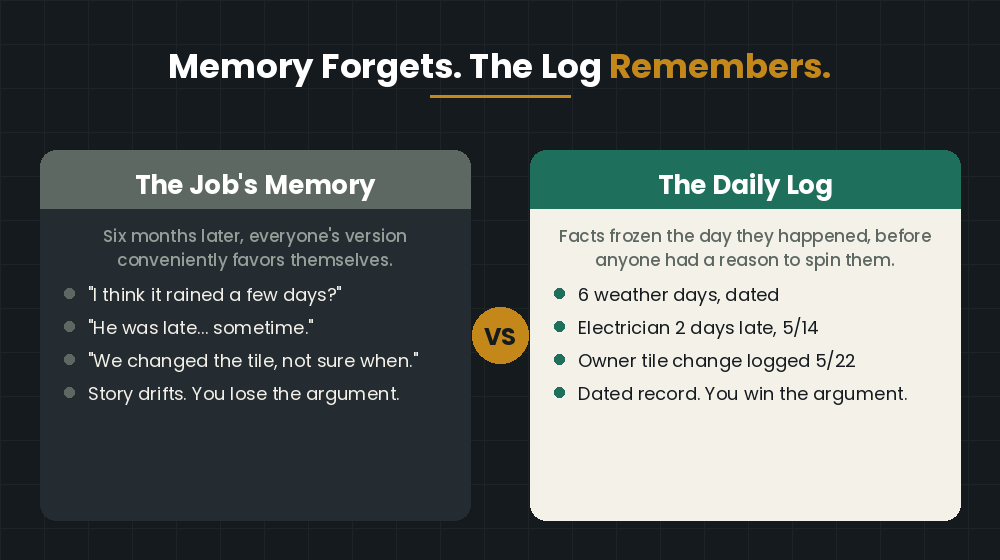
Six months after a project closes, nobody remembers which days it rained, when the client changed the tile, or that the electrician showed up two days late and threw off the whole sequence. Memory blurs, stories drift, and everyone's version conveniently favors themselves.
A daily field report freezes the facts in the moment, before anyone has a reason to remember them differently. Weather, crew on site, subs present, work performed, delays, deliveries, visitors, issues — logged the day it happened. It's not exciting to fill out. It's incredibly powerful to have when someone's version of events is costing you money.
What a real daily report captures
A daily log that actually protects you records more than "worked on the house." It captures:
Weather — because weather days are real delay days, and "it rained" without dates is worthless when you need a schedule extension.
Who was on site — your crew, headcount, and every sub present. This is your backup when a sub bills for hours he didn't work, or claims he was never there for the thing that went wrong.
Work performed — what phase, what progress, so the job's real timeline is on paper and not in anyone's imagination.
Delays and their cause — the single most valuable field. "Waiting on owner selections," "inspection failed," "material didn't arrive." This is the record that assigns delay where it actually belongs.
Deliveries, visitors, and issues — the loose events that turn out to matter exactly when you didn't think they would.
Where the daily log pays for itself
Three places, over and over:
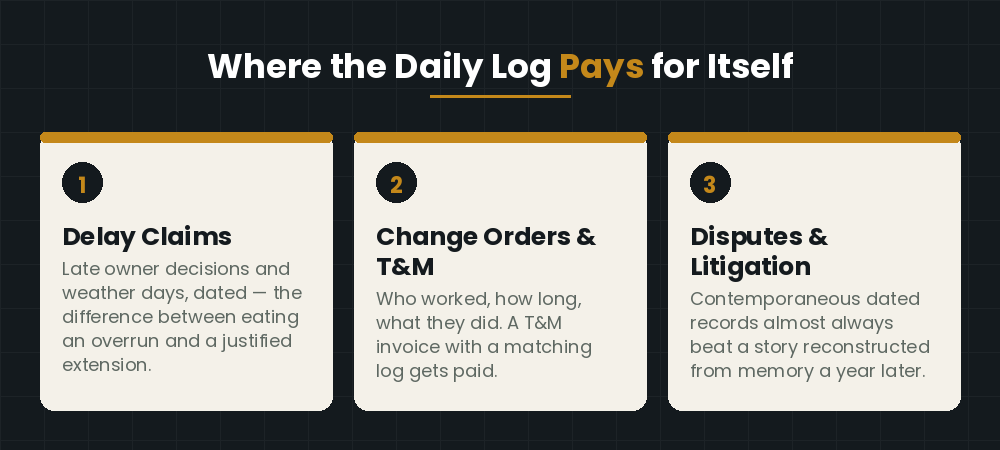
Delay claims. When a job runs long and the client wants to blame you, a daily log showing their late decisions and the weather days is the difference between eating the overrun and getting a justified extension. Without it, it's your word against theirs, and "your word" doesn't hold up.
Backing up change orders and T&M. When you bill time-and-materials or defend a change order, the daily log is the source record — who worked, how long, what they did. A T&M invoice with a matching daily log gets paid. One without invites a fight.
Disputes and, worst case, litigation. If a job ever goes sideways into a claim or a courtroom, contemporaneous daily records are gold. Attorneys will tell you the same thing: the party with the dated, consistent field logs almost always has the stronger position. The party reconstructing events from memory a year later does not.
Why crews skip it — and the fix
Daily reports don't get filled out for one reason: at the end of a long day, a blank, complicated form is the last thing anyone wants to face. So it gets skipped "just today," and today becomes every day, and the paper trail is empty exactly when you need it full.
The fix isn't nagging the crew to be more disciplined. It's making the report a two-minute job — a simple, consistent format with prompts for what matters, so the foreman fills it out from the truck before he drives off, not a homework assignment he'll "do later" and never does. The easiest log to fill out is the one that actually gets filled out.
Cheap insurance you already have the raw material for
Here's the thing: the information is already happening. Someone knows it rained, who was on site, and why Thursday got blown up. The only question is whether it lands on a dated record or evaporates by Friday. Capturing it costs two minutes a day. Not capturing it can cost you a delay claim, a T&M dispute, or a job's worth of margin when it's your memory against theirs.
Log the day, every day. It's the cheapest insurance policy on the site, and the one you'll be most grateful for the day an argument starts.
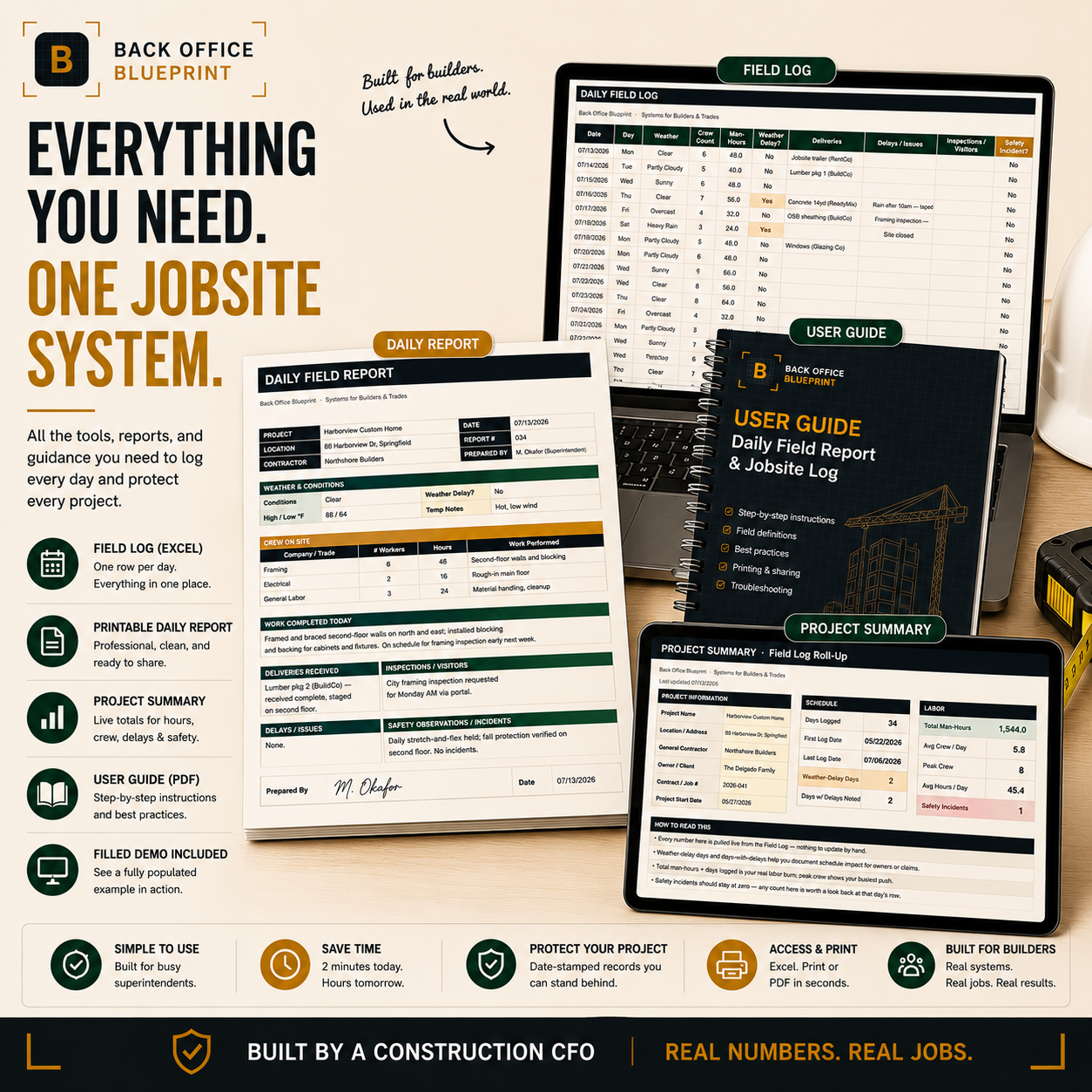
Win the argument before it starts. The Daily Field Report & Jobsite Log gives your crew a fast, consistent daily record — weather, crew, work, delays, deliveries — so you've always got the dated proof when someone's version of events threatens your margin. → Get the Daily Field Report & Jobsite Log
I'm a working construction CFO and the founder of Back Office Blueprint, where I build the estimating, job costing, and compliance systems I wished every builder and trade contractor had from day one.
Keep reading
The field paper trail: two documents that protect every job — where the daily log sits in the wider record.
Permit and inspection tracking: why one missed call stalls the whole job — the other date-stamped record that settles arguments.
The log and the inspection calendar answer different questions about the same day. The Field Ops Kit runs both.