


A certificate of insurance is a photograph, not a contract. It proves a subcontractor had coverage on the day it was issued — and tells you nothing about the day a claim actually happens.
That gap is where contractors get hurt. Most collect a COI when they onboard a sub, drop it in a folder, and never look at it again. Then six months later the sub's policy lapses, a worker gets hurt, and the liability rolls uphill to you. Or the year-end insurance audit lands, you can't produce a current certificate, and your carrier bills you for that sub as if they were your own employee.
I'm a working construction CFO, and subcontractor compliance is one of the few back-office failures that can erase a whole job's profit in a single invoice. Here's what to actually track, and why "we got their COI" is not the same as "we're covered."
Quick note: this is general guidance, not insurance or legal advice. Coverage terms and contract requirements vary — confirm yours with your agent and your subcontract.
What a COI actually is (and isn't)
A certificate of insurance — almost always the standard ACORD 25 form — is a one-page summary of a sub's coverage: the types (general liability, workers' comp, auto), the limits, and the policy dates. It's issued by the sub's insurance agent as a courtesy. Here's the part people miss: it's a snapshot, not a guarantee. The policy behind it can be cancelled, reduced, or left to lapse the day after the certificate is printed — and nobody is obligated to call and tell you. A COI from eight months ago is a photo of insurance that may no longer exist.
"Certificate holder" is not "additional insured"
This is the single most expensive misunderstanding in subcontractor compliance, so read it twice.
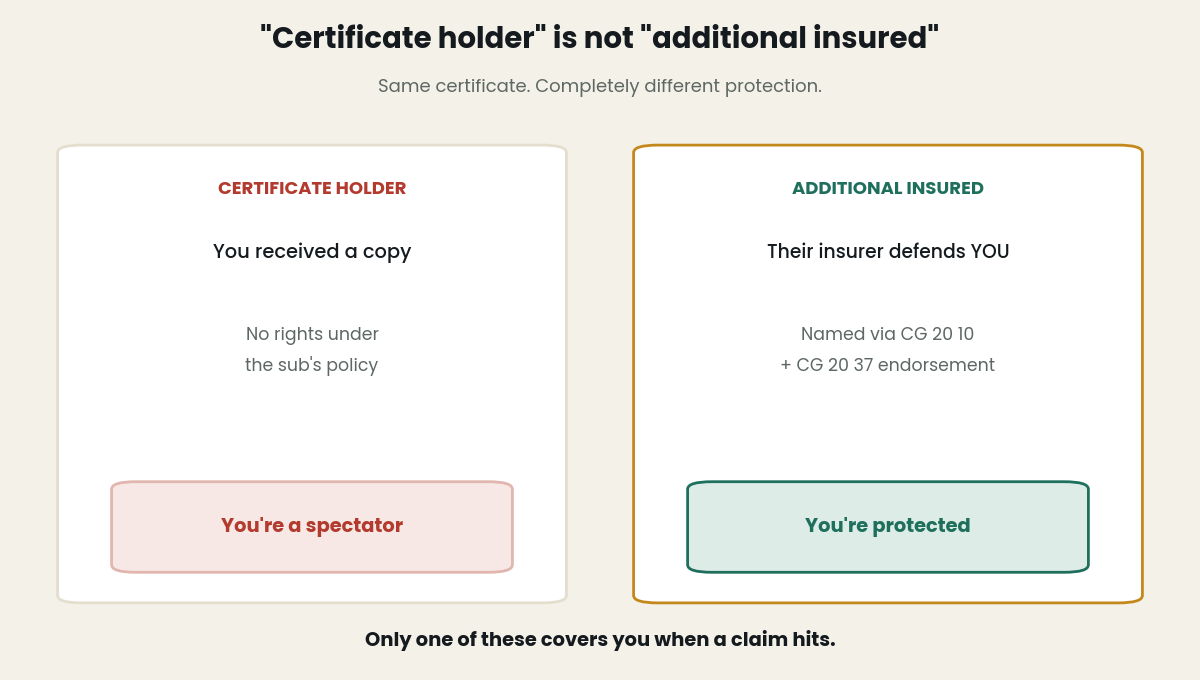
Being listed as the certificate holder just means you received a copy of the certificate. It gives you no rights under the sub’s policy. Being an additional insured means the sub’s insurer actually has to defend and cover you when a claim comes out of their work. The certificate can’t make you one. Only an endorsement on the sub’s policy does, so ask for the endorsement pages themselves (ongoing and completed work, plus primary and noncontributory wording and a waiver of subrogation if your subcontract requires them), not just the X in the ADDL INSD box. The full breakdown, with the forms and the state rules, is in additional insured vs certificate holder.
The two ways an untracked COI costs you
A COI you collected but never tracked fails you in two expensive ways. The first is a claim: if a sub's policy has lapsed and their work causes injury or damage, that liability doesn't disappear — it climbs to the next insured party in the chain, which is you. Your general liability responds, your experience rating takes the hit, and your premiums climb for years.
The second is the audit. At your annual GL and workers' comp audit, the auditor asks for a valid certificate for every sub you paid. For any sub you can't produce one for, the rule is brutally simple: they charge you premium as if that subcontractor were your own employee. Uninsured subs routinely turn into five- and six-figure premium adjustments at audit. (You can sometimes deduct up to half for materials — but only if you kept invoices splitting material from labor. Most don't.) Same missing certificate, two different ways to bleed money.
What you actually need to track on every sub
Collecting the COI is step one. Tracking the right things on it is what protects you:
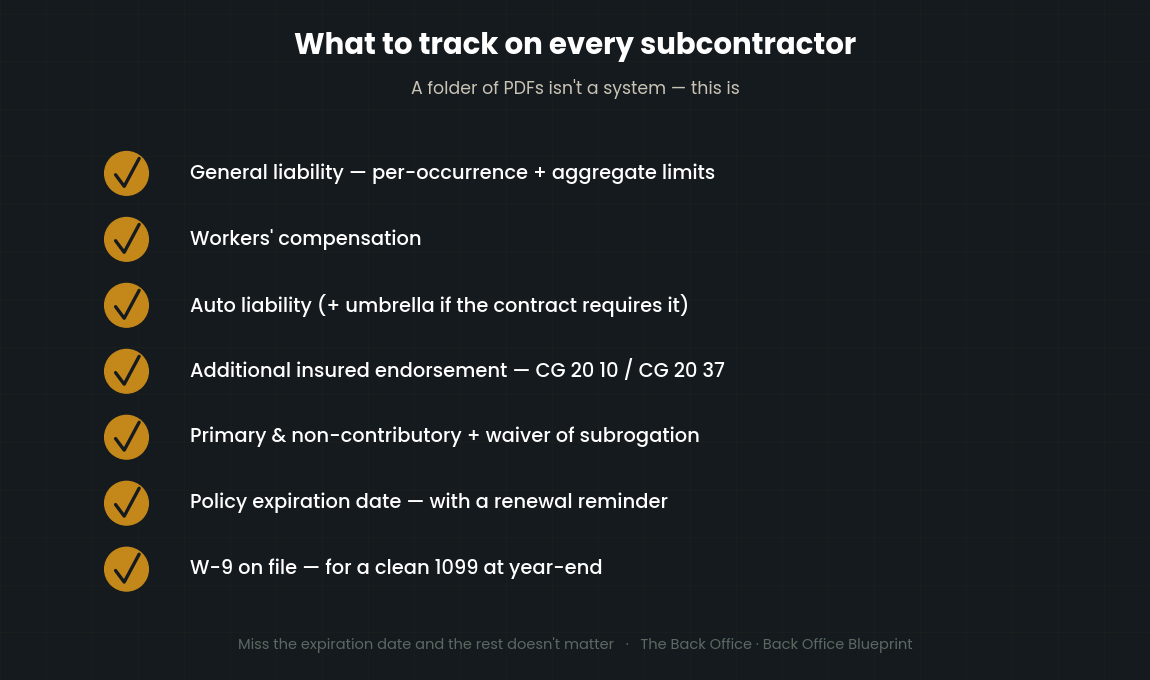
For every subcontractor, you want a record of: general liability (per-occurrence and aggregate limits), workers' compensation, auto liability, and umbrella if your contract requires it; the additional insured endorsement and primary/non-contributory + waiver language; the policy expiration date; and the sub's W-9 so you can issue a clean 1099 at year-end. Miss any one of those and you've got a hole — and holes in compliance only show up at the worst possible moment. The COI is one document of several. The free subcontractor documents checklist covers the rest of what should be on file before a sub sets foot on your job.
Expiration is the whole game
Here's the truth nobody tells you: collecting a COI is easy. Keeping it current is where every system breaks. Policies renew (or lapse) on their own schedule, not yours. The failure mode is always the same — a certificate that was perfect at onboarding quietly expires in month seven, nobody re-collects it, and you don't find out until a claim or an audit forces the issue. A real tracking system isn't a folder of PDFs; it's a list with expiration dates and a reminder that tells you to chase the new certificate before the old one dies. That's the difference between a pile of paper and actual coverage.
Don't run this on a spreadsheet you forget to open
You can absolutely track this yourself — a tab per sub, columns for each coverage, expiration dates, a W-9 on file. The problem is never building it. The problem is opening it every month and acting on what it tells you. That's exactly why I built the Subcontractor Compliance System — a single workbook that tracks every sub's COI, additional insured status, expiration dates, W-9, signed agreement, and 1099 readiness, so the system tells you who's about to lapse instead of you finding out at audit. It's the back office that keeps a sub's risk from becoming your bill.
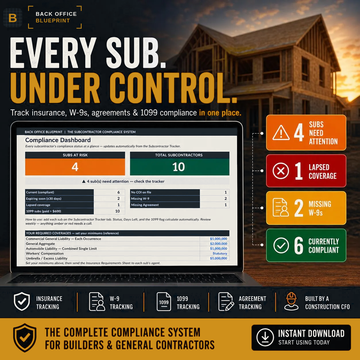
See the Subcontractor Compliance System →
I'm a working construction CFO and the founder of Back Office Blueprint, where I build the estimating, job costing, and compliance systems I wished every builder and trade contractor had from day one.
Keep reading
1099 vs. W-2: classifying your construction crew without getting burned — the classification question sitting underneath every COI you collect.
OSHA toolbox talk requirements: what is actually required, and how often — the other documentation trail a claim will test.
What goes in a contractor safety binder — section eight is where these certificates live — and where they quietly expire.
Once a sub becomes an employee, the paperwork changes shape. The New Hire Onboarding System covers that side of the file.
Subcontractor compliance is one of ten systems a back office runs on. Here is what a construction back office is, and what else belongs in yours.