


Here's a sentence I've said to more than one profitable contractor who couldn't make payroll: your problem isn't that you're not making money. Your problem is that your money is sitting in other people's bank accounts. The job was profitable on paper. The cash just never showed up on time, and "on paper" doesn't cover a payroll run.
I'm a working construction CFO, and this is the gap that quietly kills otherwise healthy contractors: the difference between earning a dollar and collecting it. You can be profitable and broke at the same time. In construction, that's not a paradox — it's Tuesday. Here's how to close it.
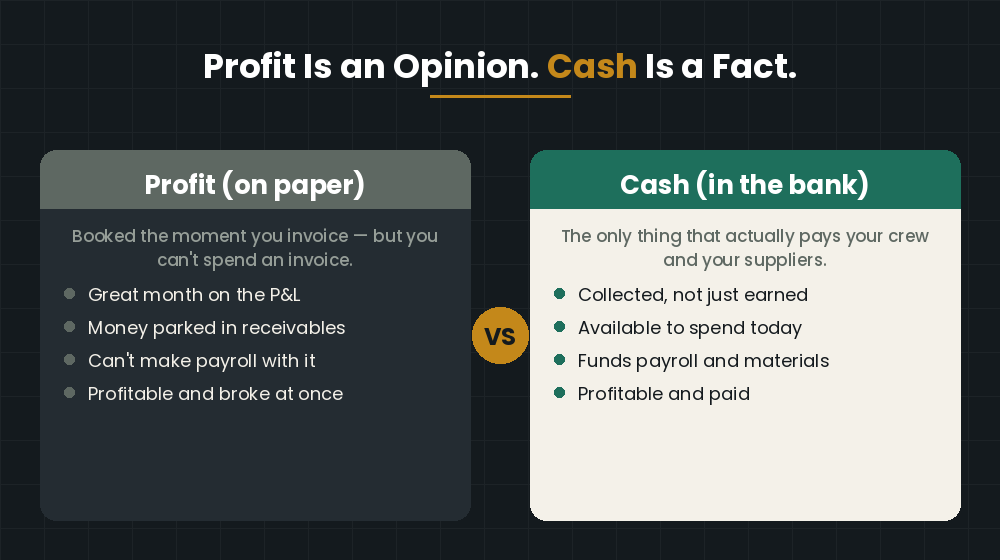
Profit is an opinion, cash is a fact
Your P&L can show a great month while your bank account is gasping. That's because profit is booked when you invoice, but you can't spend an invoice. You can only spend what's been collected. The lag between the two — the days and weeks your money spends parked in a client's account as "accounts receivable" — is where contractors get squeezed, because your own bills don't wait for their payments.
You pay your crew every week. You pay your suppliers on their terms. But your receivables come in whenever the client gets around to it. Manage that gap badly and you're financing everyone else's project out of your own cash. Manage it well and the same jobs, at the same profit, feel completely different.
AR aging: the report that shows you the leak
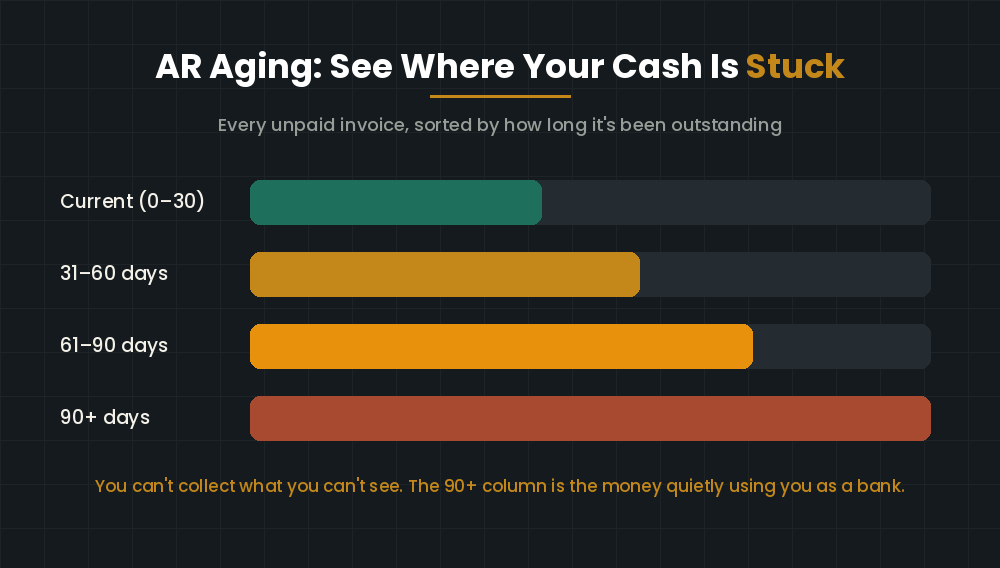
The single most important collections tool is an AR aging report — every unpaid invoice, sorted by how long it's been outstanding: current, 30 days, 60, 90-plus. It sounds like accounting homework. It's actually a map of where your cash is stuck and which clients are quietly using you as a bank.
Most contractors don't have this in front of them. They know they're owed "a bunch," but not that the Henderson job has a 74-day-old invoice nobody's chased, or that three clients account for most of the 60-plus column. You can't collect what you can't see. The aging report turns a vague feeling of "we're owed money" into a specific, actionable list of who to call today.
Draw requests: getting paid during the job, not after
On bigger jobs, the other half of the equation is the draw request — billing progress payments as the work completes instead of waiting until the end. Done right, draws keep cash flowing in as costs flow out, so you're never funding months of work before you see a dime.
Done poorly, draws are where cash goes to die. A draw submitted late is paid late. A draw that doesn't match the schedule of values gets kicked back for correction — and every round-trip is another week your money sits still. Tracking your draws — what's due, what's submitted, what's approved, what's actually landed — is how you keep the job's cash in motion instead of stalled on a lender's or owner's desk.
If you want to see how big that gap gets before the first draw lands, the free draw schedule cash calculator maps your spending curve against your billing curve and shows the deepest point you have to fund yourself.
The follow-up nobody does
Here's the uncomfortable truth about collections: most unpaid invoices aren't unpaid because the client won't pay. They're unpaid because nobody asked twice. The invoice went out, it wasn't paid on time, and then it just... sat, because chasing it is nobody's favorite job and nobody's actual job.
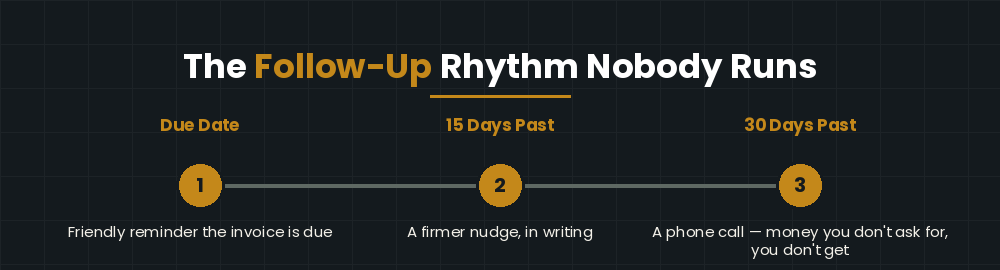
Money you don't ask for, you don't get. A simple, consistent follow-up rhythm — a reminder at due date, a firmer one at 15 days past, a phone call at 30 — collects a startling amount of "stuck" money, not because it's aggressive, but because it's consistent. The clients using you as a bank are counting on you to stay quiet. A system that won't let an aging invoice go silent is worth more than a better estimate.
Getting paid is a system, not a personality trait
The contractors who get paid on time aren't luckier or meaner. They just treat collections as a process instead of a feeling: every invoice tracked, aging visible at a glance, draws managed to the schedule, follow-ups that fire on time whether or not anyone's in the mood. That's it. That's the whole difference between profitable-and-broke and profitable-and-paid.
You already did the hard part. You bid the work, ran the job, and earned the margin. Don't leave it sitting in someone else's account because the follow-up fell through the cracks. Build the system that brings your own money home.
Bring your own money home. The Billing & Collections Blueprint gives you a construction AR aging report, an invoice tracker, and a draw request tracker in one place — so you can see exactly where your cash is stuck and collect it on a rhythm instead of a hope. → Get the Billing & Collections Blueprint
I'm a working construction CFO and the founder of Back Office Blueprint, where I build the estimating, job costing, and compliance systems I wished every builder and trade contractor had from day one.
Keep reading
Your bank balance is lying to you: construction cash flow, explained — why the account balance says yes when the math says no.
Construction change order form: how to actually get paid for changed work — the receivable that never became one.
The construction change order log — “approved but never billed” is the row that turns work you already did into money.
To see the cash position underneath the aging, the Company Cash Flow Report tracks what is really available week to week.