


It is week seven. The framing is done, the roof is on, and the rough-ins start Monday. You have billed 40% of the contract and collected most of it. On paper you are ahead.
Your account says otherwise. Payroll went out twice. The lumber package was paid in full before a single wall went up. The cabinet supplier wanted half down in June for a delivery in October. You are ahead on billing and behind on cash, and no line on your draw schedule explains why.
Here is why. Your draw schedule tells you when you get paid. It says nothing about when you spend. Those are two different curves, and the gap between them is the money you are financing.
First, the schedule you came here for
This is a real one, published by a credit union for new residential construction. Percentages are of the loan.
At closing — 10%. Permits, notice of commencement, equipment rental, builder's risk.
Draw 1 — 10%. Site prep and clearing, footing, rough plumbing, foundation slab.
Draw 2 — 20%. Exterior walls up, roofing complete, interior framing.
Draw 3 — 20%. Windows and sliding glass door, exterior doors, electric, plumbing and HVAC rough-in, septic, stucco or siding.
Draw 4 — 20%. Drywall, exterior paint, interior paint, garage doors, flooring, tile, cabinets and countertops.
Draw 5 — 10%. Driveway, soffits, landscape, final plumbing, electrical and HVAC, insulation.
Draw 6, final — 10%. Certificate of occupancy, final survey, appliances.
That is one lender. Another runs five draws, another runs eight, another lets your builder write ten line items, another funds monthly against invoices. The range across published lender documents is three to ten draws, or monthly. If you have read that four to six is standard, nobody can show you a source for it.
Take that schedule and hold it next to what a house actually costs to build.
The number nobody puts next to the schedule
The NAHB surveys builders every year on where the money goes. On an average single-family home at $428,215 of construction cost, the stages land like this:
Site work $32,719 (7.6%) · Foundations $44,748 (10.5%) · Framing $70,982 (16.6%) · Exterior finishes $57,510 (13.4%) · Rough-ins $82,319 (19.2%) · Interior finishes $103,391 (24.1%) · Final steps $27,710 (6.5%) · Other $8,835 (2.1%)
Now stack the two. Run the draw schedule and the cost curve side by side and watch what happens to the difference.
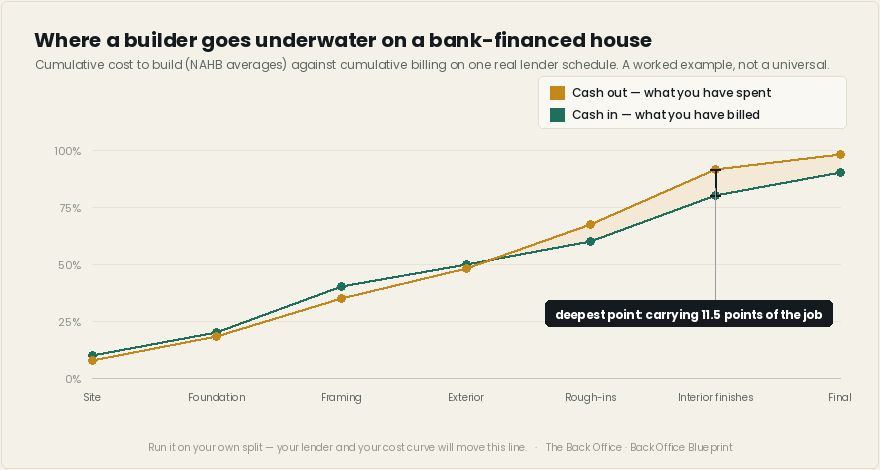
Foundation done: spent 18.1%, billed 20%. About even.
Framing done: spent 34.7%, billed 40%. Ahead.
Rough-ins done: spent 67.3%, billed 60%. Seven points behind.
Interior finishes done: spent 91.5%, billed 80%. Eleven and a half points behind.
Final: spent 97.9%, billed 90%.
On a house that size, the deepest point is roughly $49,000 of your own money, and it lands at interior finishes.
Read that number the right way. It's one national average cost curve laid against one real lender's schedule — a worked example, not your project and not a rule.
Your split is different and your lender's schedule is different, and the section at the end shows you how to run it on your own numbers. What doesn't change is the shape: you go under around rough-ins, you go deepest at interior finishes, and you climb out only at the end.

And that's the optimistic version. It assumes every draw lands the day you earn it.
Three things that make the hole deeper
The draw takes time you are not paid for. One credit union orders the inspection within 48 to 72 hours and funds within 24 hours of the report. An FHA renovation lender tells you to allow ten business days, and fifteen on the final. A construction-finance platform puts a manual lender workflow at five to ten business days. Those numbers aren't comparable — some are measuring the inspection, some the whole cycle, and almost nobody says which. Ask your lender what their number measures. Then assume the inspector is booked out in a busy market, because that's the part neither of you controls.
Your subs don't wait for the inspector. Nationally, 95% of general contractors report floating payments while waiting on disbursements, and 82% report waits over 30 days — up from 49% two years earlier.
Materials in your truck are not "work in place." Most lenders fund what is installed. A lumber package bought early to lock pricing, a cabinet deposit paid in June, trusses on order — you have spent it and there's nothing to bill against. One builder put $18,000 into the lumberyard before the first draw existed.
Lenders can fund stored materials, but the conditions are heavy: a bill of sale, insurance naming the lender, a bonded warehouse, a filing to secure their interest, photos, caps on value and time. Materials delivered to the site are far easier to get funded than materials sitting in a warehouse. If you can take delivery, take delivery.
Retainage isn't 5% of the contract. It's most of the profit. Five to ten percent held back per draw is the one figure everybody agrees on. NAHB's 2024 survey puts the average builder profit margin at 11.0% of sales price — about $73,000 on the average new home. Put those next to each other. The money sitting in someone else's account until the punch list clears is the same size as the money you're doing the job for. Run your own numbers through the free retainage calculator if you want to see what yours comes to.

What is true everywhere, what is your lender, and what is your state
Almost everything written about draw schedules blurs these together. They aren't the same and only one of them is negotiable.
True on essentially every bank-financed job. The loan funds in arrears against verified work in place — you pay first, always. Somebody independent inspects before money moves. Lien waivers are collected as payments are made, and an unconditional final waiver gates the last dollar. Something is held to the end. A certificate of occupancy and a final inspection close it out.
Your lender's policy, with no law behind it — so ask before you sign. How many draws. Whether it's fixed milestones, percentage of completion, or monthly invoices. Whether the holdback is 5% or 10% or 20%, and whether it comes off each draw or sits as a reserved final draw. How fast the inspection is ordered and how fast funds move after it. What the draw and inspection fees are. Whether title is re-run before each draw. Whether stored materials can be funded at all.
Your state, which neither of you can negotiate. In Texas, the owner must hold 10% retainage by statute during the work and for 30 days after — that's not the lender's holdback and it isn't optional. In Florida, a statute governs the lender's own conduct: if it decides to stop advancing, it owes you written notice within five business days, and failing that it can be liable for your materials and direct labor plus 15%. In California, retention is due within 45 days of completion, statutory waiver forms are mandatory or the waiver is void, and recording a notice of completion cuts your own lien window from 90 days to 60 — right when you're still waiting on the last money. In Michigan, the sworn statement runs the whole draw package through the title company.
The part almost nobody tells you: the window closes at closing
Here's the thing that separates builders who bleed on this from builders who don't.
Your payment schedule has to be in your customer's conversation with the lender before the loan documents are signed. Once that loan closes, the draw schedule is set. You aren't negotiating it. You're living inside it for the next nine months, and every gap above is now yours to carry.
Experienced builders behave differently here, and the NAHB says it plainly: newer builders shop financing on the interest rate, while experienced ones ask how predictable the draw process is and how fast inspections happen. Rate is what you pay. Draw velocity is what you carry. The cost of waiting is usually bigger than the cost of borrowing.
The other move is the one every builder discussion lands on: take a deposit from the homeowner outside the loan to cover mobilization, permits and the work before draw one.
The bank won't fund a hole it has no collateral for. The owner can. Just check your ceiling first, because in eight states there is one — and in most of them the cap only covers remodels, not a new build.
What to ask for while the window is still open
"Negotiate the draw schedule" is useless advice on its own. Here is what to actually ask for.
Make the schedule follow your cost curve, not a generic milestone list. Look at the numbers above again. Interior finishes are 24% of what the house costs you and 20% of what you bill. That mismatch isn't a law of nature — it's a template. Ask for the draw that covers interior finishes to be split in two, or weighted up, so the billing tracks where the money actually goes.
Ask for a draw at materials delivered, not just work installed. Some lenders will fund materials on site with a bill of sale and photos. That single line moves your long-lead buys from your account to the loan.
Ask for a mobilization draw at closing. Permits, insurance, site prep and equipment rental happen before anything is built and before any inspector will sign anything. Real published schedules do carry one — the example above releases 10% at closing for exactly this.
Ask what a change order does to the schedule. This is the one nobody asks and everybody gets hurt by. The draw schedule is fixed at closing. Extra work isn't in it. Lenders generally require approval for changes, and if the change pushes past the available loan funds, the homeowner covers it — which means you need that agreed in writing before you build it, not after.
The other half of the calendar
Everything above works the money coming in. You also control the money going out, and that side needs no lender's permission.
The gap is the distance between the day you pay and the day you're paid. Shortening it from the other end works just as well.
Line your supplier terms up with your draw cycle. If your lender funds ten business days after a milestone and your lumber yard wants payment in seven, you have manufactured a gap that didn't have to exist. Net-30 on the big material buys does more for your cash position than most things you can negotiate on price.
Tell your subs the draw calendar before they start. Not to push risk onto them — to stop them assuming a payment date you can't hit. A sub who knows money lands the week after inspection plans for it. A sub who finds out in week seven starts calling you daily, and you start paying out of your own account to keep the schedule.
Don't let the punch list sit. Retainage releases on completion, and completion means somebody signs off. Every week the punch list stays open is a week your margin sits in someone else's account. In California, recording a notice of completion also cuts your lien window from 90 days to 60 — so the clock that releases your money is the same clock that shortens your protection.
When a draw comes back short
It happens, and none of the pages that explain draw schedules tell you what to do about it.
The usual causes are boring and fixable. The inspector saw less finished than the request claimed. Lien waivers from the previous draw never came back — most lenders make those a condition of the next one. A change order went in without approval. A title search turned up a lien from a supplier you thought was paid.
Ask which one it is, in writing, the same day. A short draw isn't a verdict; it's usually a document. The difference between a two-day fix and a three-week fix is how fast you find out which document.
Then look at what's left in the loan. Lenders have to be able to show the undisbursed balance still covers completion. If a draw got cut because the budget is running short, the next one will be too, and that's a conversation to have immediately rather than at the next milestone.
Five questions to ask before you sign
Ask these of the lender, in writing, before the loan closes. They take one email.
1. How many draws, and against what? Fixed milestones, percentage of completion, or monthly invoices.
2. What is the holdback, and when is it released? Per draw or reserved as the final draw. Get the release trigger in words.
3. From draw request to money in the account — what is that number, and what does it measure? Inspection turnaround and funding are two different clocks.
4. Who inspects, and what do they verify? The original appraiser, a fund-control firm, or a consultant. Percentage complete or milestone complete.
5. Will you fund stored materials, and under what conditions? This one decides whether your long-lead buys are financed or self-financed.
Run it on your own job
You don't need my numbers. You need yours, and it's four steps.
One. Write your draw schedule down the page and put the cumulative percentage collected next to each milestone.
Two. Next to that, write what you actually spend to reach each milestone — labor, materials, subs, in the order the money leaves. Not the contract value of the phase. The cash.
Three. Subtract. The biggest negative number is how much of the job you're financing, and the row it sits on is when.
Four. Add the draw lag and the retainage on top, because both are real and neither is on your schedule.
That number is the working capital this job requires. It isn't a surprise, it isn't bad luck, and it isn't a sign you priced it wrong. It's a number you can know before you sign, and price for, and stop being ambushed by in week seven.
I'm a working construction CFO and the founder of Back Office Blueprint, where I build the billing, cash flow, and compliance systems I wished every builder and trade contractor had from day one.
This is general guidance, not legal or financial advice. Statutes and lender policies move — confirm the specifics with your lender and your attorney.