


I'm a working construction CFO, and I've learned to treat permits and inspections like money, because that's exactly what they are. Here's why tracking them is an operations discipline, not a filing chore.
Inspections are sequential — and one miss cascades
The thing that makes inspection tracking different from ordinary paperwork is dependency. You can't call the insulation inspection until the framing passes. You can't cover walls until insulation passes. You can't get your certificate of occupancy until the final passes. Every inspection is a gate, and every gate sits in front of the next phase of work.
Miss one, or fail one and forget to rebook, and the whole downstream schedule freezes. The crew that was supposed to start Thursday can't. The material delivery you timed for next week now sits in the way. And because trades book out weeks ahead, a two-day inspection slip can turn into a two-week crew gap. One missed call, and the dominoes go.
The costs nobody puts on the estimate
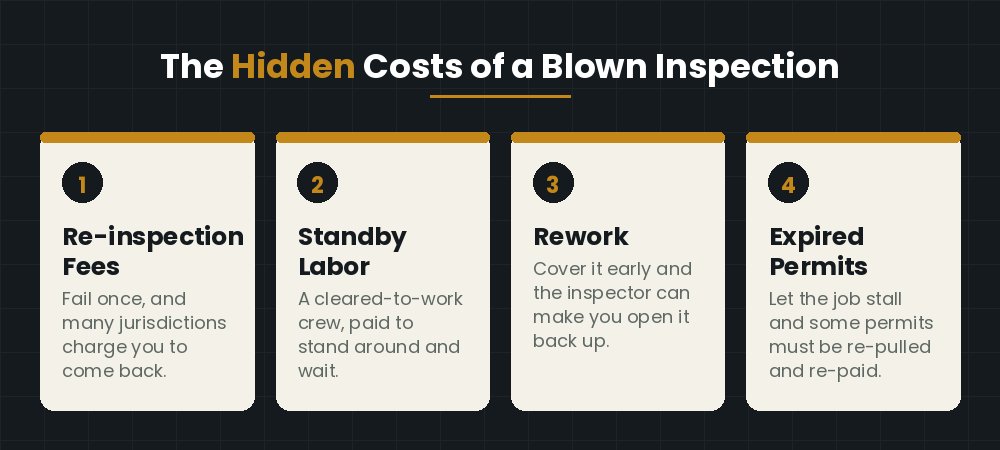
Permit and inspection failures carry a whole category of costs that never make it into the bid:
Re-inspection fees — fail an inspection and many jurisdictions charge you to come back. Small on their own, but they stack, and they're pure margin loss.
Standby labor — a crew that shows up to work a phase that isn't cleared still gets paid. That's the most expensive coffee break in construction.
Rework — the brutal one. Cover something before it's signed off and the inspector can order it opened back up. Now you're paying to undo finished work and redo it.
Expired permits — pull a permit, let the project stall, and some permits expire and have to be re-pulled and re-paid. The jurisdiction doesn't care that you got busy.
None of these are on your estimate. All of them come straight out of your profit.
Nobody loses a job over a permit. They lose the job's schedule over a permit — and on a construction project, schedule is money. A framing crew standing around because the rough inspection didn't get called, a re-inspection fee because the last one failed and nobody rebooked it, a footing poured over before it was signed off and now the inspector wants it exposed again. None of that shows up as a line item called "permit problems." It shows up as delay, rework, and margin quietly bleeding out.
"It's in the PM's head" is not a system
Most small builders track permits and inspections in exactly one place: the project manager's memory, backed up by a pile of texts and a permit card tacked to a stud. That works right up until the PM is juggling four jobs, gets pulled onto a fire at another site, and the Tuesday inspection window at this one quietly closes.
The problem isn't a bad PM. It's that inspection scheduling is a calendar-and-dependency problem, and human memory is terrible at calendars and dependencies across multiple jobs. When the tracking lives in someone's head, it fails precisely when that person is busiest — which on a construction site is always.
What tracking permits like money looks like
A real permit and inspection system does what a mental checklist can't:
It lists every permit and every required inspection per job, so nothing is a surprise — you know the full gauntlet before you break ground, not one gate at a time.
It tracks status — pulled, scheduled, passed, failed, expired — so at a glance you know exactly what's cleared and what's blocking the next phase across every active job.
It flags what's next and what's overdue so the inspection you need to call this week rises to the top before it becomes the reason the crew is standing around Thursday.
That's the whole game: seeing the gate before you reach it, so you call it in time, so the crew never waits, so a permit never becomes a schedule event.
The cheapest schedule protection you can buy
Think about what a single blown inspection actually costs — the re-inspection fee, plus the standby labor, plus the crew gap from rebooking into a full trade calendar, plus any rework. That can be thousands on one miss. Against that, the cost of simply tracking permits and inspections in one organized place is a few minutes a week.
You're already pulling the permits. You're already required to pass the inspections. The only variable is whether you see them coming or get surprised by them. Track them like the schedule-and-money events they are, and permits stop being the thing that quietly stalls your jobs.
Stop letting permits stall your schedule. The Permit & Inspection Tracker lists every permit and inspection per job, tracks status, and flags what's due next — so a missed call never becomes a frozen crew.
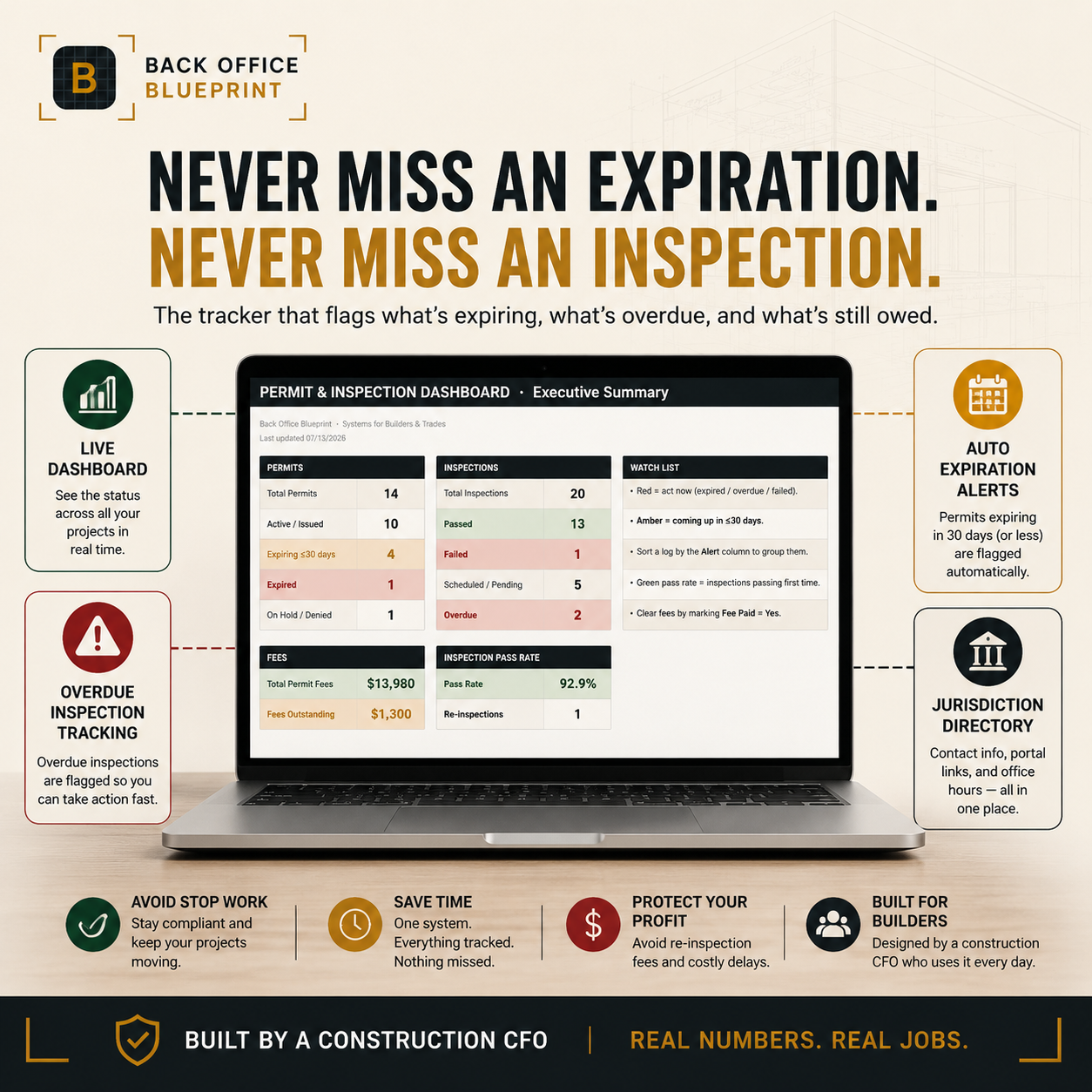
Get the Permit & Inspection Tracker →
I'm a working construction CFO and the founder of Back Office Blueprint, where I build the estimating, job costing, and compliance systems I wished every builder and trade contractor had from day one.
Keep reading
The daily log that wins the argument — the other record that decides who pays when the schedule slips.
The field paper trail: two documents that protect every job — how the log and the permit calendar work together.
If you want both in one place, the Field Ops Kit pairs the permit and inspection tracker with the daily field log.
Permits are one system out of ten. Here is what a construction back office is, and everything else that belongs in yours.