


"OSHA requires a weekly toolbox talk." You've heard it — it's repeated on a hundred safety blogs. And it's not quite true, which matters, because building your safety program on a myth is how you end up out of compliance and convinced you're fine. I'm a working construction CFO, and compliance is the part of this job that keeps me up at night, because it's where a single missing sign-in sheet turns into a back-charge or a denied claim. So here's the honest answer on toolbox talks: what's actually required, by whom, and how often.
Quick note: this is general guidance, not legal advice. OSHA standards and state plans change, and your contracts have their own rules — verify yours.
Does OSHA require toolbox talks? Not by name.
Federal OSHA has no standard that says "hold a toolbox talk every week." It doesn't mention toolbox talks by name and it doesn't set a frequency. If you're waiting for the regulation that mandates them, it isn't there. What is there is bigger than that: 29 CFR 1926.21(b)(2) requires construction employers to "instruct each employee in the recognition and avoidance of unsafe conditions" on the job, and hazard-specific standards — fall protection, hazard communication, scaffolding, respiratory protection — each require training before a worker is exposed. Toolbox talks are simply the most practical way contractors deliver that training and prove they did. So OSHA doesn't require the talk; it requires the outcome the talk produces.
But your state plan might — and several do.
Federal OSHA is the floor. About half the states run their own OSHA-approved plans, and some are far more specific:
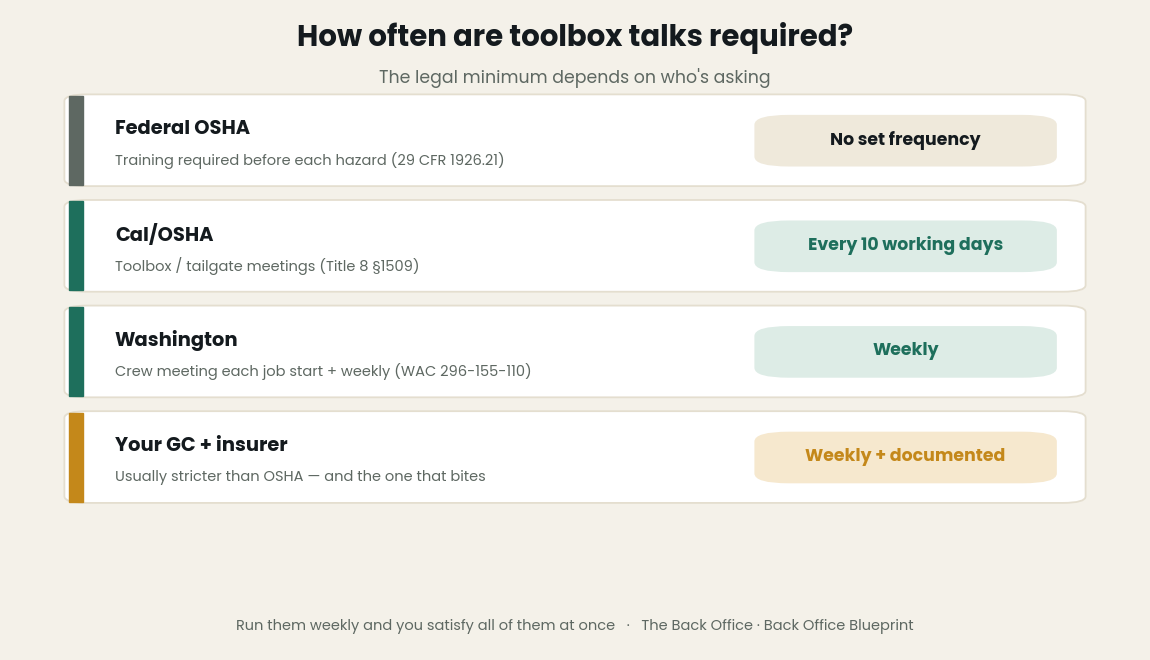
In California, Cal/OSHA (Title 8 §1509(e)) requires supervisors to hold toolbox or tailgate meetings with their crews at least every 10 working days. In Washington, construction employers must hold a crew safety meeting at the start of each job and at least weekly after that (WAC 296-155-110). Those are hard requirements with real frequencies attached. If you operate in a state-plan state, "OSHA doesn't say how often" is the wrong thing to rely on — your state probably does.
And your GC and insurer almost certainly do.
Here's the part that catches contractors who only look at the law. Even where the regulation is quiet, two other parties usually aren't: the general contractor you're subbed to, and the carrier writing your workers' comp and general liability. Most subcontracts require documented weekly safety meetings as a condition of being on the site, and most insurers expect the same — and they'll ask for the records when a claim comes in. Miss them and the consequence isn't an OSHA citation; it's a back-charge, a lost relationship with the GC, or a claim that's a lot harder to defend. In practice these are usually stricter than OSHA, and they're the ones that actually cost you money.
A toolbox talk only counts if it's documented.
This is where most programs quietly fail. Holding the talk isn't the compliance event — documenting it is. When an inspector, a GC, or a claims adjuster asks, "we talked about ladders that one time" is worth nothing without the paper to back it.
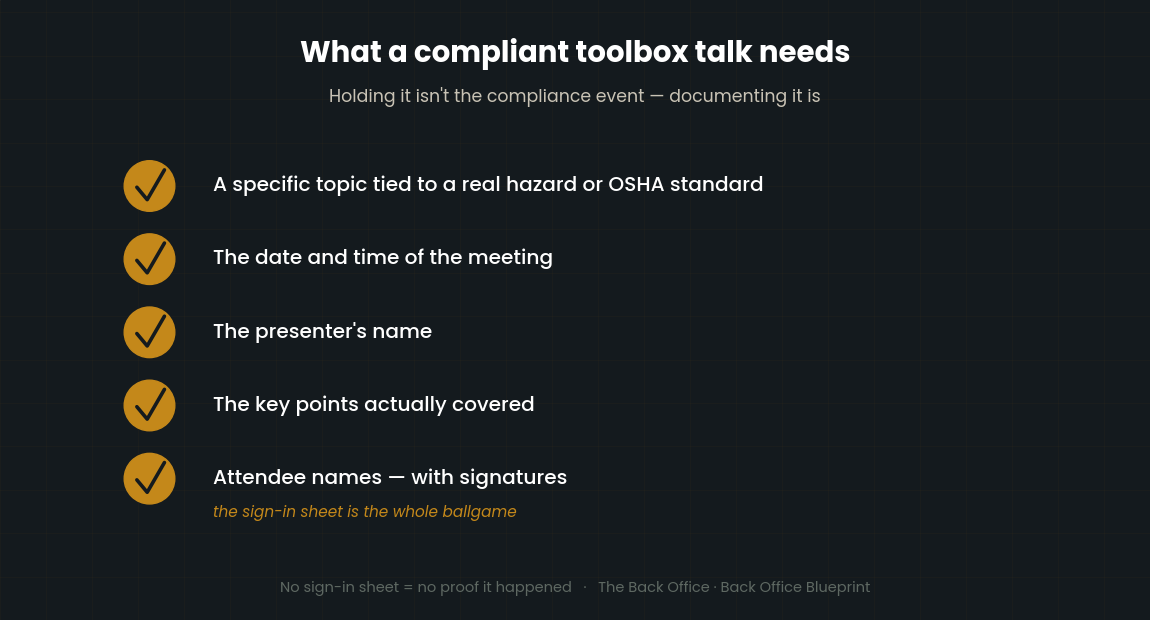
Every talk needs five things: a specific topic tied to a real hazard or standard, the date and time, the presenter's name, the key points covered, and attendee names with signatures. That sign-in sheet is the whole ballgame — it's the difference between a documented safety program and a story you're telling after the fact.
How often you should actually do them.
Forget the minimum for a second. The legal floor is a floor, not a goal. Run them weekly, plus a quick talk any time a new task or hazard shows up on site. Weekly is the number that quietly satisfies everyone at once — the strictest state plan, the GC's subcontract, and the insurer — so you never have to track which rule applies to which job. It builds the habit, it generates the documentation trail that protects you, and it does what it's supposed to do: fewer incidents, because the crew talked about the hazard before they met it.
The hard part isn't holding them. It's keeping them going.
Nobody fails at the first toolbox talk. They fail at week 14 — when no one's picked a topic, last month's sign-in sheets are somewhere in a truck, and the meeting either gets skipped or becomes two minutes of "be safe out there." That's the gap between a program that exists on paper and one that protects you. The fix is boring and it works: a full year of talks already written, in a 52-week order, each with a sign-in sheet ready to print. Remove the "what do we cover this week" friction and the habit survives past week 14.
Don't write 52 of these from scratch.
You can write your own toolbox talks — but that's 52 topics a year to research, format, and turn into something a crew will actually sit through, on top of running jobs.
Want to see what a good one looks like? Grab this week's toolbox talk, free — no charge, just a clean, print-ready talk with a sign-in sheet.
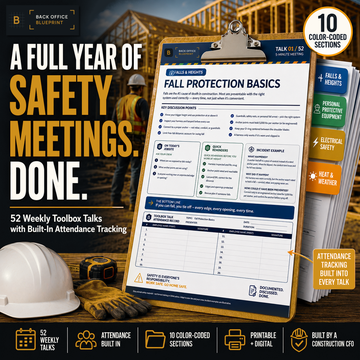
And when you want the whole year handled, the 52 Weekly Construction Toolbox Talks pack gives you a full year of meetings, each one written out, with the sign-in sheet on the page, ready to print, so the only thing left to do is hold it.
See the Toolbox Talks system →
I'm a working construction CFO and the founder of Back Office Blueprint, where I build the estimating, job costing, and compliance systems I wished every builder and trade contractor had from day one.
Keep reading
Subcontractor COI tracking: why collecting it once isn't enough — the other compliance file that decides whether a claim gets paid.
Permit and inspection tracking: why one missed call stalls the whole job — the same discipline, applied to the inspection calendar.
52 construction safety meeting topics: a full year of toolbox talks — the answer to “what do we cover this week,” already written out.
What goes in a contractor safety binder — where the signed sign-in sheets have to end up.
Toolbox talks are one tab of a real safety program. The OSHA-Ready Contractor Safety Binder covers the other seven — written program, training records, incident forms, and the paperwork an inspector actually asks for.
Safety records are one of ten systems a back office keeps. Here is what a construction back office is, and what else belongs in yours.