
Most construction "onboarding" goes like this: the new hire shows up at 6:45, someone points at a truck, and by 7 he's swinging a hammer with a W-4 he'll fill out "sometime this week." No safety orientation, no I-9 on file, no idea who to call or how he gets paid. It works right up until it doesn't — until he quits in three weeks, or gets hurt on day two, or the I-9 you never completed becomes a problem you didn't know you had.
I'm a working construction CFO, and I'll make the case that the sloppiest onboarding in your business is costing you two things you actually care about: good people, and legal cover. Neither of those is "paperwork."
The first day sets the turnover clock
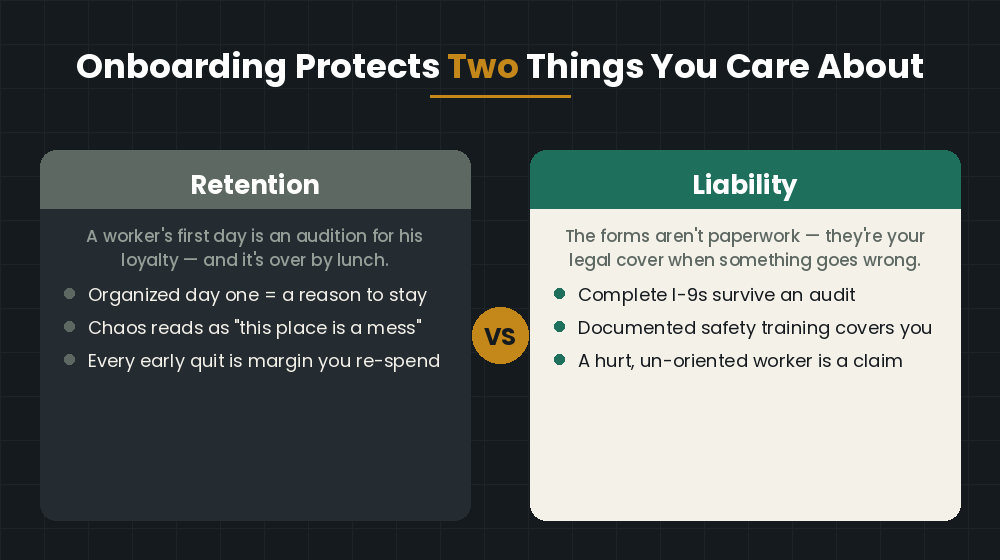
Construction runs on labor, and labor is expensive to replace. Every time a hire walks after a few weeks, you eat the recruiting time, the ramp-up, the productivity you never got back — and you do it in a trade where good people are already hard to find. Turnover isn't an HR abstraction. It's one of the most direct margin leaks in the business.
And a huge share of early turnover traces back to a bad first day. A worker who shows up to chaos — nobody expecting him, no clear role, no sense of how this company runs — reads it correctly: this place is disorganized, and disorganized job sites are miserable and unsafe places to work. A worker whose first day is organized — expected, oriented, set up, told how things work — starts with a reason to stay. You're not just processing a hire. You're auditioning for his loyalty, and the audition is over by lunch on day one.
The legal paperwork isn't optional — and the timing has rules
Here's where "we'll get to the forms later" turns into real exposure. A few pieces aren't suggestions:
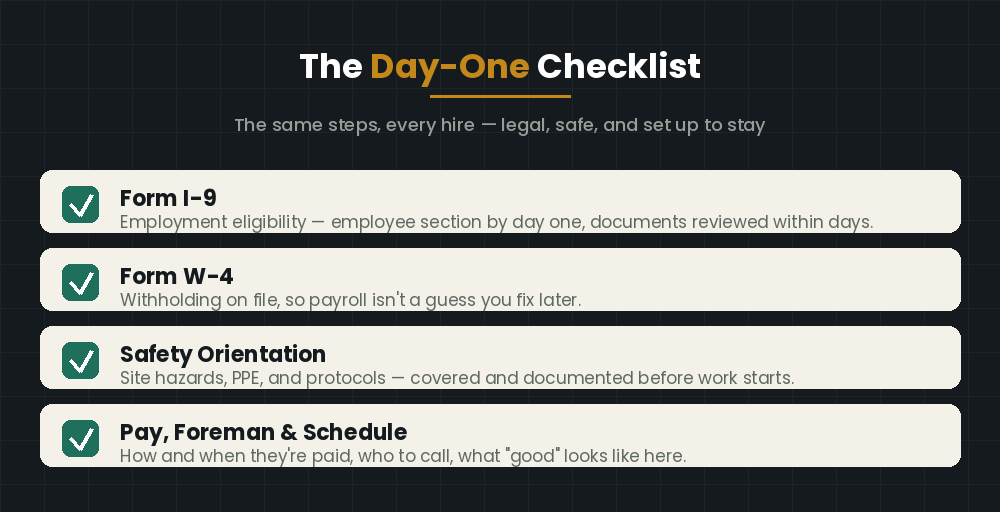
Form I-9 verifies employment eligibility, and the timing is specific — the employee section by the first day of work, the employer's review of documents within the first few business days. "We'll finish it when things slow down" is how you end up with incomplete I-9s across your whole crew, which is exactly what gets expensive in an audit.
Form W-4 determines withholding. No W-4, and you're guessing at payroll — or fixing it later.
Both of those forms assume one thing: that he's an employee. If you were planning to pay him on a 1099 instead, settle that before the first paycheck. An LLC, an invoice or a signed contractor agreement doesn't decide it. How much control you have over the work does. Run him through the free 1099 or W-2 worker test.
Safety orientation is the one that protects a life and your company. A worker hurt on day two who was never oriented to the site's hazards is a workers' comp claim with your name all over the "failure to train" line. Document that you covered site safety, PPE, and hazards before he started work, and you've protected him and yourself. Skip it, and an incident becomes a much bigger problem than the injury.
Get these done on day one, consistently, and the legal side is simply handled. Let them drift, and you're carrying risk you can't even see until someone comes looking.
The stuff that makes people stay
Beyond the legally-required forms, the difference between a hire who stays and one who bolts is often just clarity. A good onboarding also covers the boring, human stuff that answers "what did I just sign up for":
How and when they get paid. Who their foreman is and who to call with a problem. What the schedule and site expectations are. Where the equipment and PPE come from. What "good" looks like here. None of it is complicated. All of it is the difference between a worker who feels set up to succeed and one who feels like he's guessing — and people don't stay where they feel like they're guessing.
Why it doesn't happen — and how to fix it
Onboarding gets skipped for the same reason everything gets skipped in a small construction company: the owner or foreman is slammed, there's no checklist, and doing it from memory every time means half of it gets forgotten in the rush of a new job starting. So it happens differently — or not at all — every single time.
The fix is a repeatable system: one checklist, the same every hire, with the forms attached and the steps in order, so onboarding runs the same whether you're there or not. It turns a chaotic first morning into a ten-minute routine that gets the legal paperwork done, the safety orientation covered and documented, and the new hire actually set up to work. Same process, every person, no reinventing it at 6:45 a.m.
Do it once, right, every time
Onboarding is a small, front-loaded investment that pays off twice: fewer people walking out the back door, and a documented trail that covers you if anything goes wrong. Both of those are money — retention you don't have to re-spend, and liability you don't have to absorb.
You're going to hire people. The only question is whether their first day builds your company or quietly costs it. Systematize it, and every hire starts the same way: legal, safe, and set up to stay.
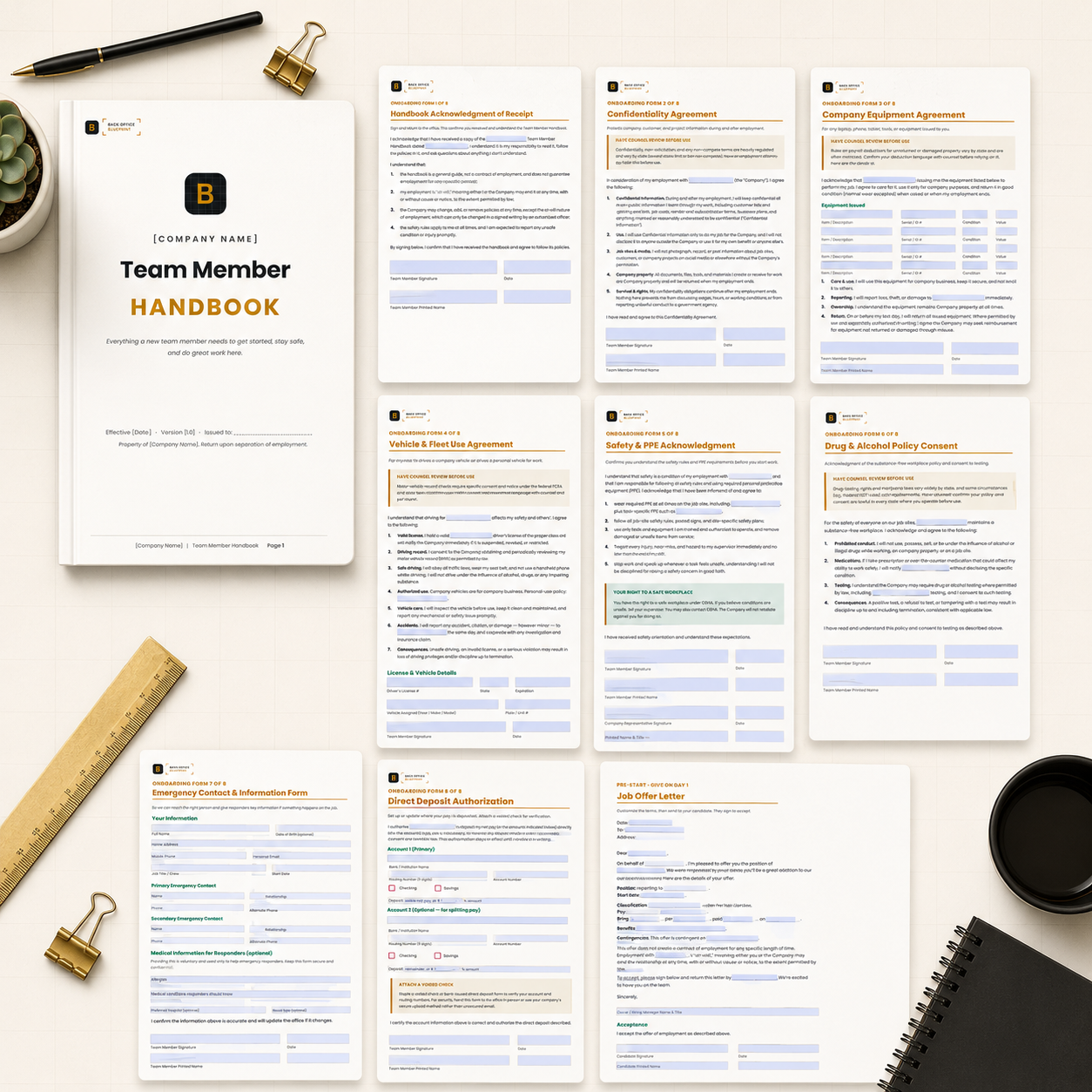
Make every first day build your company, not cost it. The New Hire Onboarding System gives you one repeatable checklist — I-9, W-4, safety orientation, and the setup steps — so every construction hire starts legal, documented, and set up to stay. → Get the New Hire Onboarding System
I'm a working construction CFO and the founder of Back Office Blueprint, where I build the estimating, job costing, and compliance systems I wished every builder and trade contractor had from day one.
Keep reading
1099 vs. W-2: classifying your construction crew without getting burned — the question that decides which onboarding file you owe.
Subcontractor COI tracking: why collecting it once isn’t enough — the same discipline for the crews you don’t employ.
For the subcontractor side of that file, the Subcontractor Compliance System tracks COIs, W-9s and agreements to expiry.