


Ask ten contractors what their margin is, and at least half will tell you a number that's actually their markup. They're not bad at math — the two words just get used like they mean the same thing, and on a jobsite, close enough usually is close enough. But on a bid, "close enough" is the gap between the profit you think you're making and the profit you actually take home, and I've watched it quietly drain thousands off a job that looked healthy on paper. So let's clear it up for good. I'm a working construction CFO, and this is the explanation I wish every estimator got on day one.
The one-sentence difference
Markup is how much you add on top of your cost. Margin is how much of the final price you actually keep as profit. Same job, same dollars, two different denominators — that's the whole trick, and it's exactly why they don't match.
Let's put real numbers on it
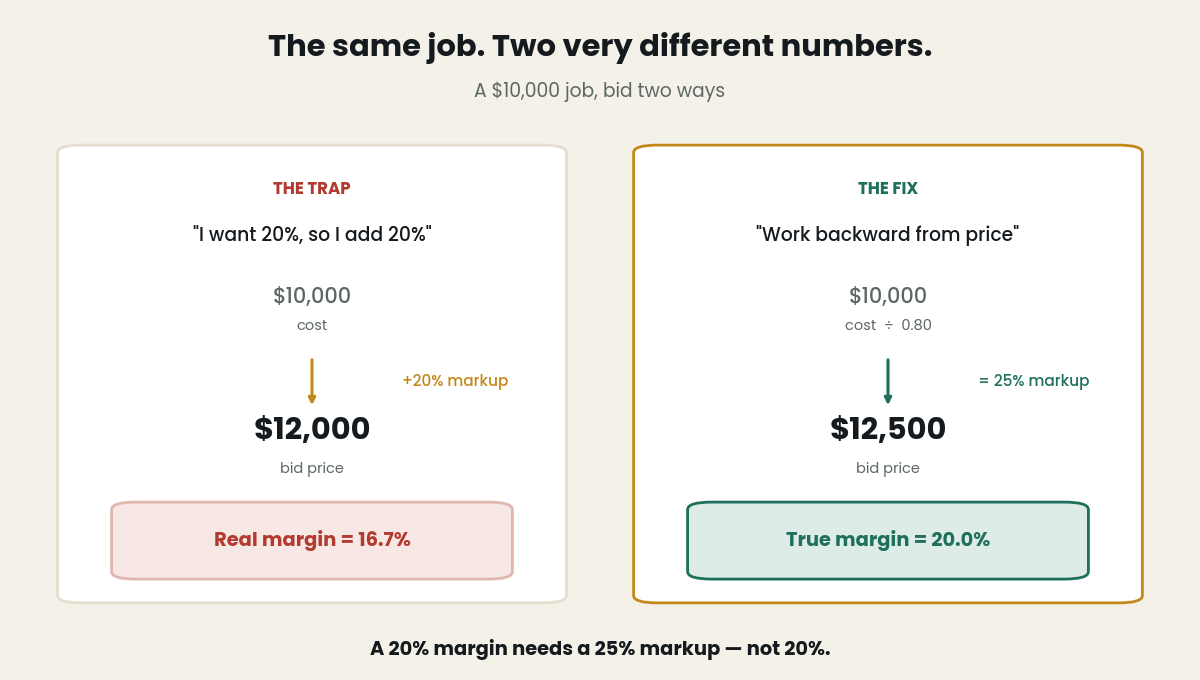
Say a job costs you $10,000 in materials and labor. You want to make 20%, so you add 20% and bid it at $12,000. Feels like a 20% job, right? Here's what actually happened:
- Your profit is $2,000.
- But that $2,000 is a slice of the $12,000 price, not the $10,000 cost.
- $2,000 ÷ $12,000 = 16.7%.
You marked it up 20%, but your real margin is 16.7%. You just left 3.3 points of profit on the table — and you'll do it again on the next bid, and the one after that.
How to actually hit the margin you want
If you want a true 20% margin, you don't add 20% — you work backward from the price:
Price = Cost ÷ (1 − desired margin)
So for our job:
$10,000 ÷ (1 − 0.20) = $10,000 ÷ 0.80 = $12,500
Bid it at $12,500 and now your profit is $2,500 — which is 20% of the final price. To get there, you actually had to mark up your cost by 25%, not 20%. That's the part that bites people: a 20% margin requires a 25% markup. They're not the same number, and the gap only gets wider as your target climbs.
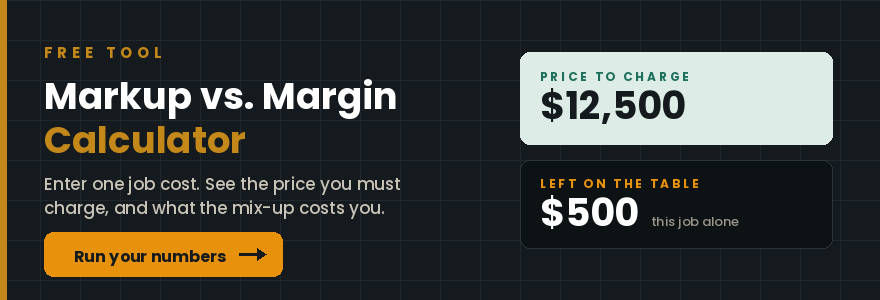
Want to skip the math on every bid? Run your numbers through the free markup vs. margin calculator.
The cheat sheet (tape this to the wall)
Here's what markup you need to hit the margin you actually want:
A 10% margin needs 11.1% markup. 15% needs 17.6%. 20% needs 25%. 25% needs 33.3%. 30% needs 42.9%. 35% needs 53.8%. And a 40% margin needs 66.7% markup — two thirds on top of your cost.
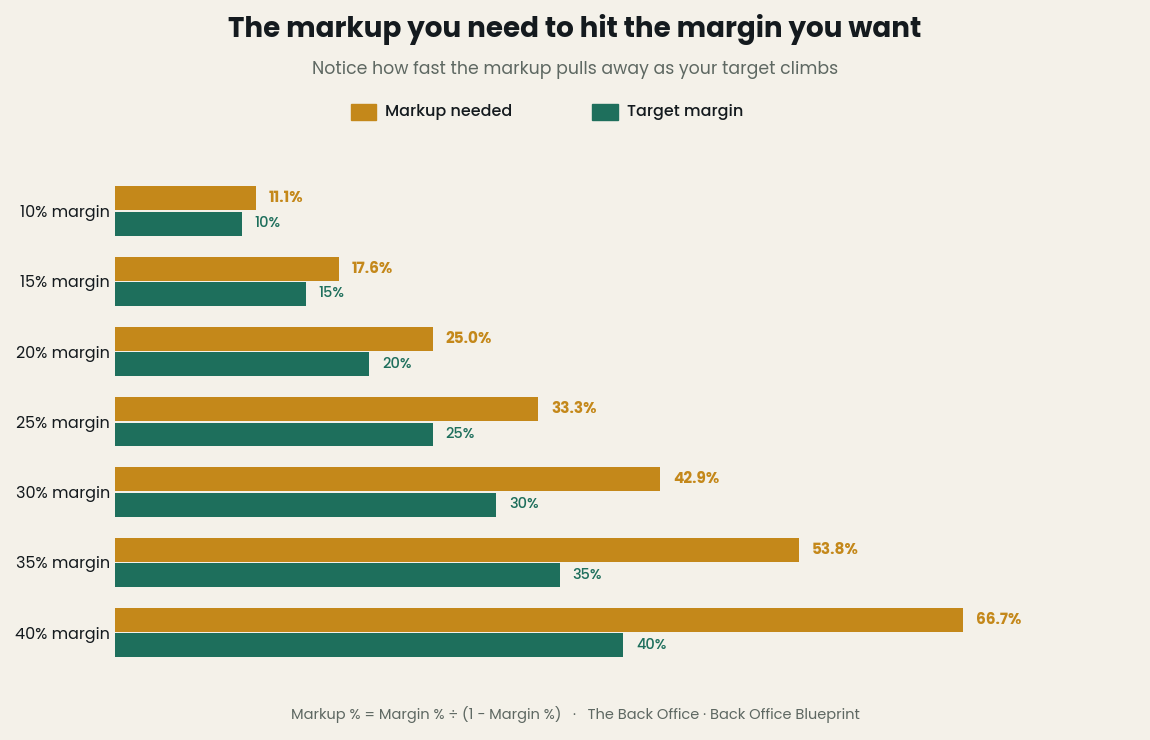
Notice how fast the markup pulls away from the margin. At a 40% margin, you're marking up two-thirds of your cost. If you've been "adding 40%" thinking that's your margin, you've been running closer to a 29% margin this whole time. The formula behind it, if you ever need it:
Markup % = Margin % ÷ (1 − Margin %)
Why this matters more than it looks
A few points of margin doesn't sound like much until you stack it across a year of work. On $1,000,000 in jobs, the difference between a 16.7% margin and a true 20% margin is $33,000. That's real money — a truck payment, a hire, a cushion for the slow season — and you earned it. You just priced it away by mixing up two words. The contractors who consistently make their number aren't working cheaper or harder; they're just doing the math on the price, not the cost.
Don't do this by hand on every bid
Knowing the formula is step one. Running it cleanly on every line of every estimate — with markup, margin, overhead, and a clean proposal coming out the other end — is where it actually sticks. That's exactly what I built the Construction Estimating Spreadsheet to do: you enter your real costs, set the margin you actually want to make, and it prices the job correctly. No backward math, no guessing, no leaving 3 points on the table because the spreadsheet added instead of working backward. It's the system I use to make sure margin is a decision, not an accident.

I'm a working construction CFO and the founder of Back Office Blueprint, where I build the estimating, job costing, and compliance systems I wished every builder and trade contractor had from day one.
Keep reading
What actually goes into a construction job costing system — where the margin you bid gets tested against the margin you got.
You’re not short on profit — you’re short on collections — the margin can be right and the cash still missing.
Bidding the right markup is step one. The Construction Job Costing Spreadsheet tells you whether the job actually held it.