

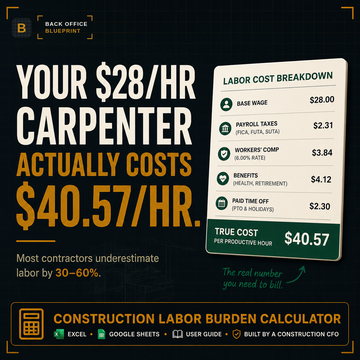
Ask a builder what a carpenter costs and you get the wage. Twenty-eight an hour. It's the number on the check, it's the number in the estimate, and it is wrong by about a third.
I'm a working construction CFO. Labor burden is the single most common reason a job that looked profitable on paper finishes at break-even, and it's rarely because anyone did bad math. It's because the math was never done at all — the wage got carried straight into the bid and everything else got absorbed quietly by the company.
Here is what actually sits on top of that wage, and how to turn it into a number you can bid with.
Labor burden is everything past the paycheck
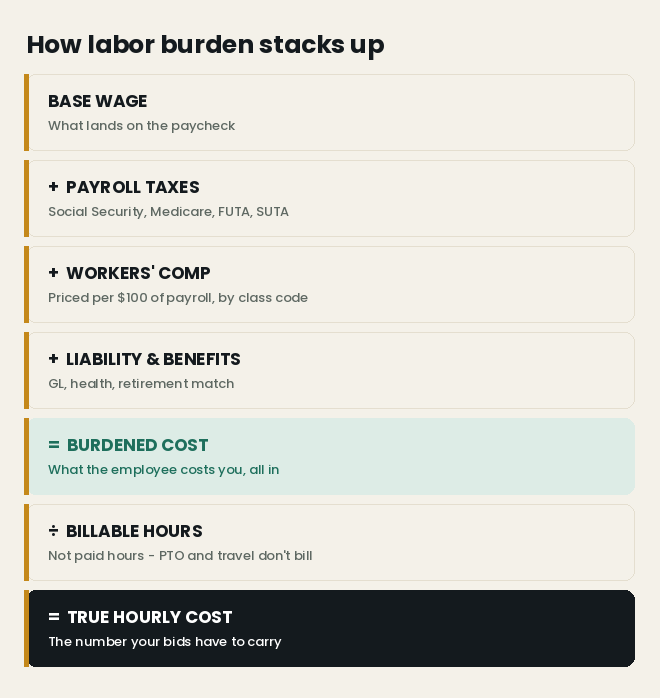
Burden is the gap between what an employee is paid and what they cost you. Payroll taxes, workers' compensation, general liability, unemployment insurance, benefits, and — the piece almost everyone misses — the hours you pay for but cannot bill to a job.
Some of it is fixed by law and easy to look up. Some of it depends on your state, your claims history, and what your crew actually does all day. The parts that vary are the parts that hurt, because they're the ones people guess at.
The taxes are the easy part
Federal payroll taxes are the same for everyone and they're small enough that people are often surprised. As the employer you pay Social Security at 6.2% on wages up to $184,500, Medicare at 1.45% with no cap, and federal unemployment at an effective 0.6% on the first $7,000 of wages. Those are 2026 figures.
State unemployment is where it starts to spread out. Rates commonly run somewhere between 1% and 6% depending on your state and your claims history, applied only to a wage base that also varies by state — some states stop at $7,000, others go past $60,000. On a $28 wage over a full year, all of that together lands somewhere near $4,700.
That's real money, but it is not what breaks the estimate.
Workers' comp is where it gets expensive
Comp is priced per $100 of payroll by class code, and construction class codes are not cheap. A framing or roofing code can run several times what a finish carpenter costs, and your experience modifier moves it again.
At $8.00 per $100 — a plausible mid-range construction rate, though yours could be half that or double — a $58,000 payroll carries roughly $4,700 in comp alone. That single line often costs more than every federal payroll tax combined, and it is the one people most often leave out of a bid entirely.
Add general liability on top, usually carried as a percentage of payroll, and you're at roughly $10,000 of burden before anyone has mentioned health insurance.
The hours you pay for but can't bill
This is the part that separates a rough burden number from a useful one, and most calculators skip it.
A full-time employee is paid for about 2,080 hours a year. They do not work 2,080 billable hours. Take out paid time off, holidays, drive time between jobs, morning yard time, equipment repair, the two hours spent chasing a material that didn't show up — and a realistic billable figure is closer to 1,800. Some crews are well under that.
Every dollar of burden still has to be recovered, but now it has fewer hours to spread across. That's why your true cost per hour is always higher than your cost per paid hour, and why bidding off the paycheck number quietly guarantees a shortfall.
Put real numbers on it
Run a $28 wage through it: 2,080 paid hours, 1,800 billable, comp at $8.00 per $100, state unemployment at 2.7%, liability at 1.5%, no benefits yet. Burden comes to about $10,300. Total annual cost lands near $68,500. Divide by billable hours and that carpenter costs $38.06 an hour — 1.36 times the wage.
Bid them at $28 and you are short $10.06 on every billable hour. Over a year that's roughly $18,000 on one employee. On a four-person crew it's $72,000, which is the difference between a good year and wondering where it all went.
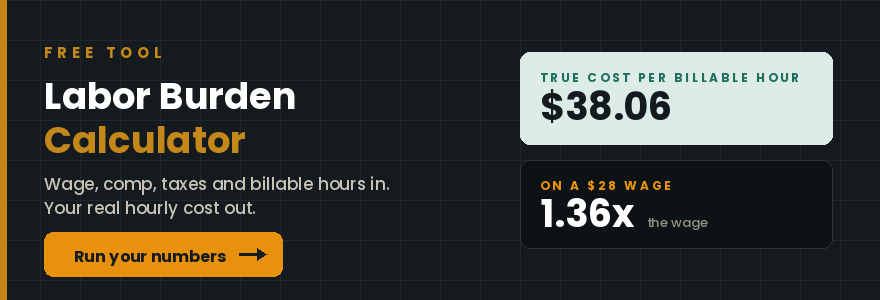
And that is before benefits. Add health coverage and a retirement match and the same carpenter clears $40 an hour comfortably.
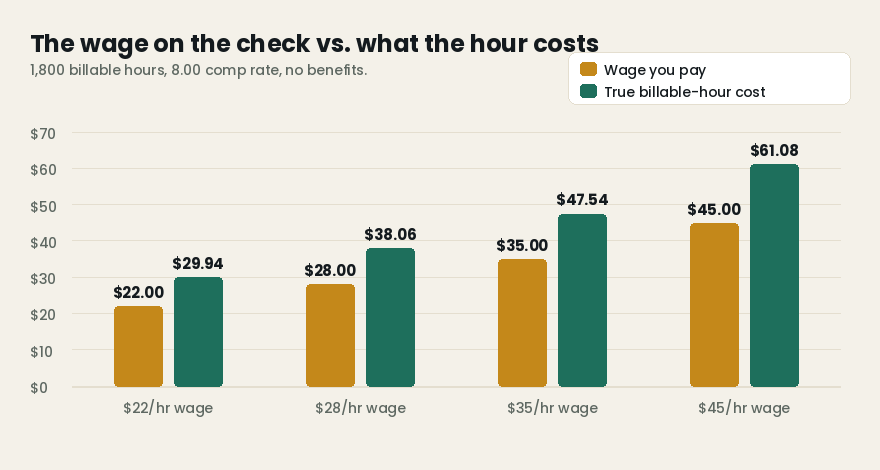
The same math at other wages: $22 an hour truly costs $29.94, $35 costs $47.54, and $45 costs $61.08. The multiplier barely moves — about 1.36 times the wage across the whole range — so bidding the raw wage leaves you short between $7.94 and $16.08 on every billable hour, whatever you pay.
What to do with the number
Two things, and they're both simple once you have it.
First, estimate at burdened cost, never at wage. Every labor line in every bid should carry the true hourly figure. If your template still has raw wages in it, that's a fifteen-minute fix that pays for itself on the next job.
Second, keep it separate from profit. Burden is cost recovery — it gets you back to zero, not into the black. Margin sits on top of the burdened number, and confusing the two is its own expensive mistake.
Recalculate it once a year, and again any time your comp rate or benefits change. It moves more than people expect. Burden tells you what an hour costs you. The free what should I charge per hour calculator turns that into the rate you bill.
The wage is what you pay. The burdened rate is what you bid.
Get the Construction Labor Burden CalculatorI'm a working construction CFO and the founder of Back Office Blueprint, where I build the estimating, job costing, and compliance systems I wished every builder and trade contractor had from day one.