


Ask most contractors where the money leaks on a job and they'll point to the estimate, the subs, the materials. Real leaks, all of them. But there's a quieter one that almost nobody names: the field paper trail — or the lack of one. The stuff that happens on site every day that never gets written down, until the day it matters and there's nothing to point to.
I'm a working construction CFO, and if I could force two documents onto every jobsite in America, it'd be these: a permit and inspection tracker, and a daily field log. Between them they cover the two ways a job hurts you in the field — compliance and disputes. Here's how they work together, and why running both is the cheapest protection you'll ever put on a project.
Two different failures, two different documents
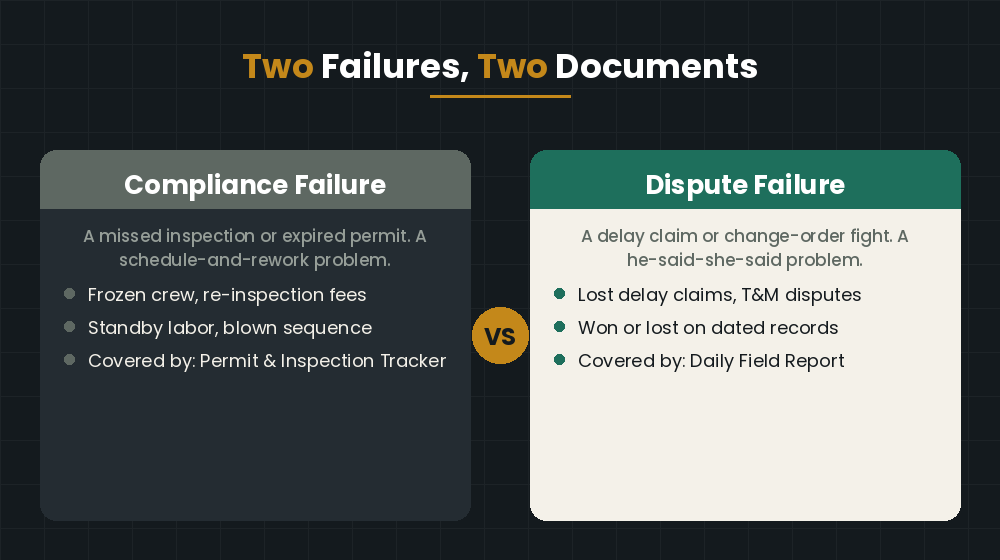
Field problems come in two flavors, and they need two different records.
The first is compliance failure — a missed inspection, an expired permit, a phase covered before sign-off. These are schedule and rework problems. They freeze your crew and cost you re-inspection fees and standby labor. The document that prevents them is a permit and inspection tracker, watching every gate on every job.
The second is dispute failure — a delay claim, a change-order fight, a sub who bills for hours he didn't work. These are he-said-she-said problems, and they're won or lost on dated records. The document that prevents them is a daily field log, freezing what happened while it's still fresh.
One protects your schedule. One protects your position in an argument. Most contractors run neither well, and pay for both.
How the two documents cover each other
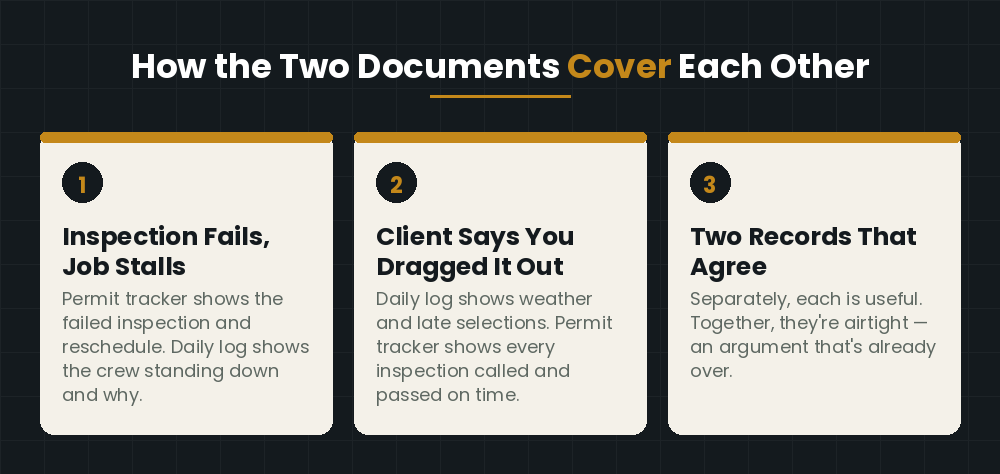
Here's what makes running them together more than the sum of the parts: the gaps in one get covered by the other.
Say an inspection fails and the job stalls for a week. Your permit tracker shows the failed inspection and the reschedule. Your daily log shows the crew standing down and why. Now, when the schedule slips and someone wants to know whose fault it is, you don't have a story — you have two independent, dated records that agree. That's not an argument you have to win. That's an argument that's already over.
Or say a client claims you dragged the job out. The daily log shows the weather days and their late selections; the permit tracker shows every inspection called and passed on time. Together they tell a clean, timestamped story that no one's memory can contradict. Separately, each is useful. Together, they're airtight.
This is the "does it run without you" test
There's a simple question I use on every process in a business: does it run without you? If a system only works when the owner is personally paying attention, it's not a system — it's a liability with good intentions.
Field documentation is exactly where owners get burned on this. The permits and the daily events live in the PM's head and the crew's memory, which means they run only as long as those specific people are focused and present. The moment things get busy — the moment you actually need the coverage — the informal system collapses. Written trackers don't. A permit log and a daily field report keep working whether you're on the site or three jobs away, which is the entire point.
Start both on the same day
If you're going to fix your field paper trail, fix both halves at once, because they protect against different things and a job can get hurt by either. Compliance failures and disputes don't take turns.
The good news is neither is complicated. A permit and inspection tracker is a status sheet that watches your gates. A daily field log is a two-minute end-of-day record. Neither requires software, a consultant, or a full-time admin. What they require is that they actually exist and actually get used — which is a format problem, not a discipline problem. Make them simple enough that a busy foreman fills them out from the truck, and they run themselves.
The cheapest insurance on the whole job
Add up what field failures cost — the re-inspection fees, the standby labor, the crew gaps, the lost delay claims, the T&M disputes you couldn't back up. On a single job it can run into real money. Against all of that, two simple field documents cost you a few minutes a day and a status sheet you glance at each week.
That's the trade: a little friction every day, against the occasional catastrophe you never see coming. Run both, and the two ways a job hurts you in the field stop being surprises and start being covered.
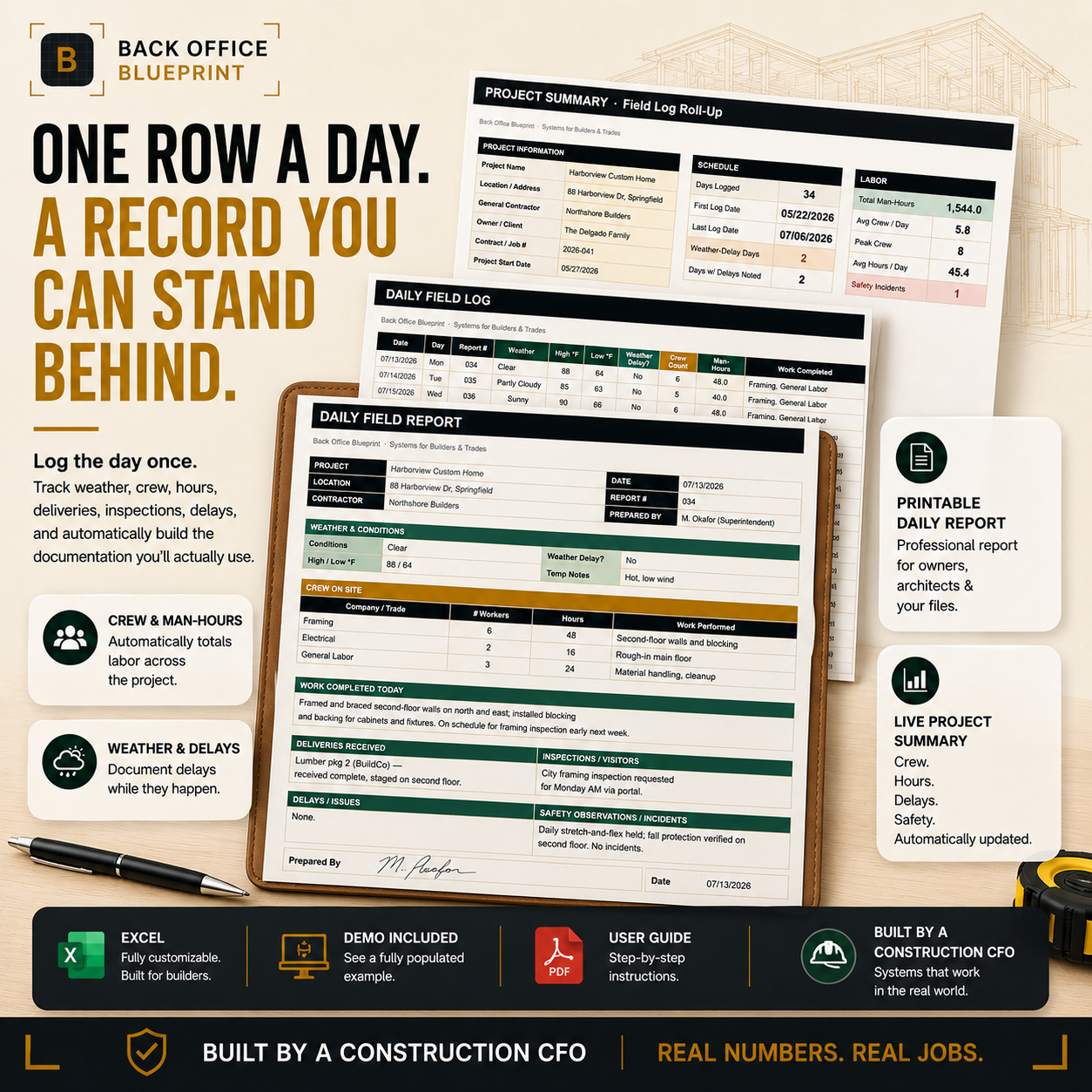
Cover both ways a job hurts you in the field. The Field Ops Kit pairs the Permit & Inspection Tracker and the Daily Field Report & Jobsite Log — two systems, one price — so your compliance and your dispute protection are running on every job. → Get the Field Ops Kit
I'm a working construction CFO and the founder of Back Office Blueprint, where I build the estimating, job costing, and compliance systems I wished every builder and trade contractor had from day one.
Keep reading
The daily log that wins the argument — the first of the two documents, in detail.
Permit and inspection tracking: why one missed call stalls the whole job — the second one, and the one that stalls schedules.
If you only want the inspection half, the Permit & Inspection Tracker runs on its own.