


The first time somebody asks for your safety binder, it will not be a casual request. It’ll be a compliance officer standing on your job, or a GC’s safety manager before they’ll let your crew through the gate, or an adjuster three weeks after somebody got hurt. In all three cases the question is the same, and it’s never really about the binder: can you prove the program existed before today?
Quick note: this is general guidance, not legal advice. OSHA standards and state plans vary, and your contracts and your carrier have their own requirements — verify yours.
The paper is the program
This is the part that catches good contractors. You can run a genuinely safe job — careful crews, real toolbox talks, nobody cutting corners — and still fail every audit, because none of it was written down. A safety program that exists only in how you actually work is invisible to an inspector, to a GC, and to a claims file.
The binder isn’t bureaucracy for its own sake. It’s the only evidence you have that the program predates the incident.
The eight sections
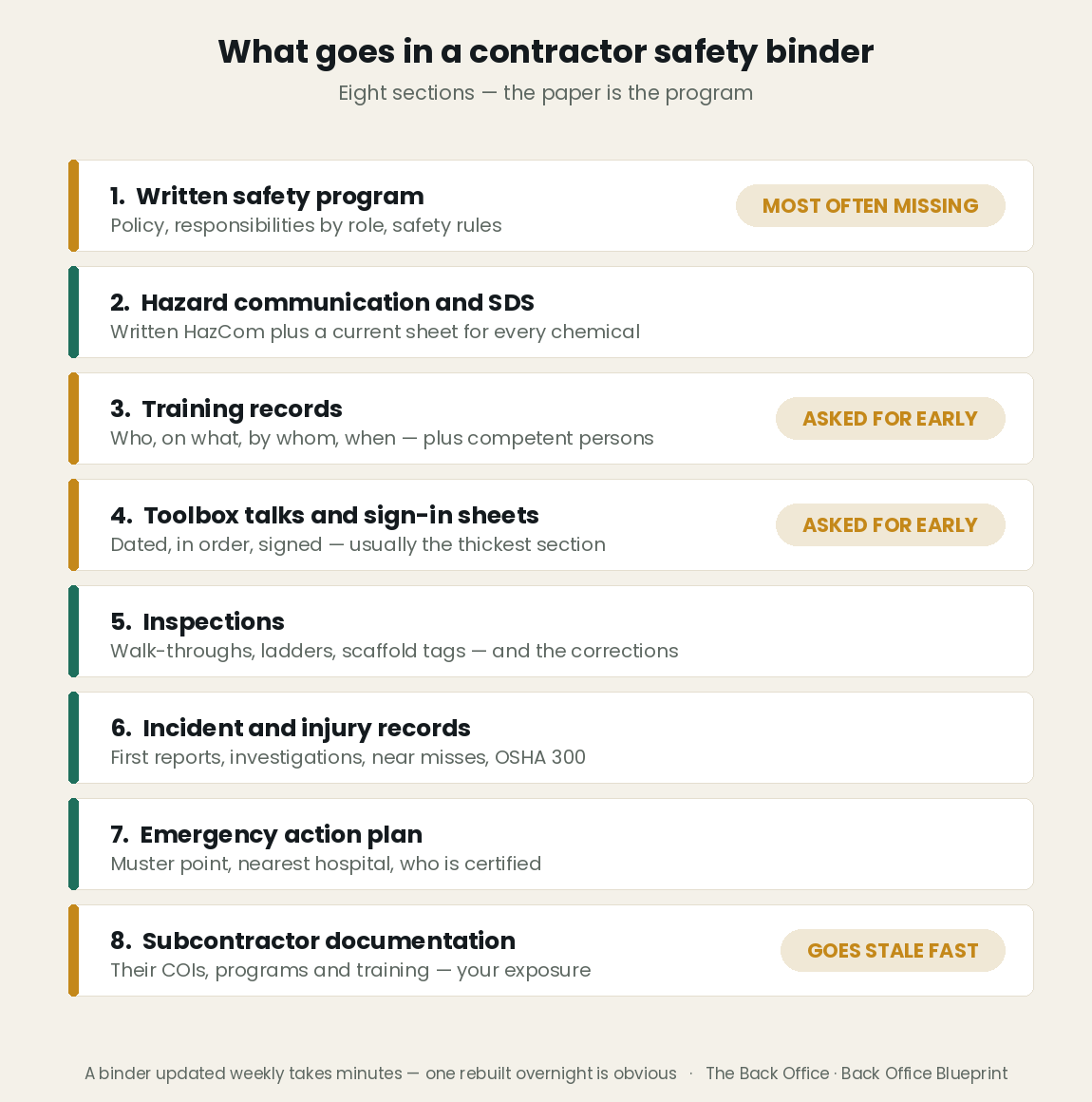
1. Written safety program. The policy itself — your commitment, responsibilities by role, disciplinary policy and general safety rules. This is the document everything else supports, and it’s the one most small contractors don’t actually have.
2. Hazard communication and SDS. Your written HazCom program plus a current safety data sheet for every chemical on site. Not a damp stack in the gang box — an index, and a known location.
3. Training records. Who was trained, on what, by whom, and when. Competent person designations, equipment-specific training, new hire orientation.
4. Toolbox talks and sign-in sheets. Dated, in order, with signatures. Usually the thickest section, and the one that proves the program is alive rather than filed.
5. Inspections. Jobsite walk-throughs, equipment and ladder checks, scaffold tags — with dates and the corrections that followed. An inspection log with no corrections on it reads as an inspection log nobody filled in.
6. Incident and injury records. First reports, investigations, near misses, and your OSHA 300 log where required.
7. Emergency action plan. Site-specific: muster point, nearest hospital, who is first-aid certified, contact tree.
8. Subcontractor safety documentation. Their certificates of insurance, their programs, their training — because on your job, their crew is your exposure.
What actually gets asked for first
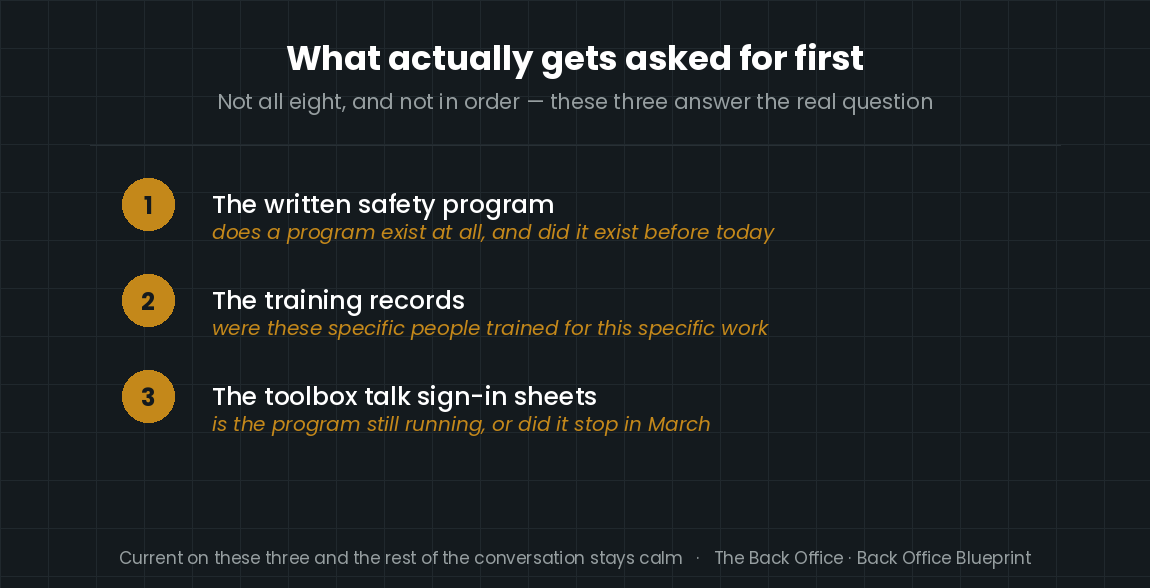
Not all eight, and not in order. In practice the first three requests are almost always the same: the written program, the training records, and the toolbox talk sign-in sheets. Those three answer “does a program exist,” “were these specific people trained,” and “was it still running last week.”
If those three sections are current, the rest of the conversation is usually calm. If they’re thin, everything else gets looked at harder.
The three that are usually missing
The written program itself. Plenty of contractors have training certificates and sign-in sheets and no actual policy document tying them together.
Inspection records with corrections. Inspections get done and never written down, which makes them unprovable — and an inspection you can’t prove is worth the same as one you never did.
Subcontractor documentation. Collected once at onboarding and never refreshed, so half the certificates in the binder expired months ago. That’s its own discipline, and I wrote about why collecting a COI once isn’t enough.
Keeping it current without it becoming a job
Three habits, and that’s genuinely all. Sign-in sheets go in the binder the same week the talk happens, not at year end. Certificates get a renewal date the day they’re filed. One calendar reminder a quarter to pull anything expired.
A binder that’s updated weekly takes minutes. A binder reconstructed the night before an audit is obvious to everyone who reads it — the handwriting is too consistent and the dates are too neat. If section four is the part you’re worried about, that’s the 52 weeks of toolbox talks problem, and it has its own fix.
Don’t build all eight from scratch
You can build every section yourself from OSHA’s published material — it’s public, and it’s free. What takes the time is turning it into a structure with the forms already made, the tabs already labeled, and the logs already formatted so somebody will actually keep them up.
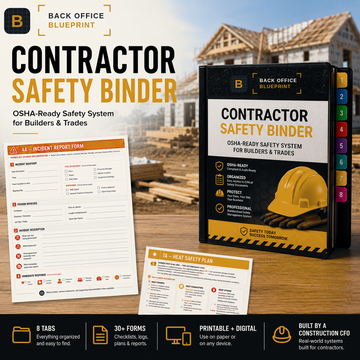
The OSHA-Ready Contractor Safety Binder is that structure — 8 tabs and 30+ forms, printable and digital, built for builders and trades.
See the OSHA-Ready Safety Binder →
I'm a working construction CFO and the founder of Back Office Blueprint, where I build the estimating, job costing, and compliance systems I wished every builder and trade contractor had from day one.
Keep reading
OSHA toolbox talk requirements: what’s actually required — what belongs in the training section, and how often.
Onboarding isn’t paperwork — it’s retention and liability — the forms signed before a new hire picks up a tool.
Permit & inspection tracking — the other binder an inspector asks about.
Your binder is only as good as your subs’ paperwork. The Subcontractor Compliance System tracks the COIs, W-9s and agreements behind it.