

Your customer asks what you need to get started. You say a third, because that's what everybody says.
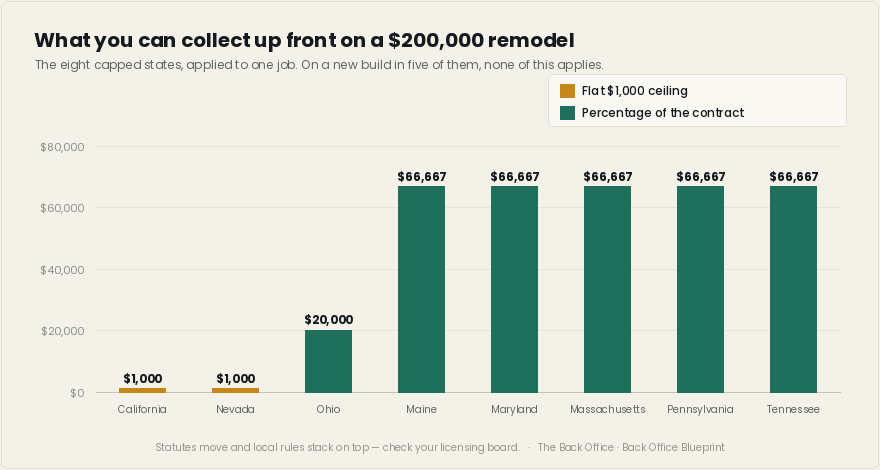
If you're remodeling a kitchen in California, that answer is illegal. The cap there is $1,000 or 10% of the contract, whichever is less — on a $200,000 remodel you can collect a thousand dollars. Not sixty-six thousand. A thousand.
If you're building that customer a new house instead, the same state has no cap at all.
That's the part every deposit chart online gets wrong. These limits are project-type rules, not residential-work rules, and the difference between a remodel and a new build decides whether the number applies to you.
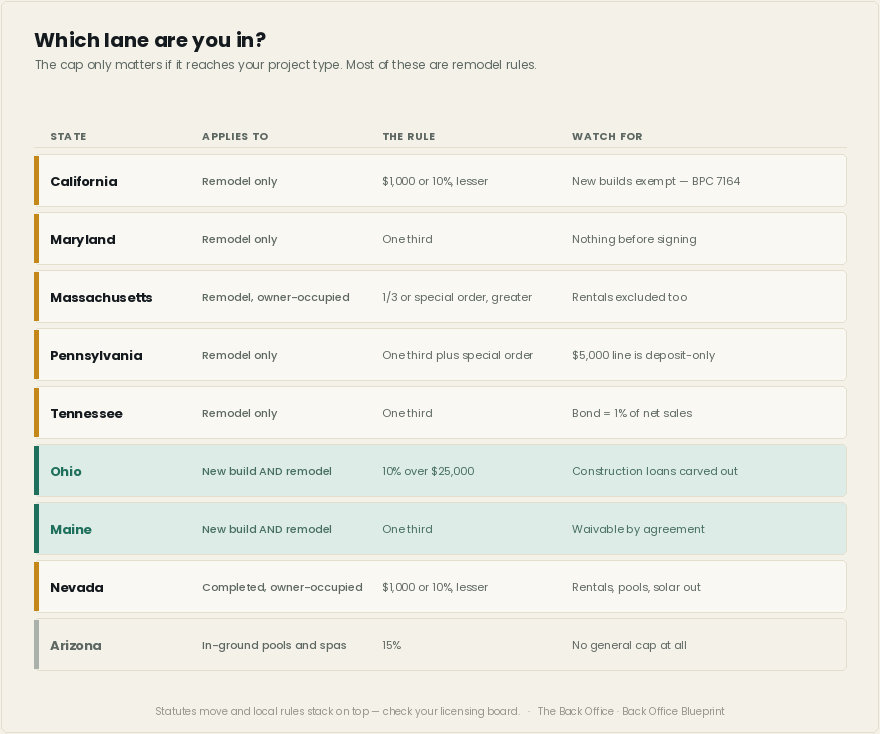
This primary-source review identified eight states with statutory limits on what residential contractors can collect up front, with additional states imposing narrower requirements, trust-fund rules, or consumer guidance. Most of those caps don't touch new construction. Two of them do. One state caps only in-ground pools. Find out which lane you're in before you go looking for a number.
This primary-source review currently covers 21 jurisdictions. It will expand as additional states are verified.
Not sure which lane your job is in? The Contractor Deposit Limit Checker runs a state and project type against the same statutes cited below, and shows the exceptions alongside the result.
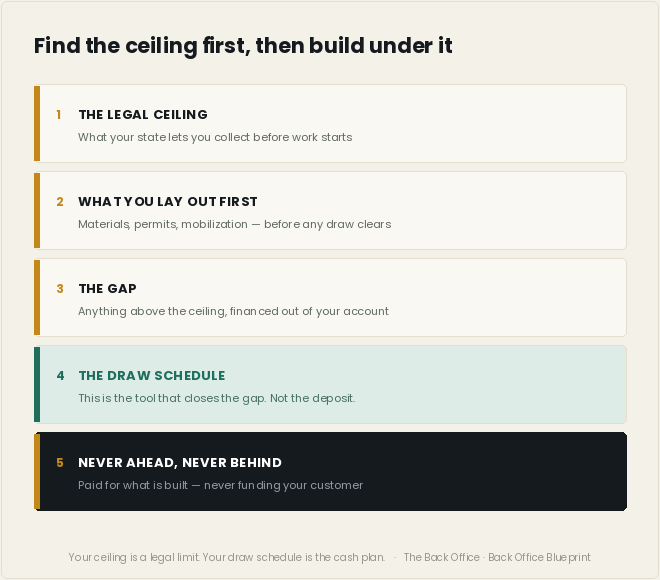
Read the cap as a cash-flow problem, not a legal one
A deposit limit isn't really about the deposit. It's about who is financing the job.
If your state lets you take a third and your material buy is 40% of the contract, you're funding the gap out of your own account until the first draw clears. If your state caps you at $1,000, you're funding nearly all of it.
Either way the deposit is not the tool that fixes it. The draw schedule is. A contractor who takes 10% up front and bills every two weeks against completed work is in far better shape than one who takes a third and doesn't invoice again for six weeks.
So find your ceiling first, then build the payment schedule underneath it.
Five states cap remodels only — new construction is exempt
California — $1,000 or 10%, whichever is less. Cal. Bus. & Prof. Code § 7159.5, and only on home improvement contracts as § 7151 defines them: repairing, remodeling, altering, converting, modernizing or adding to residential property. Building a new single-family home falls under § 7164 instead, which sets no deposit cap whatsoever. An ADU is home improvement and stays inside the cap — the licensing board said so directly in 2024. The exception is a performance and payment bond, a lien and completion bond, or a joint control approved by the registrar, and you can't hold a financial interest in the joint control.
Maryland — one third. Md. Bus. Reg. § 8-617, and no payment at all before the contract is signed. § 8-101 expressly excludes construction of a new home. Past the deposit, Maryland doesn't dictate your payment schedule — though § 8-501 requires the contract to state it.
Massachusetts — one third, or the cost of special-order materials, whichever is greater. M.G.L. c. 142A § 2, on contracts over $1,000. Read the scope in § 1 carefully: it reaches work on a pre-existing, owner-occupied building of one to four units. New construction is out. So is a rental the owner doesn't live in. You also can't demand final payment until the work satisfies both parties.
Pennsylvania — one third, plus special-order materials. 73 P.S. § 517.9(10) under HICPA. The materials only get added on if they're designated in the written contract. The $5,000 threshold applies to the deposit rule only — HICPA's other contract requirements kick in at $500, so don't read a small job as unregulated. § 517.2 excludes new home construction.
Tennessee — one third. Tenn. Code Ann. § 62-6-510(12), unless you furnish a bond of at least 1% of your annual home improvement net sales, or the owner is told in writing about the right to withhold up to 100% of payment and agrees otherwise. Note that bond test — it's your whole book of business, not one job. Subsection (11) separately bars any payment before the contract is signed. § 62-6-501 excludes new construction and jobs under $3,000.
On Tennessee's nine counties. The Home Improvement Contractor license is only required in Bradley, Davidson, Hamilton, Haywood, Knox, Marion, Robertson, Rutherford and Shelby. The deposit rule is a different question, and § 62-6-502(a) answers it: no person, "whether subject to licensing by any law or otherwise," may do anything the part prohibits in this state, and the part can't be waived by agreement. On the text, the cap is statewide and the counties only govern licensing. No Tennessee appellate court has squarely ruled on it, so that's a reading of the statute rather than settled case law.
Two states cover new construction too
Ohio — 10%. Ohio Rev. Code § 4722.04, on home construction service contracts over $25,000, with a separate allowance of up to 75% of any special-order item that isn't returnable or usable. Ohio defines "home construction service" as creating a new structure and repairing, improving, remodeling or renovating an existing one, on a one-, two- or three-family dwelling. So this one follows you onto a new build.
Two things nobody quotes. Cost-plus contracts are expressly excluded. And the section ends: "A supplier may accept payments from a construction loan." On a financed new build, that's a large hole in the 10%.
Maine — one third. 10 M.R.S. § 1487(5), on home construction contracts over $3,000 in materials or labor. § 1486 defines the contract as one to build, remodel or repair a residence of three or fewer units — new construction included. The one third counts every payment you take before or at signing, not each payment separately.
Maine is also the only one of the eight you can contract out of. § 1489 lets both parties opt out if you first inform the homeowner of their rights under the chapter and you then agree otherwise in writing. Everywhere else on this page the cap is a prohibition on you, not a default term.
Two states with a narrower rule
Nevada — $1,000 or 10%, whichever is less. NRS 624.970, added in 2023 and applying to contracts entered into on or after October 1 that year. The scope is tight: work on a completed single-family residence whose owner occupies it. A rental is outside it, and so are residential pools, spas and solar. The exception is a $100,000 consumer protection bond filed with the Board, or relief granted by the Board under NRS 624.270(5). Pools and spas have their own parallel $1,000 or 10% cap at NRS 624.940.
This one is recent enough that most deposit charts online still don't have it, or still list Nevada as pools-only.
Arizona — 15%, residential in-ground pools and spas. A.R.S. § 32-1158.01, which also sets 25% progress milestones after excavation, after steel and plumbing, and after decking. Above-ground pools aren't covered. A separate section, § 32-1158.02, caps the down payment at 50% for repairing storm damage in an area an insurer has designated — that section was rewritten by SB1206, signed in June 2026, so anything you read citing an older version is out of date. Arizona has no general residential cap: § 32-1158 makes you disclose the deposit in the contract but doesn't limit it.
No cap doesn't mean no rules
This is where most contractors get hurt, because nothing stops you taking the money. The consequence shows up later.
Florida — no cap, but a clock. Take more than 10% up front on residential work and Fla. Stat. § 489.126 gives you 30 days from the payment to apply for permits and 90 days from permit issuance to start. This one covers repair, restoration, improvement and new construction, and it applies whether or not you're licensed.
If you've read that this is prosecuted as theft, that was true until 2019 and isn't now. The theft cross-reference was repealed. It's a graded offense on its own terms — a first-degree misdemeanor under $1,000, up to a first-degree felony at $200,000 or more. There are two exits: just cause, or the owner's written agreement to a longer period. And the owner has to make written demand by certified mail first; you get 30 days from that demand to cure.
New York — escrow, not a cap. Under Lien Law § 71-a(4), money you take before substantial completion goes into escrow within five business days, unless you post a bond, an indemnity contract or an irrevocable letter of credit instead. GBL § 771 is where the contract has to disclose that duty, and § 771(1)(f) is the one that requires progress payments to bear a reasonable relationship to the work performed and the materials bought.
Trust funds — Texas, Michigan, Wisconsin. Texas makes construction payments trust funds under Prop. Code § 162.001; misapplying $500 or more is a Class A misdemeanor, and a third-degree felony with intent to defraud. On a residential contract § 162.003(b) makes the owner a beneficiary too. Michigan's MCL 570.151 does the same, with fraudulent diversion a felony carrying up to three years — but its named beneficiaries are your laborers, subs and suppliers, not the homeowner. Wisconsin has both: Wis. Stat. § 779.02(5) makes owner payments a trust fund and misappropriation theft, and Wis. Admin. Code § ATCP 110.02(10) makes it an unfair trade practice to spend a pre-completion home improvement payment on anything but that improvement. The rule reaches home improvement only; the statute reaches new construction as well.
Roofing off an insurance claim is its own category. Colorado and Georgia have no general cap, but both regulate this one. CRS § 6-22-103(2) makes a residential roofer hold any payment in trust until materials are delivered or most of the work is done. O.C.G.A. § 10-1-393.12(d) goes further and bars you from requiring any payment from an insured until the five-day cancellation period runs out. When a state legislates deposits at all, this is usually where it starts.
Two numbers that look like law and aren't
This is the part that will save you an argument.
Virginia's DPOR consumer guide tells homeowners to "consider an initial deposit of no more than 10% down or $1,000, whichever is less," with up to 30% where the job needs custom or special-order items. Connecticut's DCP tells homeowners a legitimate contractor won't ask for more than a third.
Both are consumer guidance. Neither is a statute. Virginia's regulation, 18VAC50-22-260, requires you to state the down payment amount in the contract. It doesn't cap it. Connecticut's CGS § 20-429 contains no cap either — the only financial ceiling in that section is on finance charges.
Now look at Virginia's number again. "10% down or $1,000, whichever is less" is word for word the operative language of California's statute at Bus. & Prof. Code § 7159.5(a)(3). A Virginia agency published California's binding rule as advice, and the guide's own verb is "consider."
That's how these numbers travel. They start as one state's law, get repeated as another state's suggestion, and end up in a chart as everybody's limit. A number on a state website is not automatically a number in your state's code.
The five with no cap at all
Colorado, Utah, Georgia, North Carolina and Oregon have no general statutory cap on residential deposits. Colorado and Oregon leave the amount to the contract. Utah's licensing board advises caution and sets no limit. North Carolina's contractor chapter is silent.
That's not the same as no rules — Colorado and Georgia's roofing provisions above still bite, and Utah's § 58-55-501 still covers misusing money you've already been paid.
What California is really telling everyone
Sitting in the same section as the deposit cap is a line worth reading whatever state you're in:
The contractor shall neither request nor accept payment that exceeds the value of the work performed or material delivered.
California made it law. It's good practice everywhere, and it cuts both ways — you shouldn't be paid ahead of the work, and you shouldn't be behind your own costs either.
That's the real job. A payment schedule where at no point are you financing your customer's project, and at no point have you been paid for something you haven't built. Get that right and the deposit becomes the smallest number that covers what you lay out before the first draw — which is usually a lot less than a third anyway.
One more thing. Statutes move. Nevada's cap arrived in 2023 and Arizona rewrote its storm-repair section in June 2026. This reflects what those sections said in August 2026, and your city or county may layer its own rules on top. Check your board before you change what you collect — including after reading this.
I'm a working construction CFO and the founder of Back Office Blueprint, where I build the billing, cash flow, and compliance systems I wished every builder and trade contractor had from day one.