


Nobody skips the safety meeting because they don’t believe in safety. They skip it because it’s 6:40 on a Tuesday, the concrete truck is coming at 7:15, and the foreman has no idea what he’s supposed to talk about. I’m a working construction CFO, and I’ve watched this happen on more jobs than I can count: the program starts strong in January, runs on enthusiasm for about three weeks, and quietly dies somewhere around week fourteen — not because anyone decided to stop, but because deciding what to cover every single week is its own job.
Quick note: this is general guidance, not legal advice. OSHA standards and state plans change, and your contracts have their own rules — verify yours.
The problem was never the meeting. It was the blank page.
Ask a foreman to hold a weekly safety meeting and he’ll do it. Ask him to hold fifty-two of them, each on a topic that’s actually relevant to the work happening that week, researched and written by him, on top of running the job — and you’ve handed him a second job he never signed up for. That’s the real reason toolbox talk programs collapse. Not resistance. Friction. So here’s the whole year, laid out. Take it, reorder it, run it.
How to pick the right topic for the week
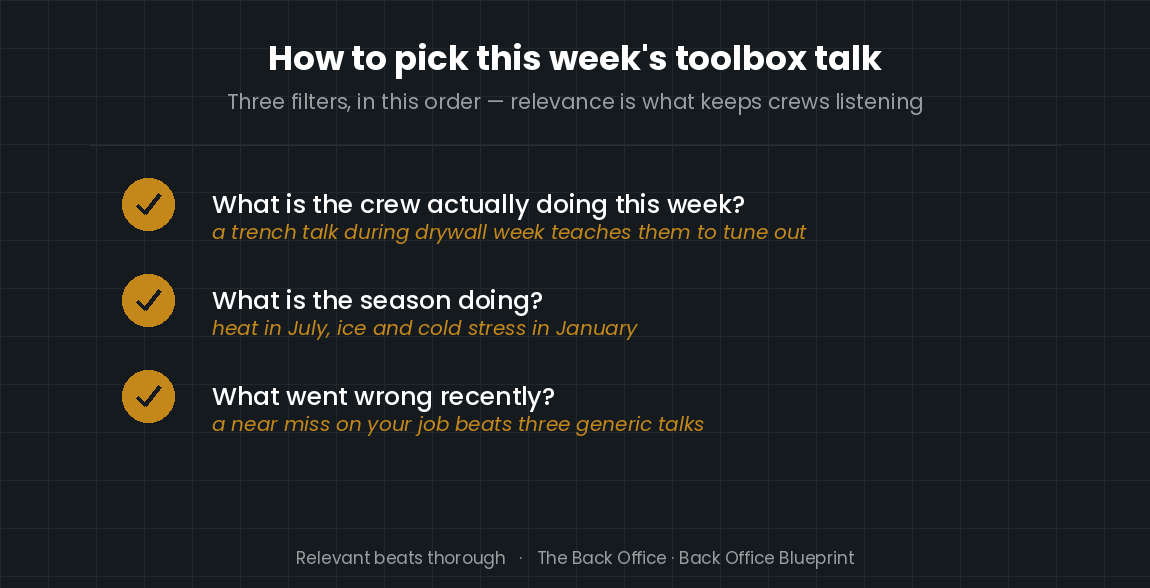
Three filters, in this order. What’s the crew actually doing this week? A talk on trench safety the week you’re hanging drywall gets tuned out, and once a crew learns the meeting is filler they stop listening to the ones that matter. What’s the season doing? Heat illness in July, cold stress and ice in January, wind and storm exposure in spring. What went wrong recently? A near miss on your own job — or a story from the crew across the street — is worth three generic talks. If you had a close call on Thursday, that’s your Monday topic.
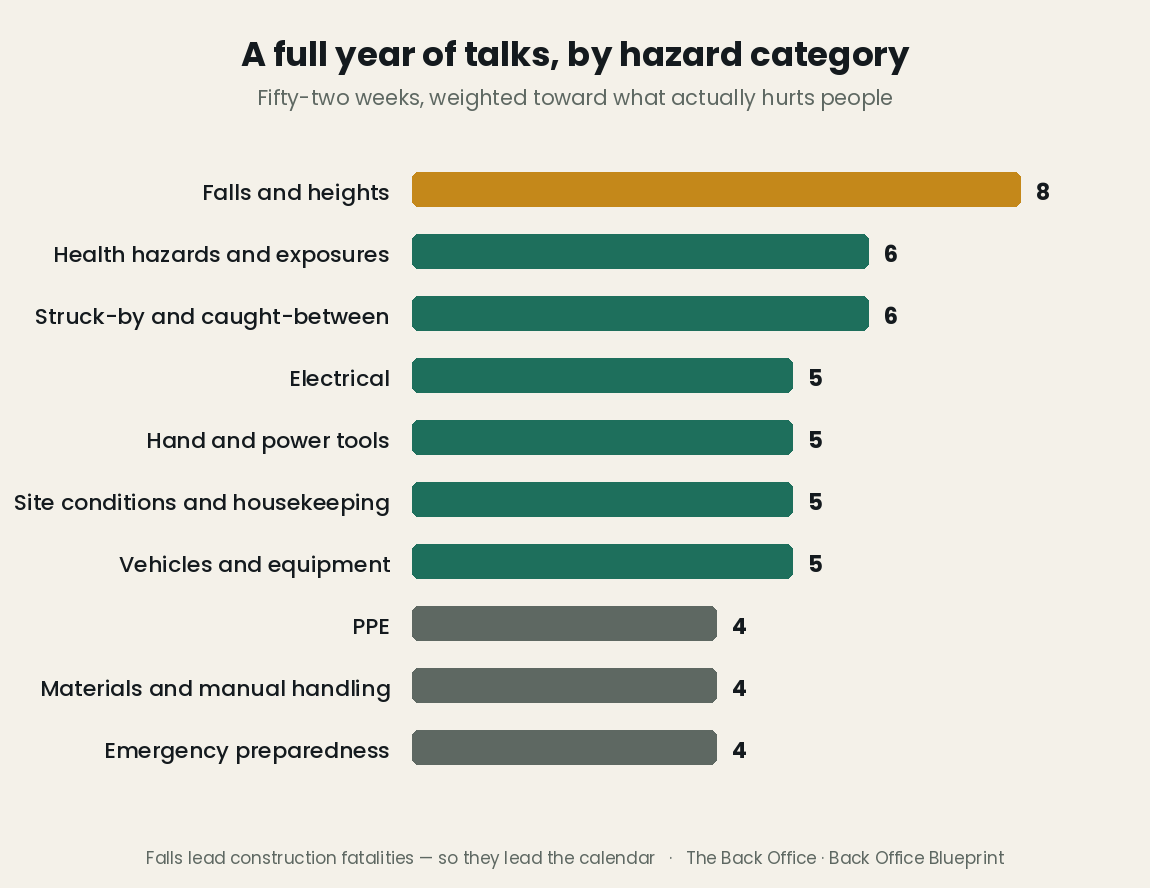
The 52 topics, by hazard category
Ten of these are written out in full below — one per hazard category — so you can see exactly what a talk that actually holds a crew's attention looks like. Each one follows the same four-part shape: the hazard in plain terms, what to say, what to check before anyone starts work, and the one question that makes it stick.
Steal the structure. It works for any of the fifty-two.
Falls and heights (8)
The leading cause of construction fatalities, which is why this category gets the most weeks.
1. Ladder setup and the 4-to-1 rule
2. Extension ladder tie-off and safe access
3. Scaffold inspection before each shift
4. Guardrails, midrails and toeboards
5. Floor and roof openings — covers and marking
6. Personal fall arrest: harness inspection
7. Anchor points and tie-off height
8. Aerial lifts and scissor lifts
Sample talk — 1. Ladder setup and the 4-to-1 rule
The hazard. Falls are the leading cause of death in construction, and a startling share of them are from portable ladders under twelve feet. Not scaffolds. Not roofs. Step ladders and extension ladders that were set up wrong or climbed wrong, on ordinary days, on ordinary jobs.
What to say. An extension ladder wants its base one foot out from the wall for every four feet of working height. At sixteen feet of height, that's four feet out. Any steeper and the ladder wants to tip backward with you on it; any shallower and the base slides out. The ladder also has to extend three feet above the landing you're stepping onto — that's what you hold while you transition, which is the moment most falls happen. Three points of contact going up and coming down, every time, which means you are not carrying material up a ladder. And nobody stands on the top cap of a step ladder, ever, including for "just a second."
What to check before anyone climbs.
- Feet flat on firm ground, not on a scrap of plywood over mud.
- Rails and rungs undamaged and clean.
- The top tied off if it's going to be climbed more than a couple of times.
- Nothing overhead — power lines especially.
The question that makes it stick. Ask the crew: what's the tallest thing you've climbed this month, and was that ladder tied off? You will get an honest answer, and it will tell you more about your site than an inspection would.
Struck-by and caught-between (6)
9. Overhead loads and never walking under a pick
10. Rigging inspection: slings, shackles and chokers
11. Backing, blind spots and the spotter’s job
12. Trench and excavation cave-in awareness
13. Pinch points on moving equipment
14. Rebar caps and impalement hazards
Sample talk — 9. Overhead loads and never walking under a pick
The hazard. Struck-by is one of the deadliest categories in construction, and the version that kills people on small sites isn't a tower crane. It's a bundle of trusses on a boom truck, a pallet of block on a telehandler, or a load that shifted because the rigging was fine yesterday.
What to say. The rule is simple and it is not negotiable: nobody stands under a suspended load, and nobody walks through the swing radius to save thirty seconds. If the load is in the air, the ground under it and around it belongs to nobody. The operator cannot see everything and is not responsible for guessing where you went — you are responsible for staying out. Loads get set down before anyone touches them. And if you are the one guiding a load, you use a tag line, not your hands.
What to check before the lift.
- Who is the signal person, and does everyone know it's them.
- Whether the swing radius is physically marked or just assumed.
- Whether the ground under the outriggers will hold.
- Whether anyone is working directly below on another task nobody thought about.
The question that makes it stick. Ask: if the operator lost sight of you right now, would he know where you are? On most sites the honest answer is no, and that's the whole talk.
Electrical (5)
15. Temporary power and GFCI protection
16. Extension cords: damage, ratings and daisy-chaining
17. Lockout/tagout on the jobsite
18. Overhead power lines and minimum clearance
19. Working near energized panels

Sample talk — 15. Temporary power and GFCI protection
The hazard. Temporary power is the most improvised system on any jobsite. It gets built fast, added to by whoever needs a circuit, and nobody owns it. It is also wet half the time.
What to say. Every 120-volt, 15 and 20-amp receptacle outlet on a construction site that isn't part of the permanent wiring needs ground-fault protection, either GFCI protection or a written assured equipment grounding conductor program. The electrical code reaches further and covers 30-amp temporary outlets too, so the simple site rule is that every temporary outlet gets protected. In practice, for most builders and trades, that means GFCI, because the paperwork alternative is a program somebody has to actually run. A GFCI is not a one-time install: it has a test button for a reason, and a device that won't trip on test is a device that won't trip on you. Cords plugged into a GFCI-protected outlet are protected; cords daisy-chained off a strip somewhere else are not.
What to check.
- Test buttons pressed on the temporary panel this week.
- No cords run through doorways, standing water or across traffic.
- Nothing plugged in with the ground pin snapped off — which is the single most common thing you will find.
The question that makes it stick. Ask who tested the GFCI on the temp pole last. If nobody can name a person or a day, you've just found your action item.
Hand and power tools (5)
20. Circular saw guards and kickback
21. Nail gun safety and sequential triggers
22. Angle grinder wheels and guarding
23. Powder-actuated tools
24. Daily tool and cord inspection

Sample talk — 20. Circular saw guards and kickback
The hazard. Kickback happens in well under a second. The blade binds, the saw drives backward toward the operator, and whatever the lower guard was doing at that moment decides how bad it gets.
What to say. The lower guard has to return on its own the instant the cut finishes. If it sticks, hangs, or has been wedged back with tape or a zip tie because it was "catching," that saw is out of service until it's fixed — and this is worth being blunt about, because wedging the guard is common and it is exactly how people lose fingers. Support the material close in on both sides of the cut, not spanning two far-apart sawhorses, so the kerf doesn't close on the blade. Cut with the wide part of the shoe on the supported side. Keep the cord behind you and out of the blade path. Let the blade stop before you set the saw down.
What to check.
- Snap the lower guard back and let go — it should return instantly.
- Blade sharp and the right one for the material.
- Depth set so roughly a tooth's worth shows below the stock.
The question that makes it stick. Ask everyone to check their own saw guard right now, in front of each other. Somebody will find one that sticks. That's the talk earning its five minutes.
PPE (4)
25. Hard hats: inspection, replacement and why backwards matters
26. Eye protection matched to the task
27. Hearing protection and when it’s required
28. Choosing the right glove for the job

Sample talk — 26. Eye protection matched to the task
The hazard. Eye injuries on jobsites are overwhelmingly preventable and overwhelmingly caused by the gap between "wearing safety glasses" and "wearing the right protection for what I'm about to do."
What to say. Basic safety glasses stamped ANSI Z87.1 handle flying debris from the front. They do not handle a grinder throwing sparks sideways, they do not handle overhead work where dust falls straight down behind the lens, and they do not handle chemical splash at all. Grinding and cutting want a face shield over safety glasses — the shield alone is not primary protection. Anything involving liquids that can burn wants goggles that seal. And scratched lenses get replaced, because a worker who can't see through them takes them off.
What to check.
- That Z87 stamp actually exists on the frame.
- That there are spares on the truck, because the real reason people work without eye protection is that theirs broke.
- That anyone grinding today has a shield within reach, not in a gang box across the site.
The question that makes it stick. Ask: what's the last thing that hit you in the face this month? Nearly every crew has a story, and it makes the next part of the conversation easy.
Health hazards and exposures (6)
29. Respirable crystalline silica when cutting concrete
30. Lead paint awareness on pre-1978 remodels
31. Asbestos awareness in older buildings
32. Heat illness prevention and acclimatization
33. Cold stress and winter work
34. Hazard communication and how to read an SDS

Sample talk — 29. Respirable crystalline silica when cutting concrete
The hazard. Cutting, grinding or drilling concrete, block, brick or stone releases silica dust fine enough to reach deep into the lungs. It doesn't hurt at the time. The damage is permanent and it shows up years later as silicosis or worse.
What to say. OSHA's construction silica standard is 29 CFR 1926.1153, and the practical route for most contractors is Table 1 — a list of common tasks paired with the controls you have to use. Almost all of them come down to the same two things: water on the blade, or a vacuum with the right filter on the tool. Dry-cutting concrete indoors with nothing is the version that gets cited and the version that hurts people. A dust mask off the shelf is not the answer, and a respirator only counts if the person wearing it has been fit-tested and medically cleared.
What to check.
- Water source or shroud vac actually on the saw, not sitting in the van.
- Filters not clogged.
- Who on the crew is doing the cutting today and whether they're set up for it before they start, not after the dust is already up.
The question that makes it stick. Ask: if you cut this dry, who else on this site breathes it? Silica travels, and framing crews two rooms away rarely realize they're exposed.
Site conditions and housekeeping (5)
35. Housekeeping and trip hazards
36. Fire prevention and extinguisher locations
37. Task lighting and low-light work
38. Weather stand-down criteria
39. Site access, gates and protecting the public
Sample talk — 35. Housekeeping and trip hazards
The hazard. Housekeeping sounds like the least serious topic on this list and produces some of the most expensive claims — slips, trips and falls on the same level, plus every puncture wound from stepping on something.
What to say. The standard is that walkways stay clear as work goes, not at the end of the day. Cords and hoses get routed along walls, not across the path everyone takes to the truck. Cut-offs and banding go straight into a bin, because banding is what wraps around an ankle at the top of a stair. Anything with a nail in it gets bent over or picked up the moment it hits the floor. And the last hour of the day is when most of this happens — which is also when people are tired and moving fast.
What to check.
- Stair paths and doorways clear.
- Bins actually within throwing distance of where the work is, because if they're not, debris stays on the floor.
- Lighting adequate anywhere the walkway isn't obvious.
The question that makes it stick. Ask the crew to name the one spot on this site they'd trip on in the dark. They will all name the same spot. Fix that one today.
Vehicles and equipment (5)
40. Skid steer and mini-excavator safety
41. Forklift and telehandler operation
42. Load securement on trucks and trailers
43. Jobsite traffic control and flagging
44. Driving to and from the job

Sample talk — 43. Jobsite traffic control and flagging
The hazard. On residential and light commercial work the traffic risk usually isn't inside the site — it's the delivery backing into a live street, and the public who have no idea a jobsite is there.
What to say. Somebody owns the street when a truck is backing, and it is a named person, not "whoever's closest." That person faces traffic, not the truck, and they have one job. Cones and signs go out before the truck arrives, not while it's already halfway across the lane. Drivers stop the moment they lose sight of their spotter — that rule is what makes spotting work, and it has to be said out loud so the driver knows the crew expects it. If the work closes a lane on a public road, that is a certified flagger and a traffic control plan, not a crew member with a vest. And nobody rides on equipment that wasn't built to carry them.
What to check.
- Who is flagging today, by name.
- Whether they have a vest that is actually high-visibility and not grey with dust.
- Sight lines at the gate.
- Whether pedestrians — including kids, on residential streets — have a safe path that isn't through the work zone.
The question that makes it stick. Ask: who's flagging the concrete truck Thursday? If nobody knows yet, you just prevented Thursday's problem.
Materials and manual handling (4)
45. Safe lifting and when to call a team lift
46. Material stacking and storage
47. Loading and unloading trailers
48. Keeping laydown areas clear

Sample talk — 45. Safe lifting and when to call a team lift
The hazard. Back injuries rarely stop a job on the day they happen. They stop a career, and they are one of the more expensive things that can land on a workers' comp claim, because they linger.
What to say. The mechanics are the part everyone has heard: load close to the body, feet set, lift with the legs, no twisting under load, and plan where you're setting it down before you pick it up. The part nobody sets is the number — and OSHA does not give you one. So pick your own and say it out loud: over this weight, or awkward enough that you can't see over it, it's a two-person lift or it's a machine. A crew that has a number will use it. A crew that's been told to "use good judgment" will lift the sheet of plywood alone every time, because asking for help feels slower.
What to check.
- Whether the path is clear before the lift starts.
- Whether there's a cart, dolly or machine available and someone just didn't want to go get it.
- Whether the heaviest material got staged closest to where it's needed, which is a planning decision that prevents lifts entirely.
The question that makes it stick. Ask: what did you carry alone last week that you'd have wanted help with? Then set the number based on what you hear.
Emergency preparedness (4)
49. First aid, bleeding control and who on site is certified
50. Emergency action plan and muster points
51. Reporting near misses without blame
52. Injury reporting and what happens next
Sample talk — 51. Reporting near misses without blame
The hazard. A near miss is the same event as an injury with the timing changed by a second. Sites that hear about near misses fix things. Sites that don't hear about them find out the expensive way.
What to say. Be direct about why this one is hard: people don't report near misses because they think they'll get blamed, look careless, or slow the job down. So the ground rule has to be stated and then honored — reporting a near miss never gets anyone in trouble, and the first time it does, nobody will ever report another one. What gets reported is anything that could have hurt somebody and didn't: the load that shifted, the cord that sparked, the plank that flexed. It goes to one named person, it takes thirty seconds, and something visibly changes as a result.
What to check.
- That there is a named person and a way to tell them that isn't a form nobody has.
- That the last near miss reported actually produced a fix, and that the crew knows it did — that's the only proof the system is real.
The question that makes it stick. Ask: what nearly happened this week? Then say thank you, fix it, and mention it again next week so people see the loop close.
That's ten of the fifty-two, written the way a talk needs to be written to survive contact with a real crew at 6:45 in the morning. The other forty-two follow the same shape — and the shape is the point. A topic title is not a talk. What makes a foreman able to run one in five minutes is having the hazard, the talking points, the checks and the question already on the page in front of him.
How often do you actually have to hold one?
Shorter answer than most people expect: federal OSHA never says “weekly.” It requires training before a worker is exposed to a hazard, which is a higher bar than a calendar. Your state plan may set an actual frequency — California says every ten working days, Washington says weekly — and your GC and your insurer almost certainly require weekly and documented, which is usually the strictest rule in the stack and the one that actually costs you money when it’s missed. I wrote up the full picture in a separate post on what OSHA actually requires, and how often.
The part that decides whether any of it counted
Holding the talk isn’t the compliance event. Documenting it is. A topic with no sign-in sheet is a conversation you can’t prove happened, and “we covered ladders back in the spring” is worth nothing to an adjuster. Every talk needs the date, the topic, who ran it, what was covered, and the signatures of everyone who was standing there. Keep them in one place, in order, for the whole year — which is what the safety binder is for.

Don’t build fifty-two of these from scratch.
You can build all fifty-two from this list — that’s the point of publishing it. But writing, formatting and printing a year of talks with sign-in sheets is real work, and it’s the part that doesn’t survive a busy month.
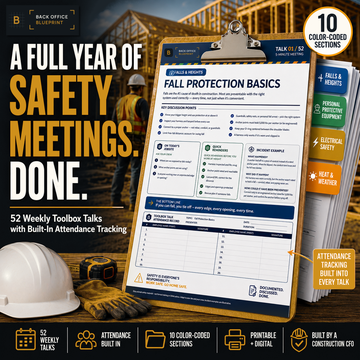
The 52 Weekly Construction Toolbox Talks pack gives you the whole year already written, each with the sign-in sheet on the page, ready to print, so the only thing left to do is hold it.
See the Toolbox Talks system →
I'm a working construction CFO and the founder of Back Office Blueprint, where I build the estimating, job costing, and compliance systems I wished every builder and trade contractor had from day one.
Keep reading
Onboarding isn’t paperwork — it’s retention and liability — safety orientation belongs on day one, not week one.
Subcontractor COI tracking: collecting it once isn’t enough — the subs standing in your talk need to be covered too.
The field paper trail: two documents that protect every job — the same habit, applied to the rest of the jobsite record.
A talk you can’t prove you held did not happen. The OSHA-Ready Contractor Safety Binder is where the signed sign-in sheets end up.