


Every job has a moment where it's basically finished. The big work is done, the crew's mentally on the next project, and all that's left is a short list of small stuff. That short list is where jobs go to die slowly.
The punch list is the last 5% of the work — and it sits directly on top of 100% of your final payment. Your retainage doesn't release, the client doesn't sign off, and your reputation doesn't get locked in until that list hits zero. I'm a working construction CFO, and the punch list is one of the few places where a finished, profitable job can quietly bleed margin and goodwill in the final stretch. Here's why it's so dangerous, and how to close it out fast.
What a punch list actually is
A punch list is the document of every incomplete or defective item that has to be finished or corrected before a project reaches final completion and final payment is released. The contractor creates it — not the architect, not the owner. It's your list of what's between you and getting paid in full. It sounds small because the items are small: a paint touch-up here, a missing outlet cover there, a door that sticks. But "small" and "cheap to ignore" are not the same thing. Every open item is a reason for someone to hold your money.
Why the last 5% costs the most
The final stretch is uniquely expensive for reasons that have nothing to do with the work itself. Your best crew has already rolled onto the next job, so the punch items get whoever's left. The items are scattered across rooms and trades, so nobody clearly owns them. And the whole time the list stays open, your retainage — typically five to ten percent of the entire contract — sits in the owner's account, not yours. A job can be 100% built and still have a meaningful chunk of its profit locked up because of a list of fifteen-minute fixes nobody's tracking. That's the trap: the cheapest work on the job is guarding the most expensive money on the job.
Substantial completion is a money event
Here's the part contractors underestimate. Substantial completion — the point where the building can be used for its intended purpose, even with minor items left — isn't a paperwork milestone. It's a financial one. When you hit it, the clock flips: retainage usually steps down (often from 10% to 5%) and starts heading toward release, warranty periods begin, the owner takes over insurance and maintenance, and lien and other legal deadlines start counting down. A clean, closed-out punch list is what gets you to substantial completion quickly instead of letting it drag for weeks. Every day you shave off that list is a day closer to your money.
If you want to see what that step-down is actually worth in dollars on your job, run the numbers through the free retainage calculator — it shows how much is being held at each stage and what releases when.
The pre-walk that saves the close-out
The single highest-leverage move at close-out costs you nothing: walk the job yourself before the client or architect does.
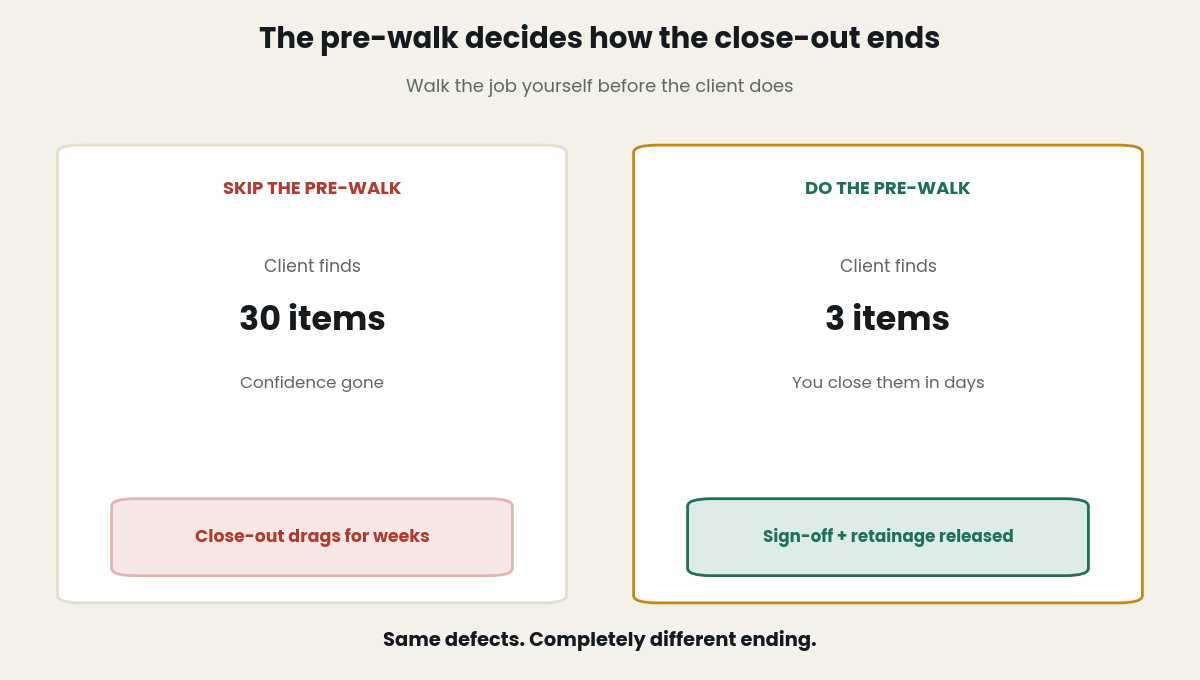
When you skip your own walk, the client's walkthrough turns into a scavenger hunt. They find thirty things — half of them stuff your crew would've caught in five minutes — and now they've lost confidence in the whole job, even the parts that are perfect. When you do a tight pre-walk and fix the obvious misses first, the client finds three things, you close them in days, and they walk away impressed. Same job, same defects — completely different ending, and completely different odds of a referral.
A punch list dies on a napkin
Here's where it actually breaks: the tracking. A punch list scribbled on a clipboard, buried in a text thread, or carried around in someone's head will fail you every time. Items slip. The same defect gets "fixed" twice while another gets missed. The client re-finds something you thought was closed, and now you look disorganized at the exact moment you need them to trust you.
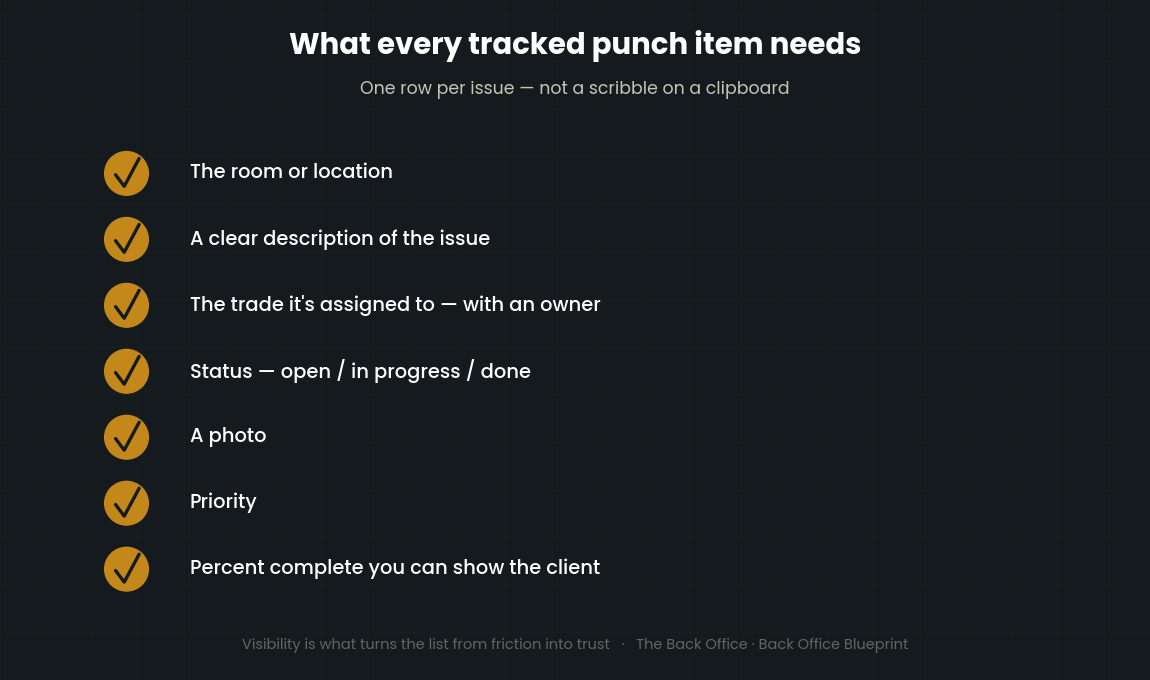
A punch list that actually closes out has structure: one row per issue, the room or location, a clear description, the trade it's assigned to, a status you can see at a glance, a photo, and a percent-complete you can show the client. That last part matters more than it sounds — when a client can see the list going from 60% to 90% to done, they stop nagging and start trusting. Visibility is what turns a punch list from a source of friction into proof that you've got it handled.
Close out faster, get paid sooner
You can run your punch list on a notepad. Most contractors do — and most contractors also spend the last few weeks of every job chasing items they can't quite remember, fielding "is this done yet?" texts, and waiting on retainage. That's exactly what I built the Punch List Tracker to fix — a single workbook with a close-out dashboard, color-coded status tracking, one row per issue, and a trades-and-contacts tab so every item has an owner and a deadline. Track the issues, assign the trades, watch the list hit zero — and get to your retainage faster. It's the difference between a close-out that drags and one that's done
 .
I'm a working construction CFO and the founder of Back Office Blueprint, where I build the estimating, job costing, and compliance systems I wished every builder and trade contractor had from day one.
Keep reading
The field paper trail: two documents that protect every job — the records that keep punch items from becoming disputes.
You’re not short on profit — you’re short on collections — what the open punch list is really costing you.
The construction change order log — the other thing standing between finished work and final payment.
Closeout starts in the field. The Field Ops Kit keeps the daily log and inspection dates straight on the way there.