

A sub's laborer steps off a ladder wrong on your job. His lawyer sues the sub, and he sues you, because it was your site. You pull the sub's certificate out of the file. Your company's name is right there in the box at the bottom left.
That box is worth $0 in coverage. It says you received a copy of the paperwork. It doesn't say the sub's insurance company owes you anything, and when you call, they'll tell you so.
Whether you're the certificate holder or an additional insured decides who pays that claim: the sub's policy, or yours.
The short answer
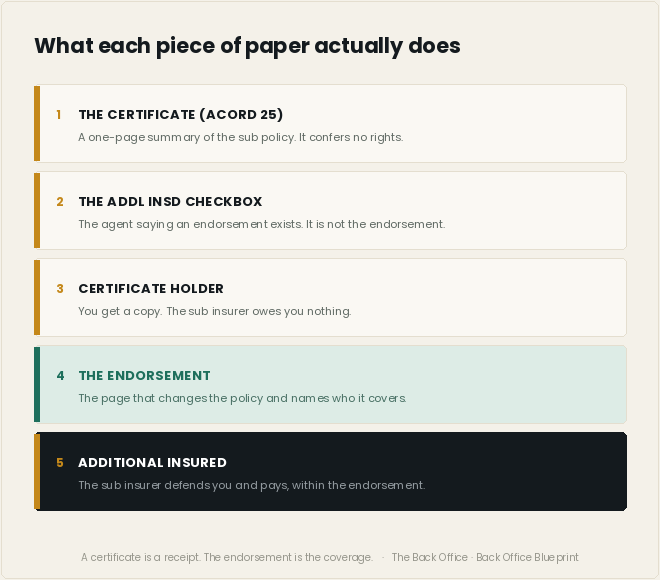
A certificate holder is the person who gets a copy of the certificate. That's all. The certificate is a one-page summary of someone else's policy, and holding one gives you no rights under that policy.
An additional insured is a person or company the policy itself covers, through a written change to the policy called an endorsement. If you're an additional insured on your sub's general liability policy, their insurer has to defend you and pay for claims that come out of their work, up to the limits and terms of that endorsement.
One is a receipt. The other is coverage. Most GCs and remodelers have a file full of the first and assume they have the second.
What the certificate says about itself
You don't have to take my word for this. The standard form, the ACORD 25 certificate of liability insurance, says it in capital letters at the top: it is issued "as a matter of information only and confers no rights upon the certificate holder." The same box says it doesn't amend, extend or alter the coverage in the policies it lists.
Then, one line down, it tells you exactly what to do instead: if the certificate holder is supposed to be an additional insured, "the policy(ies) must have ADDITIONAL INSURED provisions or be endorsed."
That's the trap in one sentence. There's a column on the form headed ADDL INSD, and your sub's agent can put an X in it. The X is not the endorsement. It's the agent telling you an endorsement exists somewhere. The Texas Department of Insurance puts it plainly: a certificate can't name you as an additional insured unless the policy endorsement actually does.
The endorsement is the coverage, and there are two of them
On most contractor general liability policies, additional insured status comes from standard forms written by ISO, the organization that drafts much of the standard policy language carriers use. Two of them matter on almost every job:
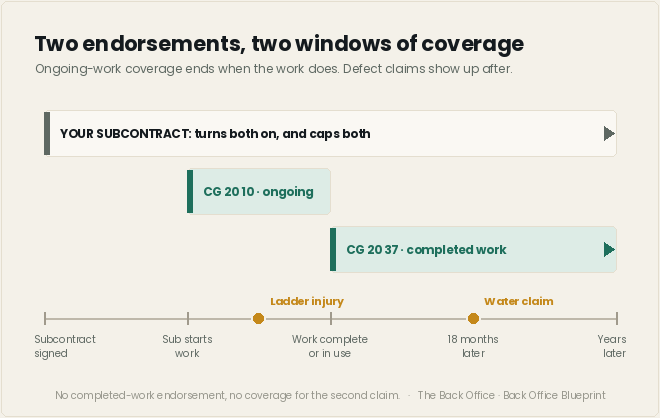
Ongoing work: CG 20 10. Covers you for claims caused by the sub's work while they're doing it. Read section B of the form: coverage stops once the work is complete, or once the part of the project it applies to is put to its intended use.
Completed work: CG 20 37. Covers you for claims that come out of the sub's finished work, after they've packed up and left.
Here's why that split costs builders money. The ladder claim happens during the job. The water claim from a bad flashing detail shows up 18 months after closeout. If you only got the ongoing-work endorsement, you were covered for the first and you're on your own for the second, and defect claims are the second kind.
Carriers often use their own blanket versions instead of the ISO forms by name. That's fine. What matters is whether the endorsement covers ongoing and completed work, and whether it reaches you.
Your subcontract is what turns it on
This is the part almost nobody tells a small GC. The 2013 edition of CG 20 10 says the coverage "will not be broader than that which you are required by the contract or agreement to provide." CG 20 37 ties its limits to the contract too: the insurer pays the lesser of what the contract requires or the policy limit.
So if your subcontract doesn't require additional insured coverage, or requires ongoing work and says nothing about completed work, that's roughly what you get. The insurance clause in your subcontract is the trigger. The endorsement only pays what the contract asked for.
Blanket endorsements, the kind that cover "anyone you're required by written contract to add," have a second catch. Most want a written contract signed before the loss. Courts have gone both ways on unsigned or oral agreements, but they've been strict about timing: an agreement signed after the injury generally doesn't count. A subcontract you meant to get signed is a subcontract that may not exist when you need it.
Two more lines that decide who pays
Primary and noncontributory. When you're an additional insured, this wording decides whose policy pays first. Primary means the sub's policy goes first. Noncontributory means it won't turn around and ask your policy to split the bill. ISO's version, CG 20 01, only kicks in when a written contract requires it and you have your own policy.
Waiver of subrogation. After an insurer pays a claim, it can go after whoever caused the loss to get its money back. A waiver means the sub's insurer agrees not to come after you. On workers comp it's its own endorsement, WC 00 03 13, and it can carry a charge: Tennessee's insurance department notes that in its assigned-risk market, carriers charge 5% of the premium for the covered work, with a $250 minimum per waiver.
That second point matters when a sub pushes back. The endorsements you're asking for can cost them real money. That's a reason to put the requirements in the bid package up front, not a reason to skip them.
Why "just put it on the certificate" doesn't work
When a sub's agent sends a certificate without the endorsement, the easy fix seems to be asking them to type the right words onto it. In some states that's not just useless, it's against the law.
Texas: an insurer or agent "may not issue a certificate of insurance if the certificate alters, amends, or extends the coverage" of the policy it lists (Insurance Code §1811.051, in effect since September 2011).
New York: Insurance Law §502 says certificates can't alter or extend coverage or confer rights beyond the policy, and a person can't require certificate wording the policy doesn't include.
In both states, and everywhere else in practice, the answer is the same. Don't ask for better words on the certificate. Ask for the endorsement.
The sub insurance packet
This is what to collect from every sub before they start, and it's six pieces of paper, not one.
- The certificate (ACORD 25), current dates, your company as certificate holder. It tells you what policies exist and when they end.
- The additional insured endorsement for ongoing work. CG 20 10 or the carrier's blanket equivalent. The actual pages, not the X in the box.
- The additional insured endorsement for completed work. CG 20 37 or equivalent. This is the one that answers the defect claim two years from now.
- The primary and noncontributory endorsement, if your subcontract requires it.
- Waiver of subrogation endorsements, general liability and workers comp, if your subcontract requires them.
- Your signed subcontract, with an insurance clause that names each of the above. Signed before they start, because the endorsement only pays what the contract required.
If your subcontract doesn't require items 2 through 5 today, fix the contract first. Everything else hangs on it.
What it costs when the paper's missing
Endorsements protect you from the big claim. The certificate itself protects you from the small, certain one, and that's usually the one builders meet first.
At your workers comp and general liability audits, a sub you can't produce a current certificate for can get treated as your own payroll and charged at your rates. Say you paid subs $180,000 this year and $40,000 of it went to two subs whose certificates lapsed mid-job. At a workers comp rate of $8 per $100 of payroll, that's $3,200 added to your bill, before general liability, months after the job closed.
That's a worked example, not your number. Run yours in the free checklist above. It takes four inputs.
What to do this week
Pull the certificate file for every sub on an active job. For each one, look for the endorsement pages, not the checkboxes. Where they're missing, email the sub's agent and ask for the additional insured endorsements for ongoing and completed work, plus whatever else your subcontract requires. Then set a reminder 30 days before each expiration date, because a perfect packet goes stale the day the policy renews.
None of this replaces a conversation with your own insurance agent, who can read your policy and your contracts together. It gets you to that conversation with the right questions and the right paper.

I'm a working construction CFO and the founder of Back Office Blueprint, where I build the job costing, cash flow, and compliance systems I wished every builder and trade contractor had from day one.
This is general guidance, not legal or insurance advice. Policy forms and state rules vary. Confirm the specifics with your insurance agent and your attorney.
Keep reading
- Subcontractor COI tracking: collecting it once isn't enough
- 1099 vs W-2: how to tell who's really a sub
- The Subcontractor Compliance System: COI, W-9 and 1099 tracking for small GCs