


Paying a guy on a 1099 feels like the smart, lean move. No payroll taxes, no workers' comp premium, no benefits — just a check and a form at year-end. That's exactly why so many contractors do it, and exactly why so many of them are sitting on a liability they don't see coming.
I'm a working construction CFO. I've watched misclassification turn a "we saved money on payroll" decision into a back-taxes-plus-penalties bill that dwarfed anything the company ever saved. So before you 1099 your next worker, understand how this is actually decided — because it isn't decided by you, and it isn't decided by what the worker agreed to.
(Quick disclaimer: I'm a CFO, not your attorney or CPA. This is how the rules generally work — run your specific situation past a professional before you act on it.)
You don't get to choose — the relationship decides
Here's the first thing to unlearn: writing "1099 contractor" on an agreement and having the worker sign it does not make them a contractor. Neither does the worker preferring it. The IRS and your state look past the paperwork and at the actual working relationship. If it walks like employment, it's employment — no matter what the contract says.
That's why "but he agreed to be 1099" is worth nothing in an audit. The classification is a fact about how you work together, not a box you both checked.
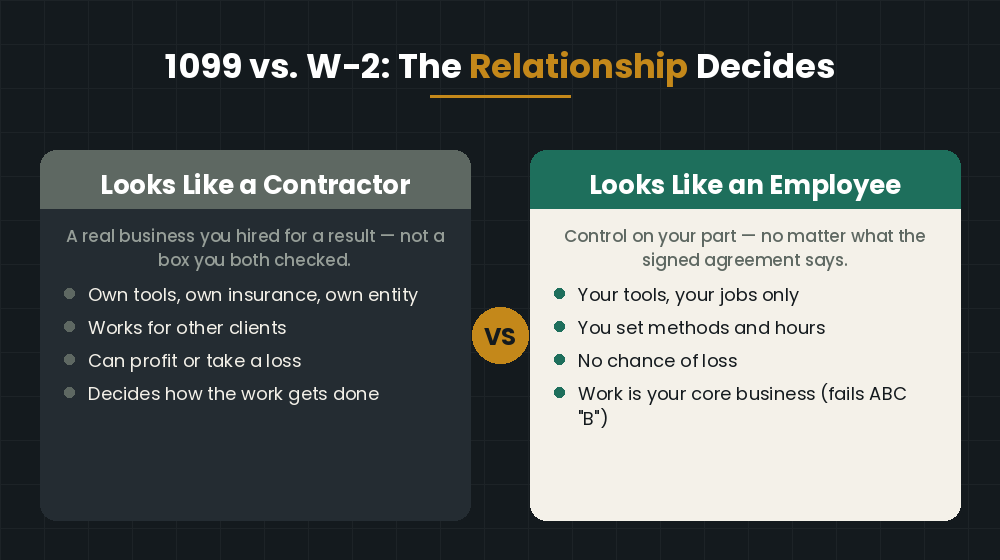
The IRS common-law test: three kinds of control
Federally, the IRS weighs three categories of control. The more control you have, the more that worker looks like a W-2 employee:
Behavioral control — do you direct how the work gets done? If you set the methods, provide the training, and tell them when to show up and what to do all day, that's an employee. A true contractor decides how to accomplish the result you hired them for.
Financial control — who's running a business here? Contractors invest in their own tools and equipment, can make a profit or take a loss, carry their own liability and workers' comp insurance, and work for other clients. A worker who uses only your tools, on only your jobs, with no chance of loss, is an employee.
Type of relationship — is this open-ended and ongoing, or a defined project? Providing benefits, an indefinite arrangement, and work that's part of your core business all point to employment. Run a worker through the free 1099 or W-2 test if you want to see where one of yours actually lands before you decide.
The state ABC test is where construction gets nailed
A number of states — California's AB5 being the most famous — use a stricter "ABC test" that presumes every worker is an employee unless you can prove all three of these:
(A) The worker is free from your control and direction.
(B) The work is outside your company's usual course of business.
(C) The worker is independently established in that trade.
Read (B) again, because it's the one that quietly destroys construction contractors. If you're a general contractor and you hire a framing crew, framing is squarely within your usual course of business — so factor B fails automatically, and no signed agreement can save it. In ABC-test states, a lot of the "subs" contractors pay on 1099 are employees the moment they pick up a hammer.
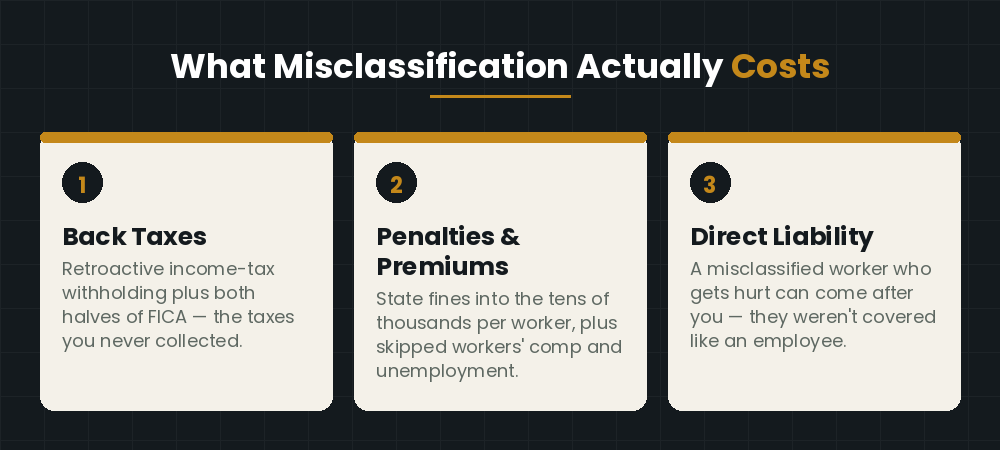
What misclassification actually costs
This is where it stops being paperwork and starts being money. Get it wrong and you're potentially on the hook for back income-tax withholding, both halves of FICA, and penalties on top — plus the retroactive workers' comp and unemployment premiums you skipped. State fines can run to the tens of thousands per worker. And a misclassified worker who gets hurt can come after you directly, because they weren't covered the way an employee would've been.
The cruel part is the timing: this bill never arrives when you're flush. It shows up in an audit, a workers' comp claim, or a disgruntled ex-worker's complaint — always at the worst possible moment, always with interest.
How to actually protect yourself
You don't fix this by guessing. You fix it by treating classification as a decision you document every time you bring someone on:
Run each worker against the tests honestly — control, financial independence, relationship — before you decide how to pay them. For anyone you legitimately classify as a sub, collect and keep the proof that they're running their own business: a real business entity, their own insurance certificates, their own tools, invoices that aren't just disguised timesheets. That documentation is what turns "trust me, he's a contractor" into a defensible position if anyone ever asks.
Classify carefully, paper it properly, and the lean 1099 move stays lean instead of turning into the most expensive shortcut you ever took.

Keep your subs defensible, not just cheaper. The Subcontractor Compliance System helps you collect and track the exact documentation — entity, insurance, agreements — that proves a 1099 worker is really a contractor, so classification stops being a gamble. → Get the Subcontractor Compliance System
I'm a working construction CFO and the founder of Back Office Blueprint, where I build the estimating, job costing, and compliance systems I wished every builder and trade contractor had from day one.
Keep reading
Subcontractor COI tracking: why collecting it once isn’t enough — the insurance side of the same file.
Onboarding isn’t paperwork — it’s retention and liability — what changes the day a 1099 becomes a W-2.
If the answer is W-2, the file gets bigger. The New Hire Onboarding System covers what has to be collected on day one.