








Written Safety Programs Pack — 7 OSHA Plans for Trades
Your GC asked for your written safety programs. You have a poster on the wall and a binder of blank forms.
Seven written programs you fill in with your company's information, built for a five-person crew and not a safety department.
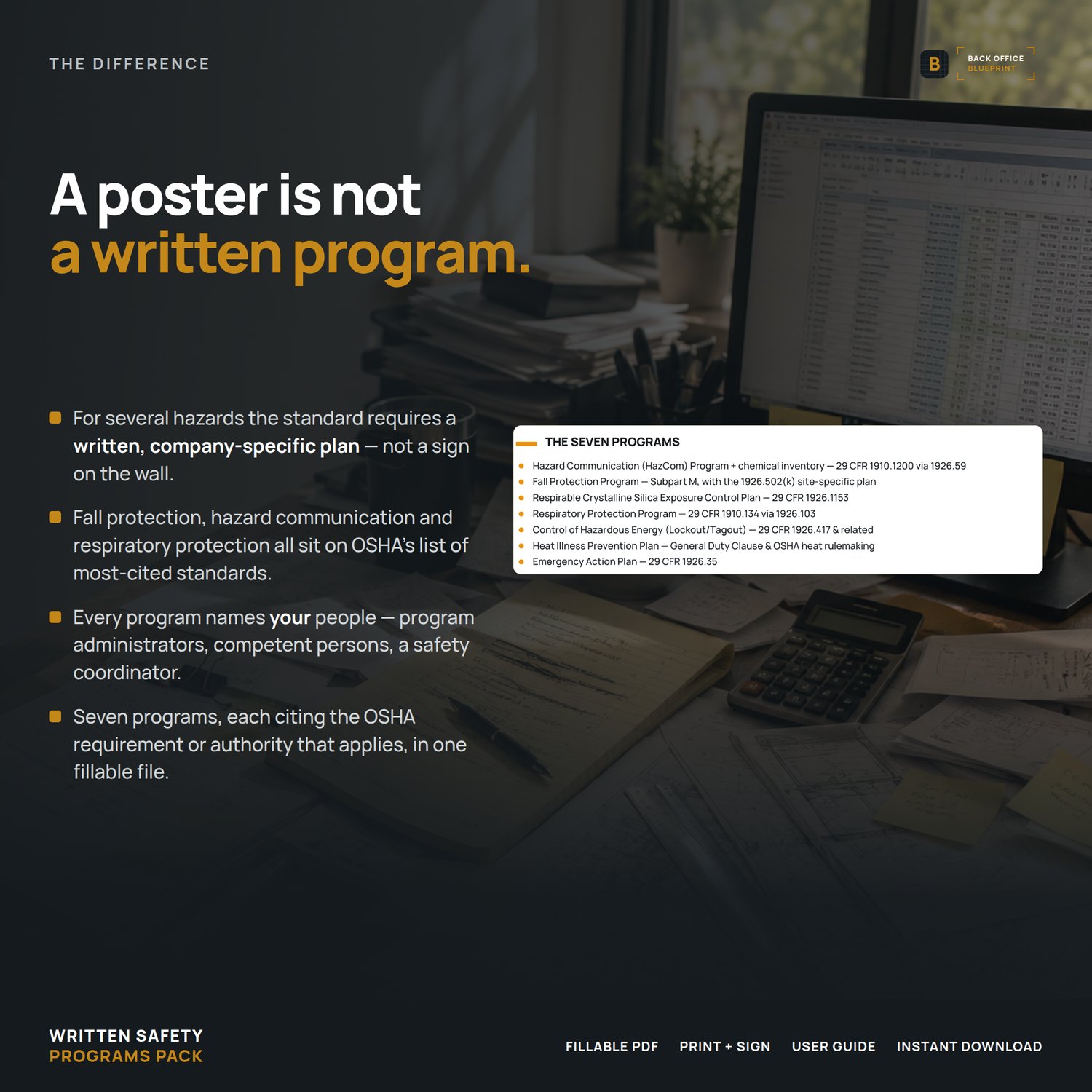
A jobsite poster is not a written program. For several hazards the standard asks for a written, company-specific plan: one that names your people and describes what your crews actually do. These are those plans, each citing the OSHA requirement or authority that applies.
Who it's for
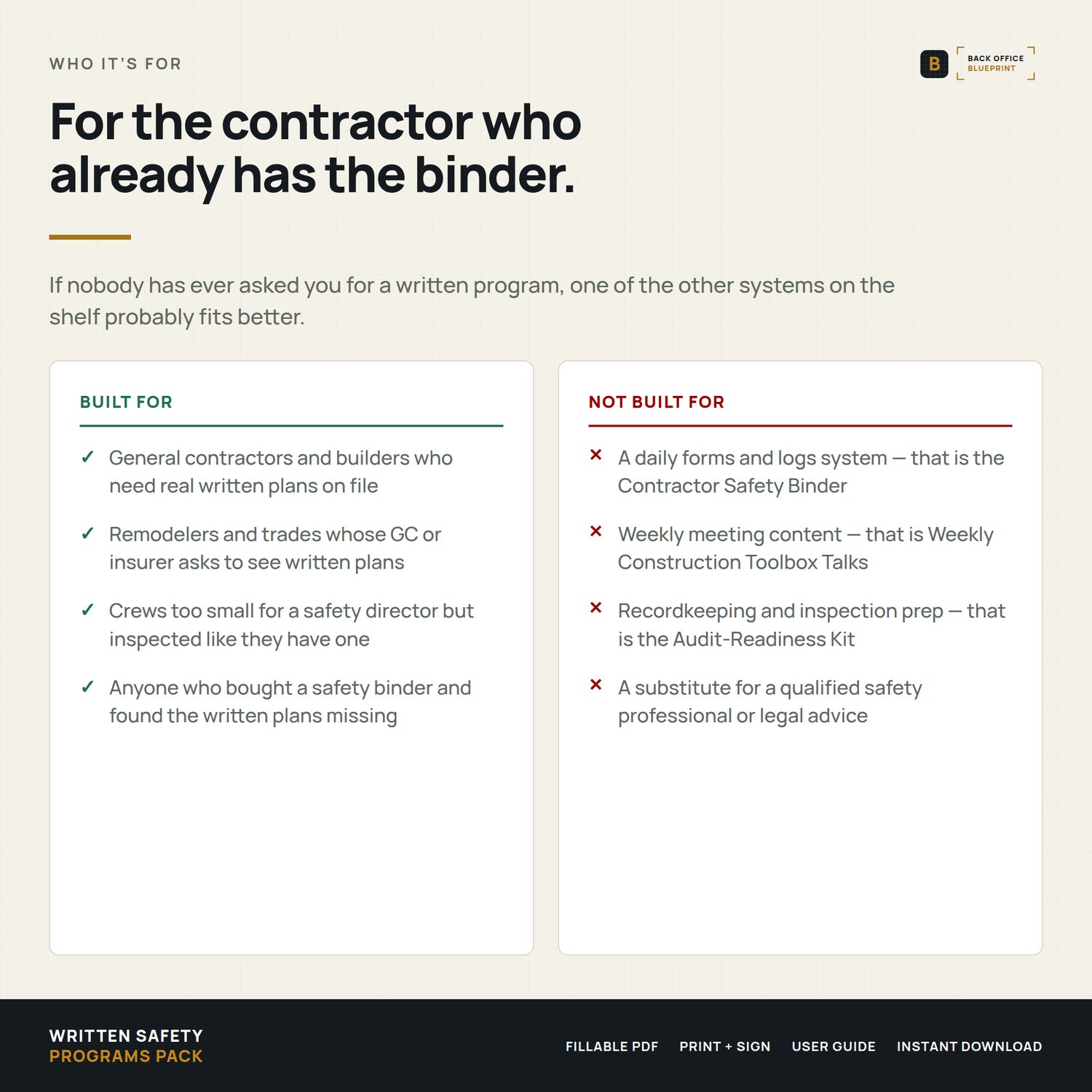
You run a crew of 3 to 25 and your GC or your insurance carrier has started asking for written programs.
Not for you if you already have a safety manager writing your programs.
What you get
Seven written programs in one fillable PDF:
- Hazard Communication (HazCom) — 29 CFR 1910.1200 via 1926.59. Container labeling, SDS access, training, and a fillable hazardous-chemical inventory. A written program and a chemical list are required wherever your crews work with hazardous chemicals.
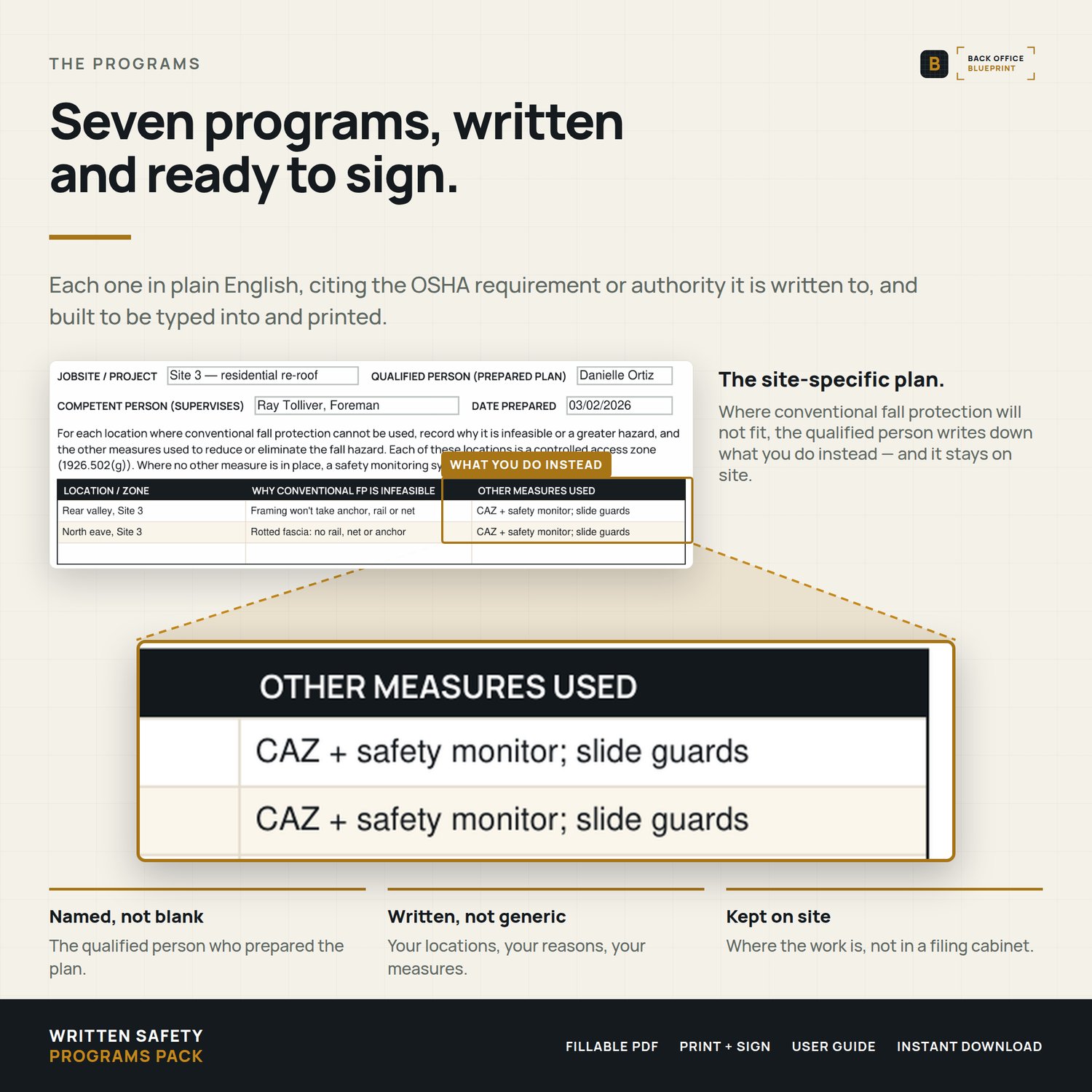
- Fall Protection — Subpart M, 29 CFR 1926.501–.503. Your 6-foot policy, the methods your company actually uses, inspection and rescue — plus the site-specific plan under 1926.502(k) for leading-edge, precast and residential work where conventional protection is infeasible.
- Respirable Crystalline Silica — 29 CFR 1926.1153. Tasks, engineering controls, Table 1, housekeeping, restricted access, and the competent person the standard requires you to name. Written plan required where the standard applies.
- Respiratory Protection — 29 CFR 1910.134 via 1926.103. Selection, medical evaluation, fit testing, maintenance and recordkeeping. Required once respirators are necessary for the work.
- Control of Hazardous Energy (Lockout/Tagout) — 29 CFR 1926.417 and related. Construction has no single lockout standard — the duties sit across the electrical, concrete-equipment and conveyor rules. This program gives you the step-by-step energy-control procedure and a fillable equipment-specific control list.
- Heat Illness Prevention — General Duty Clause and OSHA heat rulemaking. Acclimatization, water, rest and shade, monitoring and response. There is no federal heat standard yet — heat is cited under the General Duty Clause, OSHA runs a National Emphasis Program on it, and several states run their own enforceable heat rules.
- Emergency Action Plan — 29 CFR 1926.35. Emergency contacts, escape routes and who uses which, evacuation, assembly and headcount. Required where another standard calls for one; if you have ten or fewer employees you may communicate it orally.
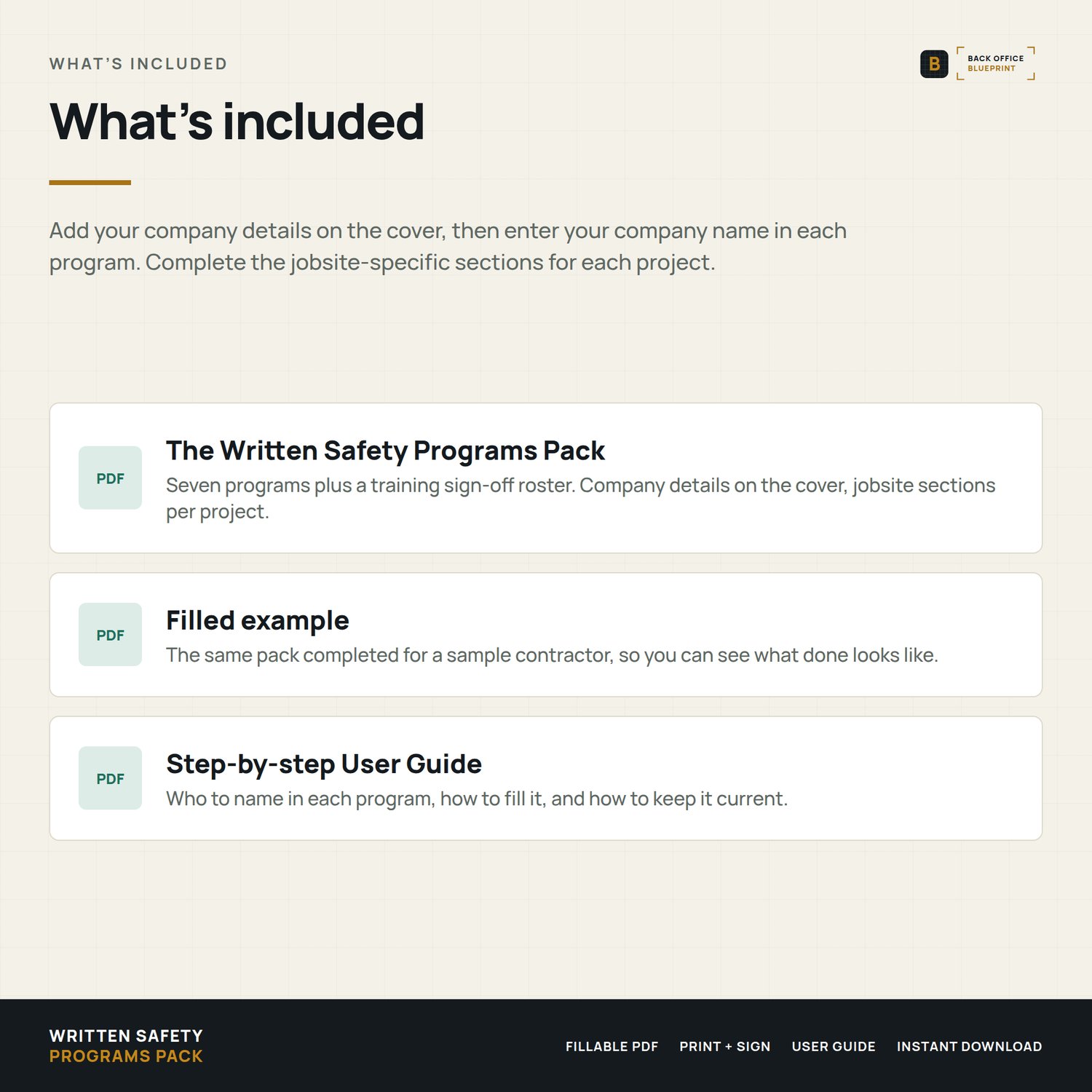
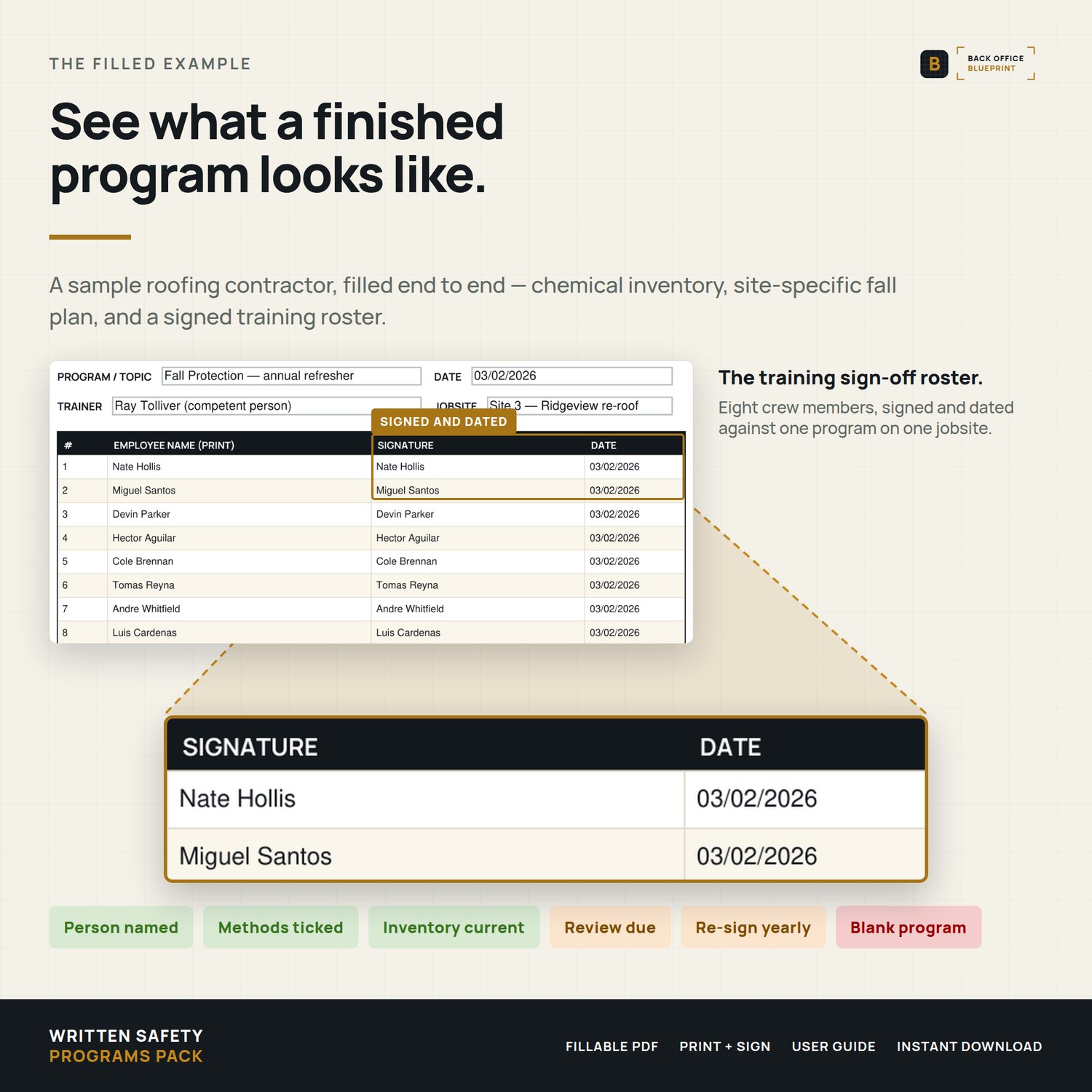
Plus a training sign-off roster you can photocopy for any program — the signed, dated proof that the training actually happened.
Why seven, and why written? For several construction hazards, the standard does not ask whether you have a poster or a toolbox talk — it asks for a written, company-specific plan naming your people and describing your actual work. Fall protection, hazard communication and respiratory protection all sit on OSHA's list of most-cited standards.
Also included
- A filled example — the whole pack completed for a sample roofing contractor, so you can see what "done" looks like before you start.
- A step-by-step user guide — who to name in each program, how to fill it, and how to keep it current.
How it works
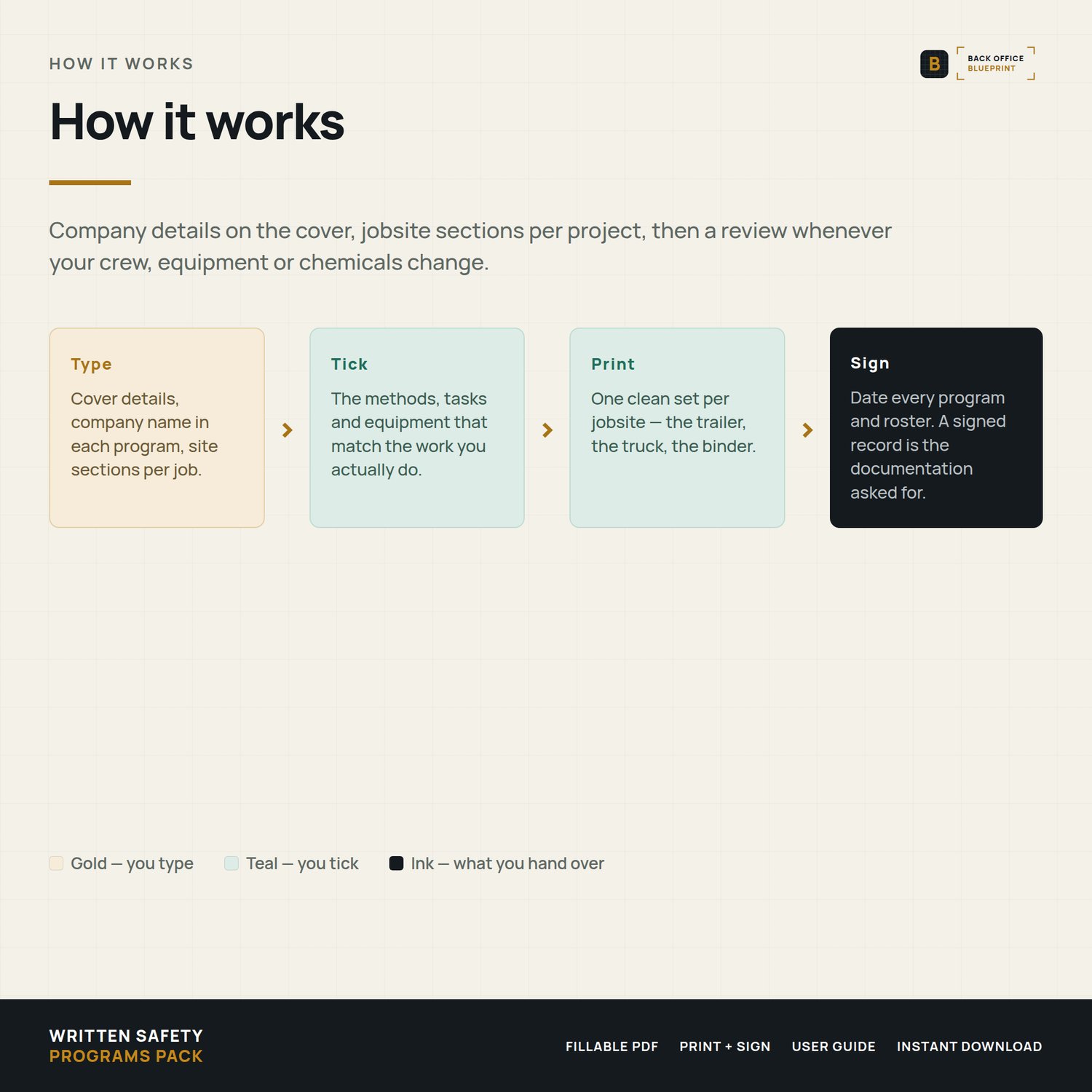
- Type your company details, competent persons, and the people each standard names
- Tick the methods, tasks and equipment that match the work you actually do
- Print one clean set per jobsite — the trailer, the truck, the binder
- Sign and date every program and roster
Add your company details on the cover, then enter your company name in each program. Complete the jobsite-specific sections for each project: the fall protection plan and the emergency action plan carry site details. Then review whenever your crew, equipment or chemicals change.
Honest about what this is
These are professionally drafted templates, not legal advice, and they do not replace a qualified safety professional.
Not every program here is required in writing for every contractor. HazCom is required wherever your crews work with hazardous chemicals, and the silica plan wherever the silica standard applies; the others apply when the work, equipment or chemicals are present. Page 2 of the pack tells you which is which. Requirements also vary by trade and state, and many states run their own OSHA plan with stricter rules — California, Oregon, Washington, Nevada, Maryland and Minnesota all have their own heat rules, and California additionally requires a written Injury and Illness Prevention Program that no federal standard matches. Review each program against your operations and your state plan.
Instant download
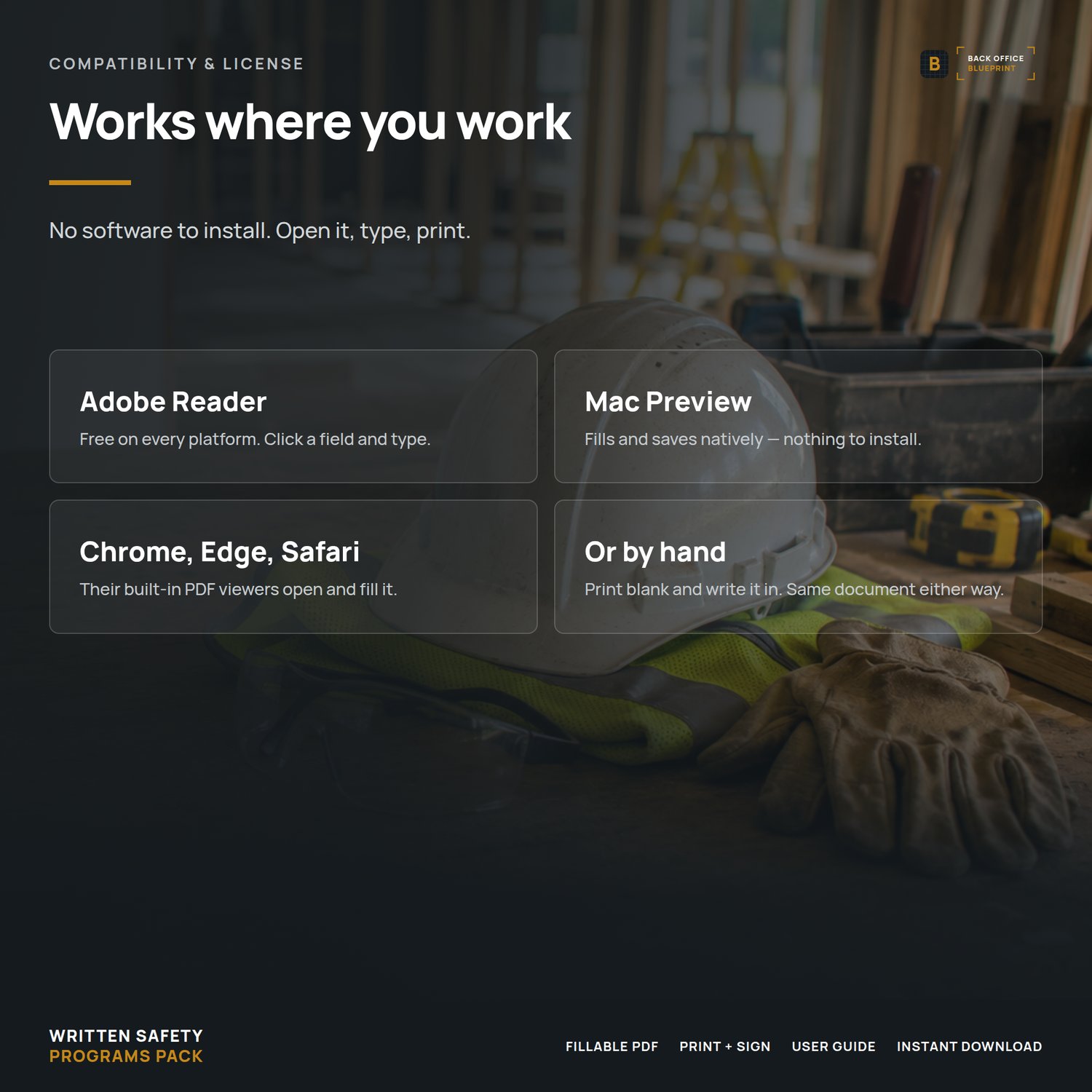
Fillable PDF — works in free Adobe Reader and Mac Preview, and opens in Chrome, Edge and Safari. No software to install, no subscription. Print blank and write it in by hand if you prefer; same document either way.
Built by a construction CFO who runs the back office for real contracting companies — not templates scraped together from a search. Questions before you buy? Email hello@getbackofficeblueprint.com and we answer personally.Want all three?
The written plans, the daily forms and the inspection-day system are also sold together as the OSHA Compliance Bundle, for less than buying the three separately.