

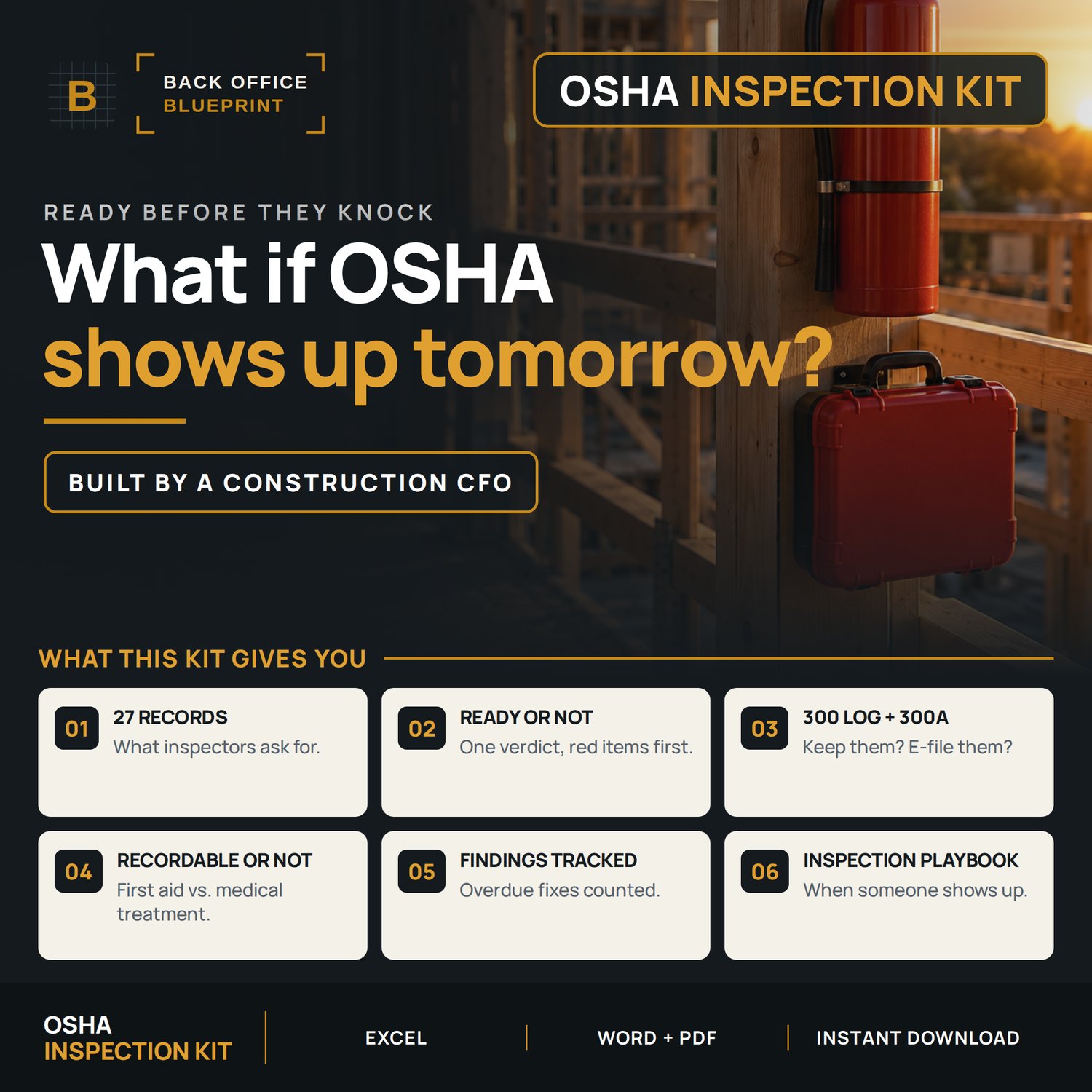





OSHA Inspection Readiness Kit — Self-Audit & 300 Log
Most contractors don't know whether they're even required to keep an OSHA 300 log. Ten or fewer employees and you probably aren't.
Type two numbers — your peak employee count and your NAICS code — and this workbook works out which records you actually owe, shows you what's missing, and tells you what to do the day somebody shows up.
Built for a five-person crew and not a safety department. Your records are spread across four binders and somebody's truck. That's normal. This is the system that pulls them into one place.
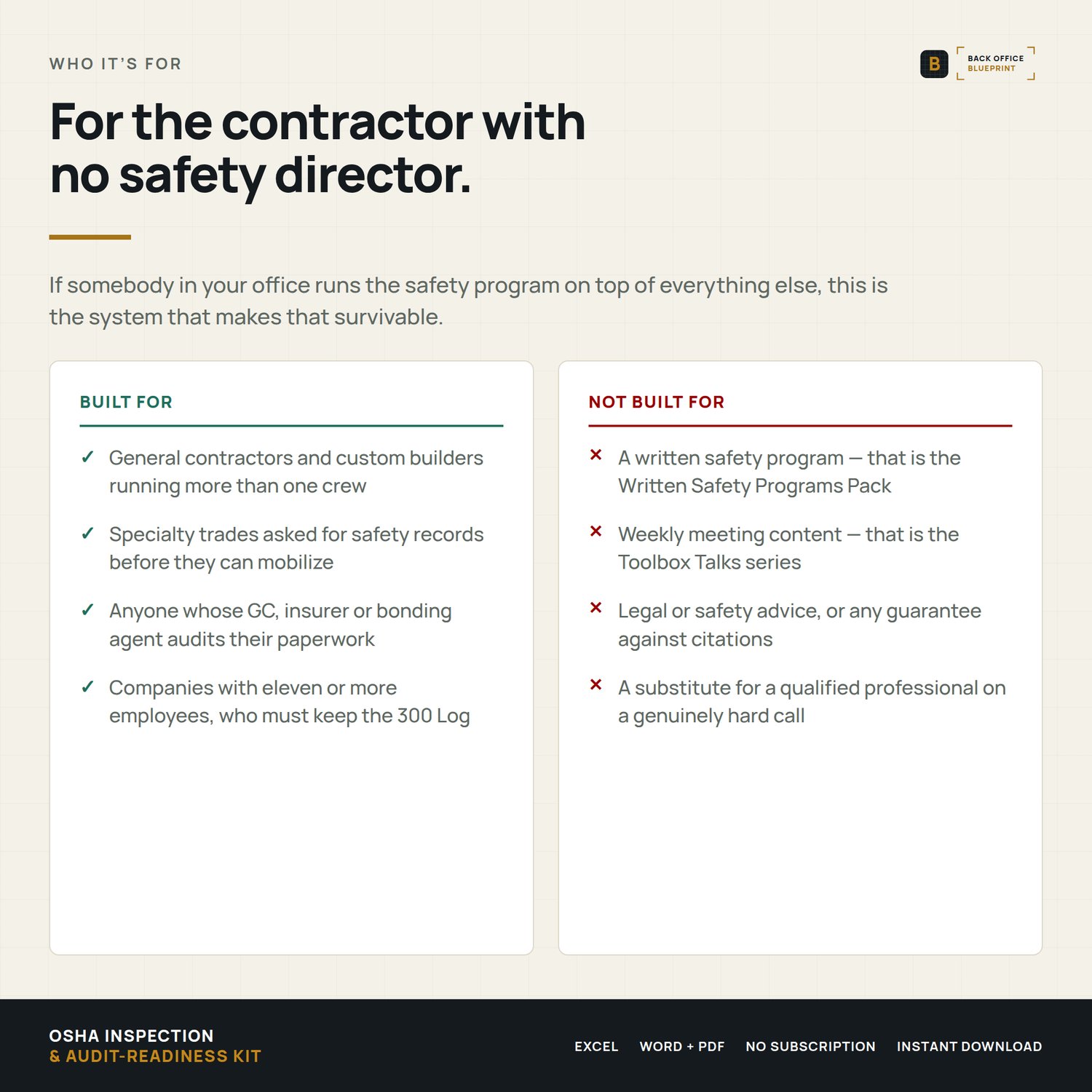
Who it's for
You run a crew of 3 to 25 and your GC, your carrier, or a bid packet has started asking what safety records you keep.
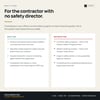
Not for you if you already have a safety manager running your recordkeeping — you'll find this too basic.
Built for construction. The obligations answers are for NAICS codes starting 23; any other code reads CHECK instead of an answer.
This is the system that answers that, and keeps the proof.
It starts by telling you what you actually have to do
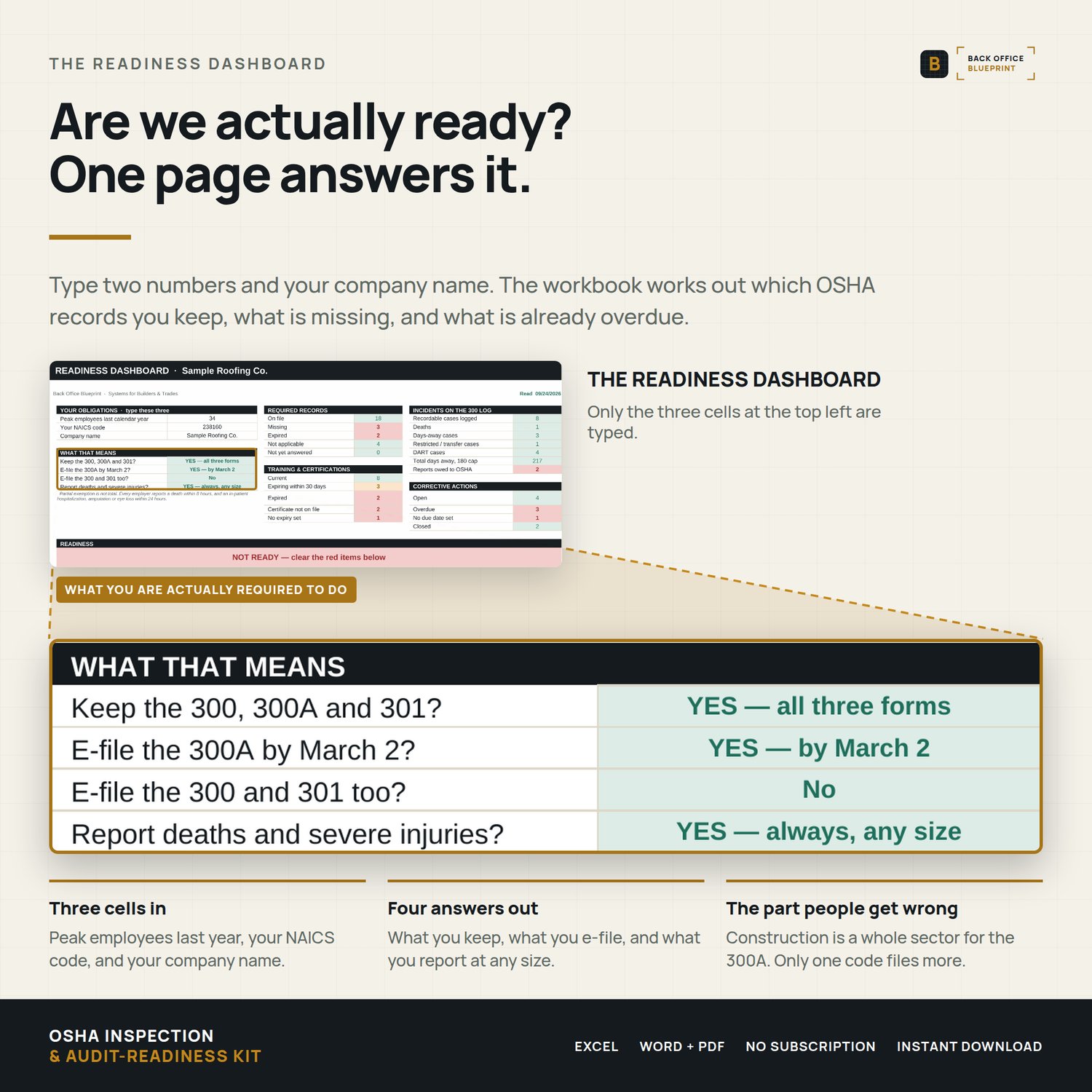
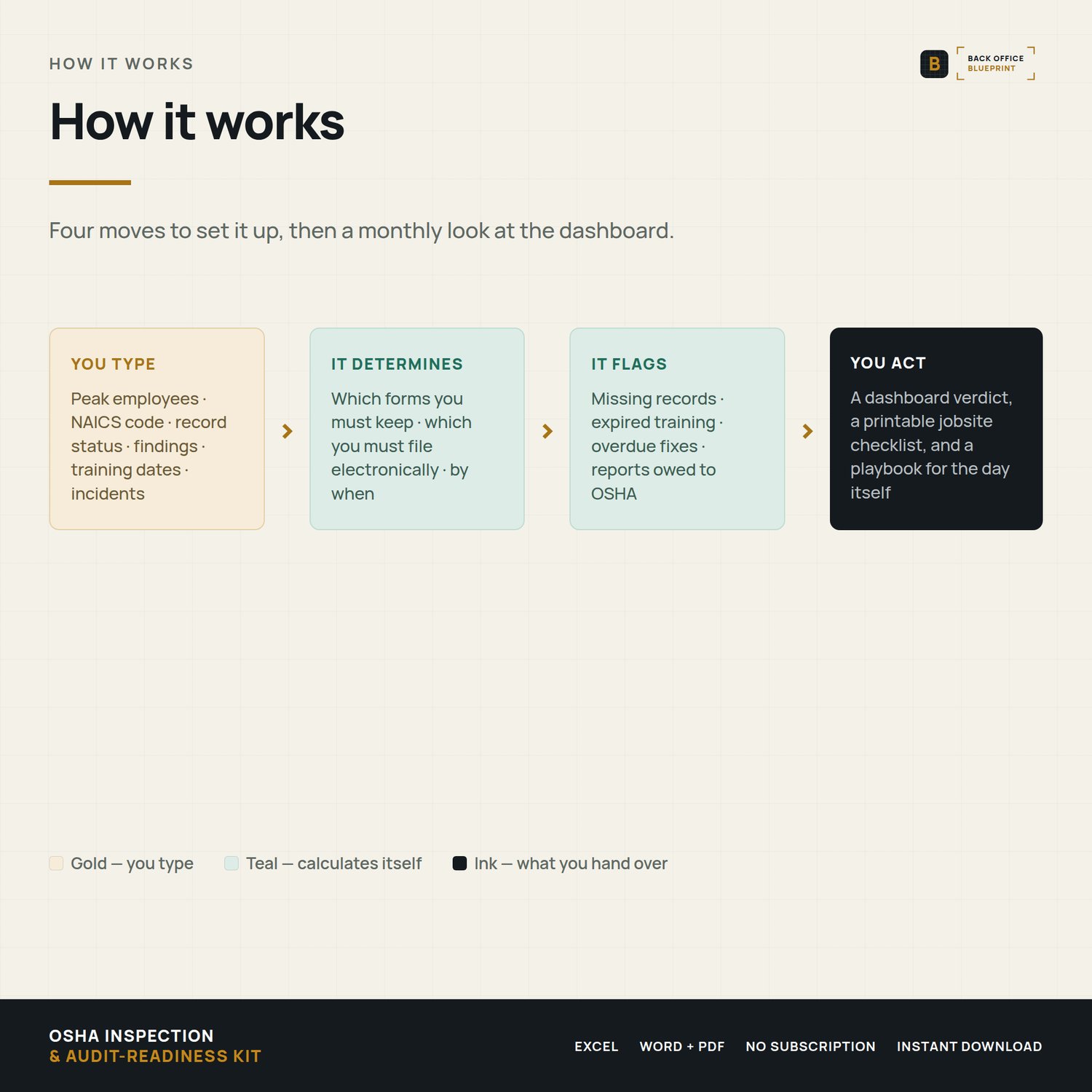
Type two numbers — your peak employee count for last year and your NAICS code — and the workbook works out your obligations:
- Whether you keep the 300, 300A and 301 at all. Ten or fewer employees and you are partially exempt. Partially, not entirely.
- Whether you file the 300A electronically by March 2. Construction is listed as a whole sector, so construction establishments with 20 to 249 employees file.
- Whether the 300 and 301 go too. Only one construction code is on that list. Most contractors who think they must file the full detail do not have to.
- What you report no matter what size you are. A death within 8 hours. An in-patient hospitalization, amputation or loss of an eye within 24.
It is the most misunderstood corner of construction recordkeeping, and it takes two cells to settle.
Then it shows you what is missing
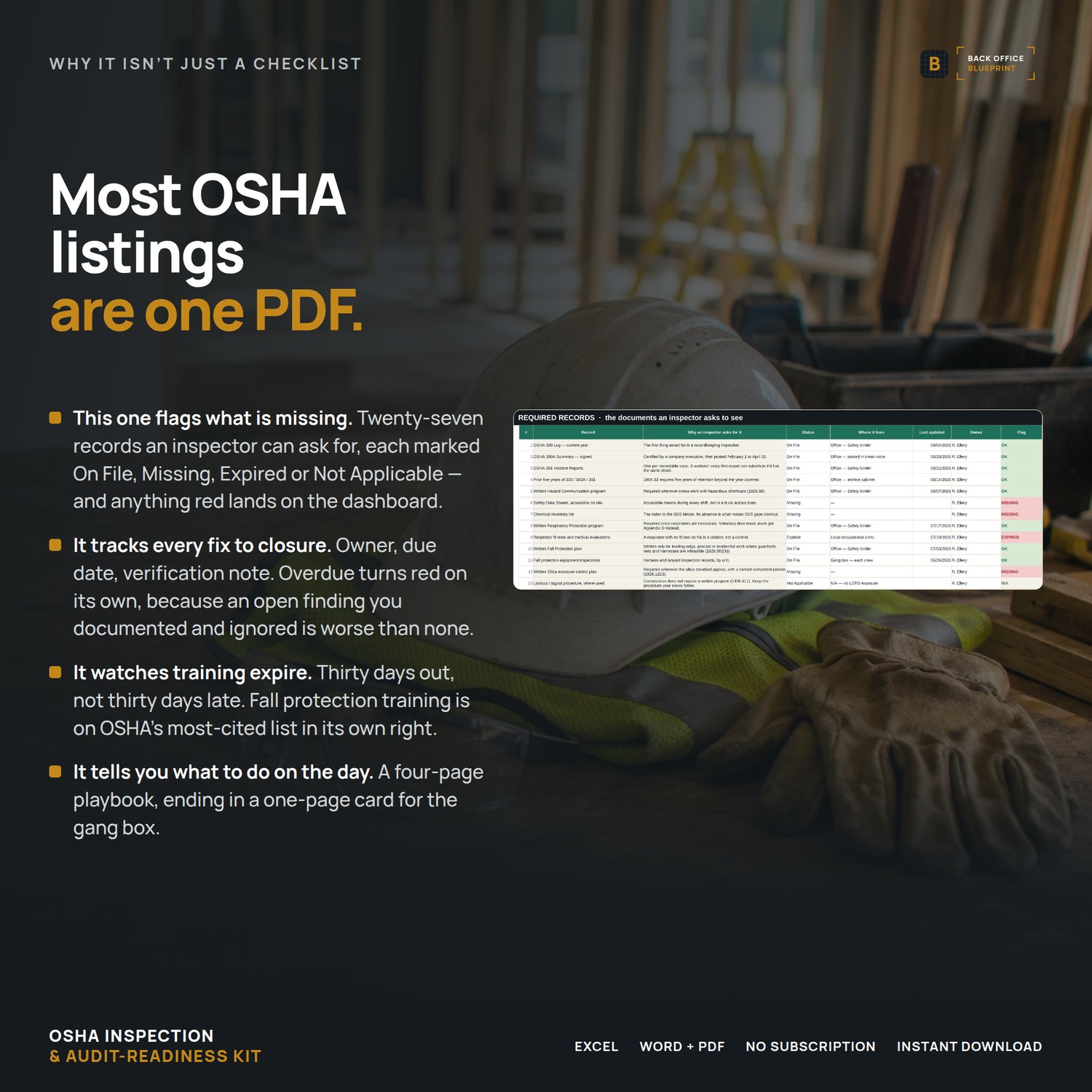
- 27 records, the documents an inspector asks to see, each marked On File, Missing, Expired or Not Applicable. Anything red lands on the dashboard.
- A jobsite self-audit checklist: twelve sections, fall protection first, because it has topped OSHA's most-cited list for more than a decade.
- Corrective actions tracked to closure — owner, due date, verification note. Overdue turns red on its own, because a finding you wrote down and ignored is worse than one you never made.
- Training that expires on a warning, not a surprise — flagged 30 days out. Fall protection training is on OSHA's most-cited list in its own right.
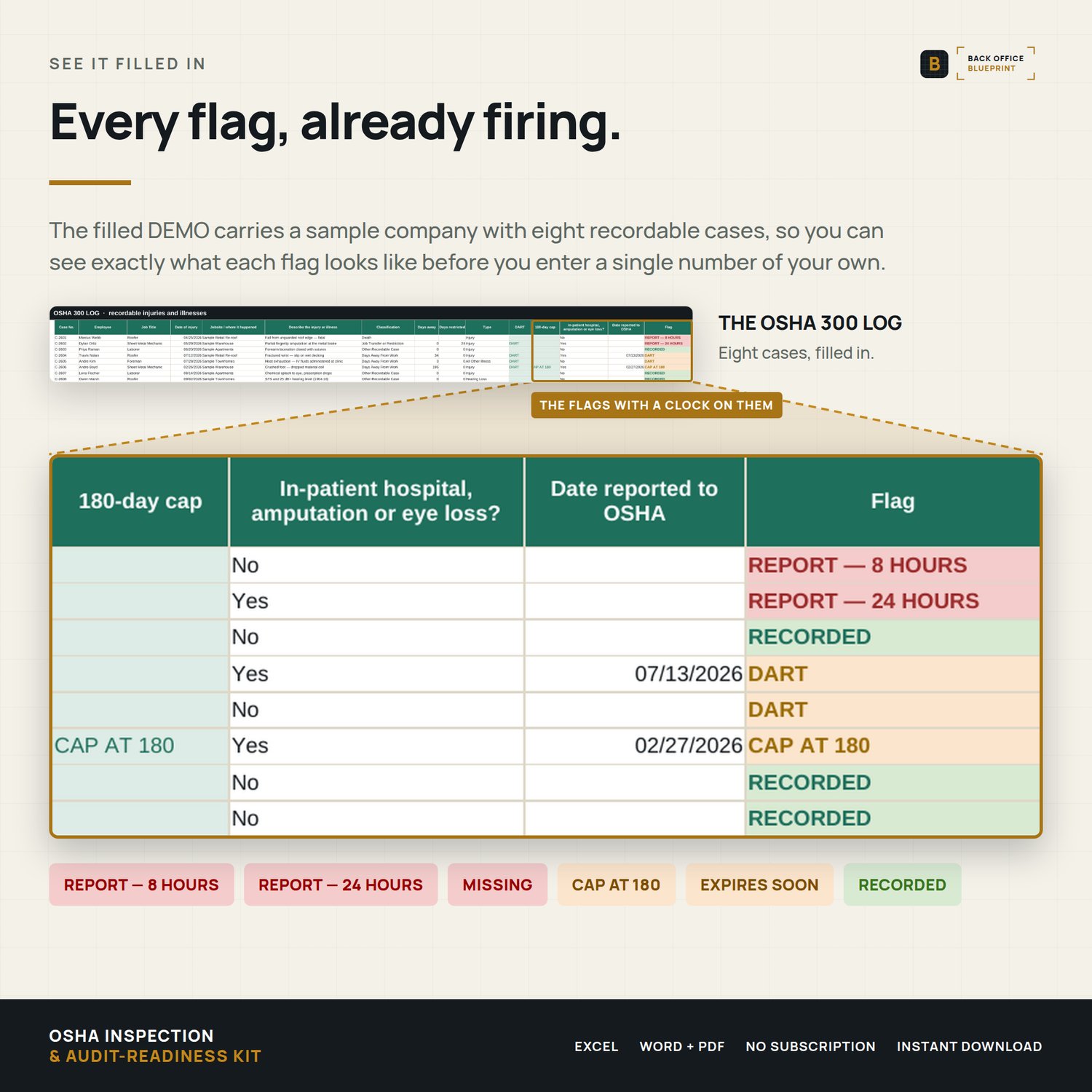
- A working 300 Log — flags DART cases, the 180-day counting cap, and any case with a reporting clock still running.
- A recordable-or-first-aid decision guide — OSHA's first aid list is exhaustive and published. If a work-related injury needs treatment that is not on it, the case is recordable. The whole list is in the workbook, along with the separate test for hearing loss.
And it tells you what to do on the day
The Inspection-Day Playbook is the part no checklist gives you. Four pages on what happens from the moment somebody arrives:
- The three decisions to make before anyone shows up, including who leads and what your consent position is
- The first ten minutes, in order — verify credentials, make the call, never leave them alone, ask why they are here
- The opening conference, and how to write down the scope so you can tell later if it moved
- The walkaround: shoot what they shoot, fix what you can fix on the spot, answer exactly what is asked and then stop
- What not to do — the list that costs contractors the most
- Employee interviews, and why coaching a crew member is a far more serious problem than whatever they might say
- After they leave: 15 working days to contest, from receiving the citation. An informal conference does not pause that clock.
It ends in a one-page card for the trailer, the gang box, and the truck.
What's inside
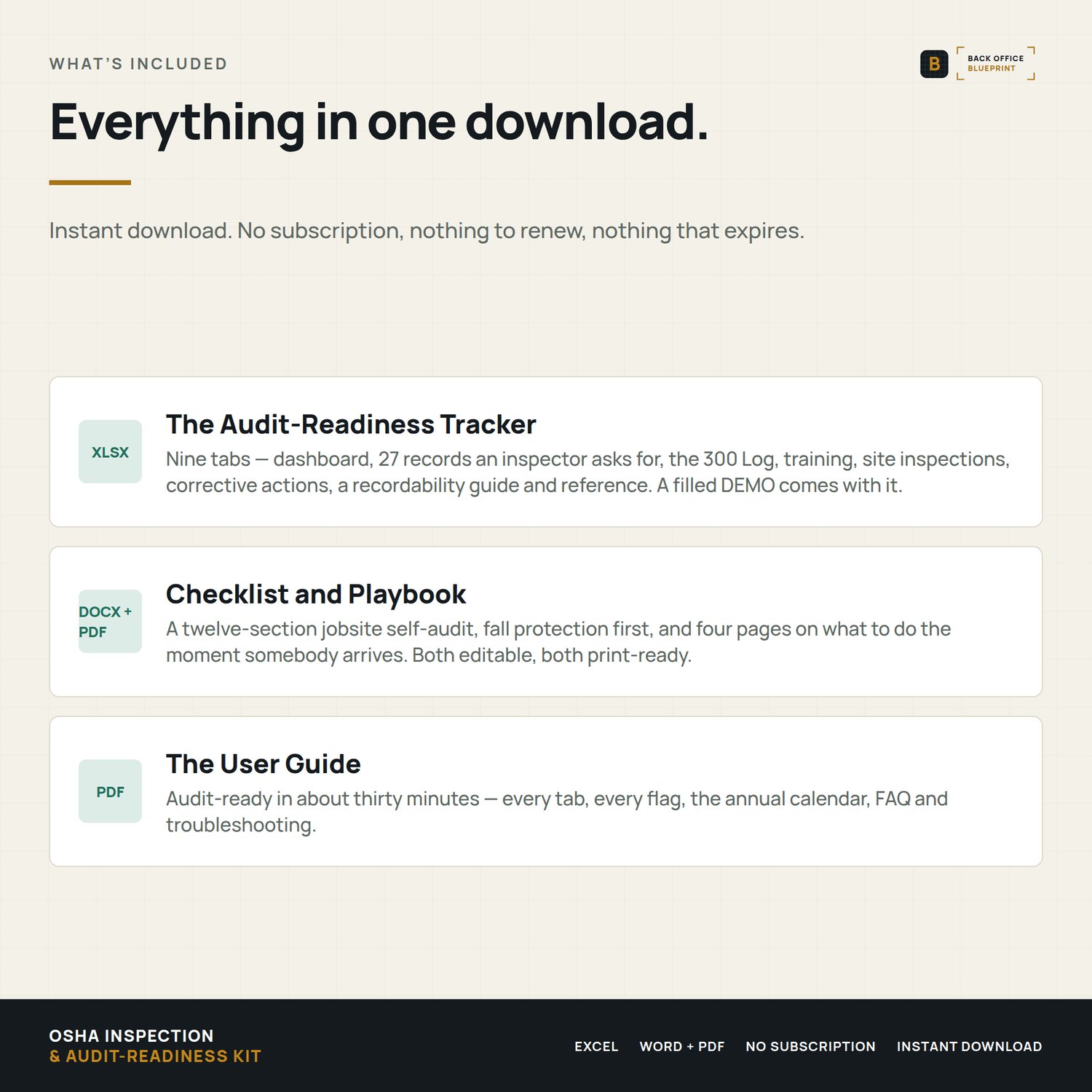
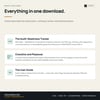
- The Audit-Readiness Tracker (Excel) — nine tabs: Readiness Dashboard, Required Records, OSHA 300 Log, Training & Certifications, Site Inspections, Corrective Actions, a Recordability Guide, a Reference tab and a Read Me.
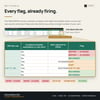
- A filled DEMO — a sample roofing contractor with eight recordable cases, fourteen training records and ten corrective actions, with every single flag firing somewhere, so you see what red means before it is about you.
- Jobsite Self-Audit Checklist (Word + PDF) — twelve sections, editable, print-ready.
- The Inspection-Day Playbook (Word + PDF) — four pages, the last one a card for the trailer and the gang box.
- The User Guide (PDF, 11 pages): audit-ready in about thirty minutes, with the yearly rhythm, FAQ and troubleshooting.
Why it's different
- It works out your obligations. Most OSHA downloads assume you already know what applies to you.
- It flags, it doesn't just list. Missing records, expiring training and overdue fixes surface on their own.
- It covers the day itself. Preparation is common. What to do at the gate is not.
- The recordability call is built in, with OSHA's exhaustive first aid list, rather than left to a search.
- No subscription. A one-time download — not another monthly platform.
- Built by a construction CFO who runs safety and compliance back-office for construction companies.
How it works
- Buy and download instantly.
- Open the DEMO first and spend five minutes on it.
- Enter your peak employee count, NAICS code and company name on the dashboard and read your obligations.
- Work the Required Records tab, walk one jobsite with the checklist, and give every finding an owner and a date.
- Read the Playbook once, now, while nothing is happening.
About thirty minutes to set up, then a monthly look at the dashboard.
Details
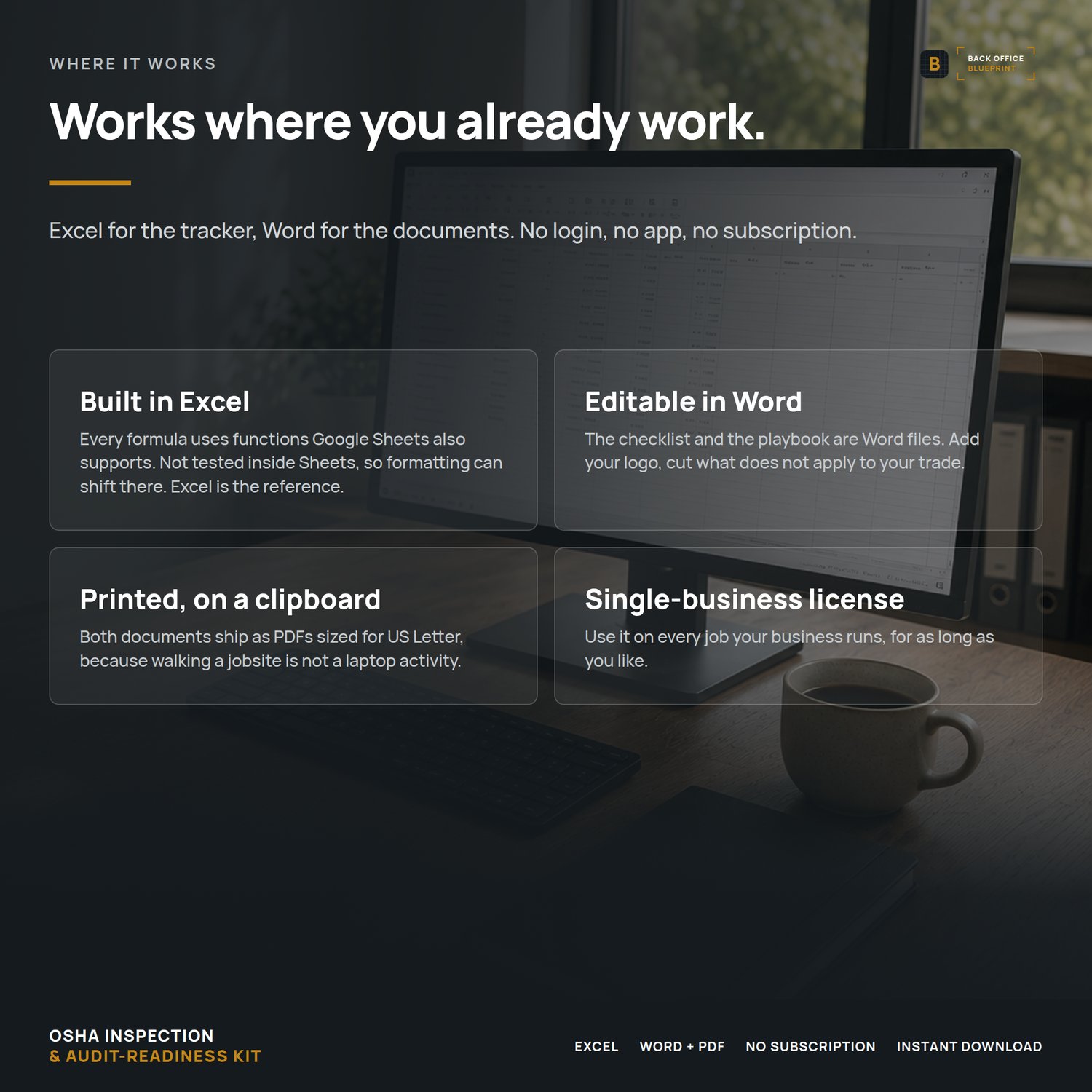
Format: Microsoft Excel (.xlsx) + editable Word documents + PDFs. Microsoft Excel is the reference version, and every formula uses functions Excel 2007 and later support. Google Sheets supports the same functions, but the tracker has not been tested inside Sheets, so formatting, dropdowns and print setup may differ there.
Capacity: 100 incident rows, 120 training rows, 120 inspections, 120 corrective actions, and the Dashboard counts the first 500 rows of every log if you extend one. Each log prints its first 30 entries; widen the print area for more.
License: Single-business commercial use. Use it on every job your business runs; modify freely for your own use. Don't redistribute, resell, or share with another business.
Delivery: Instant digital download. Nothing physical ships. All sales final on digital products.
Please note: This kit is a preparation and organization tool — not legal, safety or OSHA-compliance advice, and not a guarantee against citations, penalties or injuries. It does not make you compliant; what you do on the jobsite does that. OSHA requirements vary by industry and by state, and state-plan states such as California impose additional rules of their own. The 300, 300A and 301 forms are public-domain federal forms, free from osha.gov — the workbook mirrors them and adds the flags and roll-ups a spreadsheet can give you. Confirm what applies to you with OSHA and a qualified safety professional.
Questions before you buy? Email hello@getbackofficeblueprint.com, we respond personally.
Pair it with
The OSHA-Ready Contractor Safety Binder, for the daily forms and logs your crews fill in, and 52 Weekly Construction Safety Talks, for a safety meeting every week with the sign-in sheet already attached. This kit keeps the proof.
Want all three?
The OSHA Compliance Bundle is this kit, the Contractor Safety Binder and the Written Safety Programs Pack in one download, for less than buying the three separately.