
















Commercial Pay Application & Schedule of Values System
The work is done, the punch list is signed, and $600,000 of your money is still sitting in the owner's account.
Retainage is the largest receivable a commercial builder carries, and the reason it hasn't come back is almost never the work. It's an operations and maintenance manual on somebody's desk, or a consent of surety nobody requested.
This is the schedule of values, the monthly pay application, the stored materials paperwork and the retainage ledger in one file, built the way a commercial job actually bills.
Built for a builder running 1 to 12 commercial jobs, not for a company with a project accountant.
────────────────
Who it's for
You bid and build ground-up commercial, tenant improvement, medical, retail or light industrial work, you bill the owner monthly against a schedule of values, and the owner holds retainage.
Not for you if you take draws from a homeowner's construction loan — that's a different document, and I make a separate draw schedule system for it.
────────────────
What's in it
Ten tabs. You type in six of them.
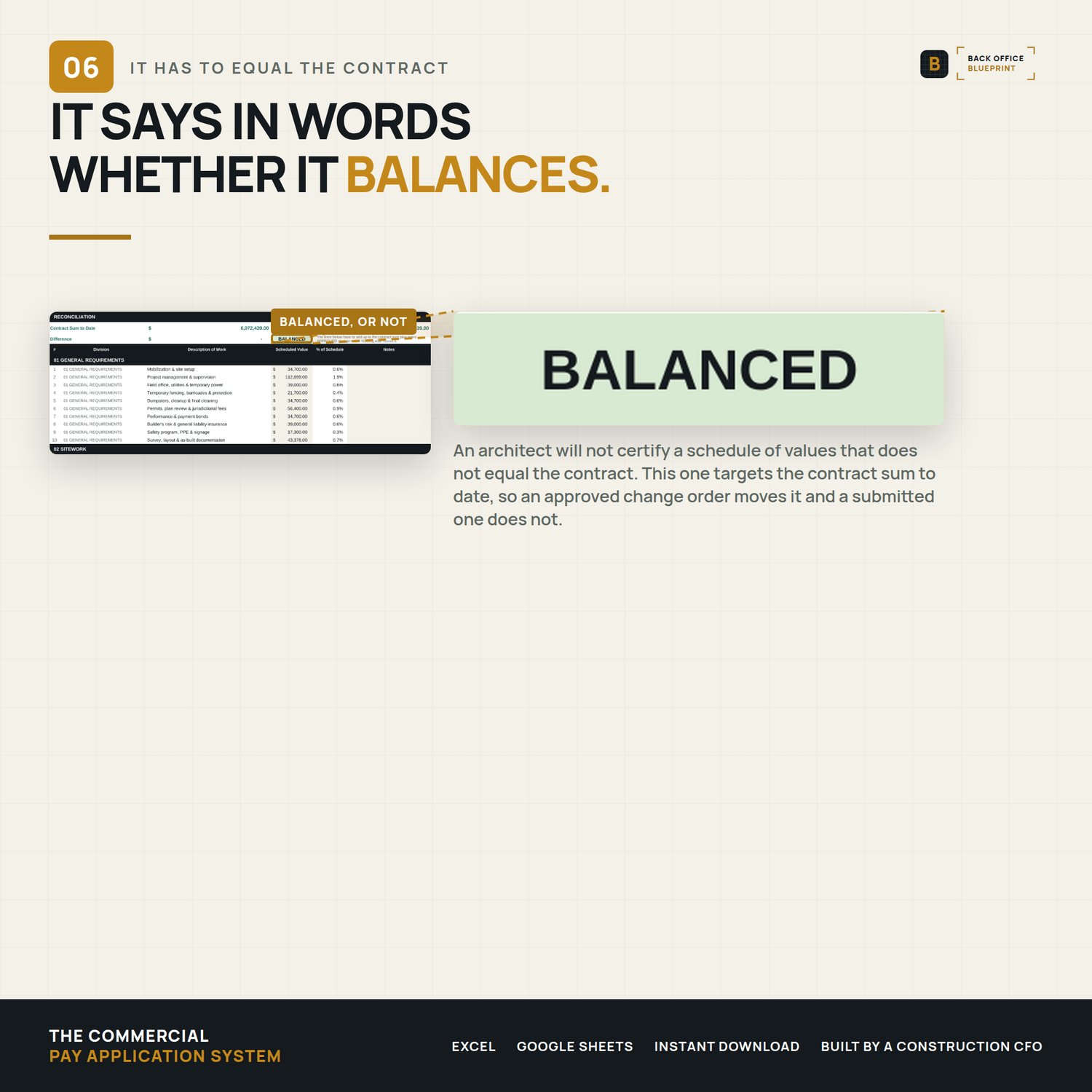
- Schedule of Values — 70 pre-written lines across 19 divisions: the 16 classic CSI MasterFormat divisions plus allowances, closeout and soft costs. The reconciliation at the top says BALANCED or OUT OF BALANCE in words, because an architect won't certify a schedule that doesn't equal the contract. 36 numbered blank rows for your own lines.
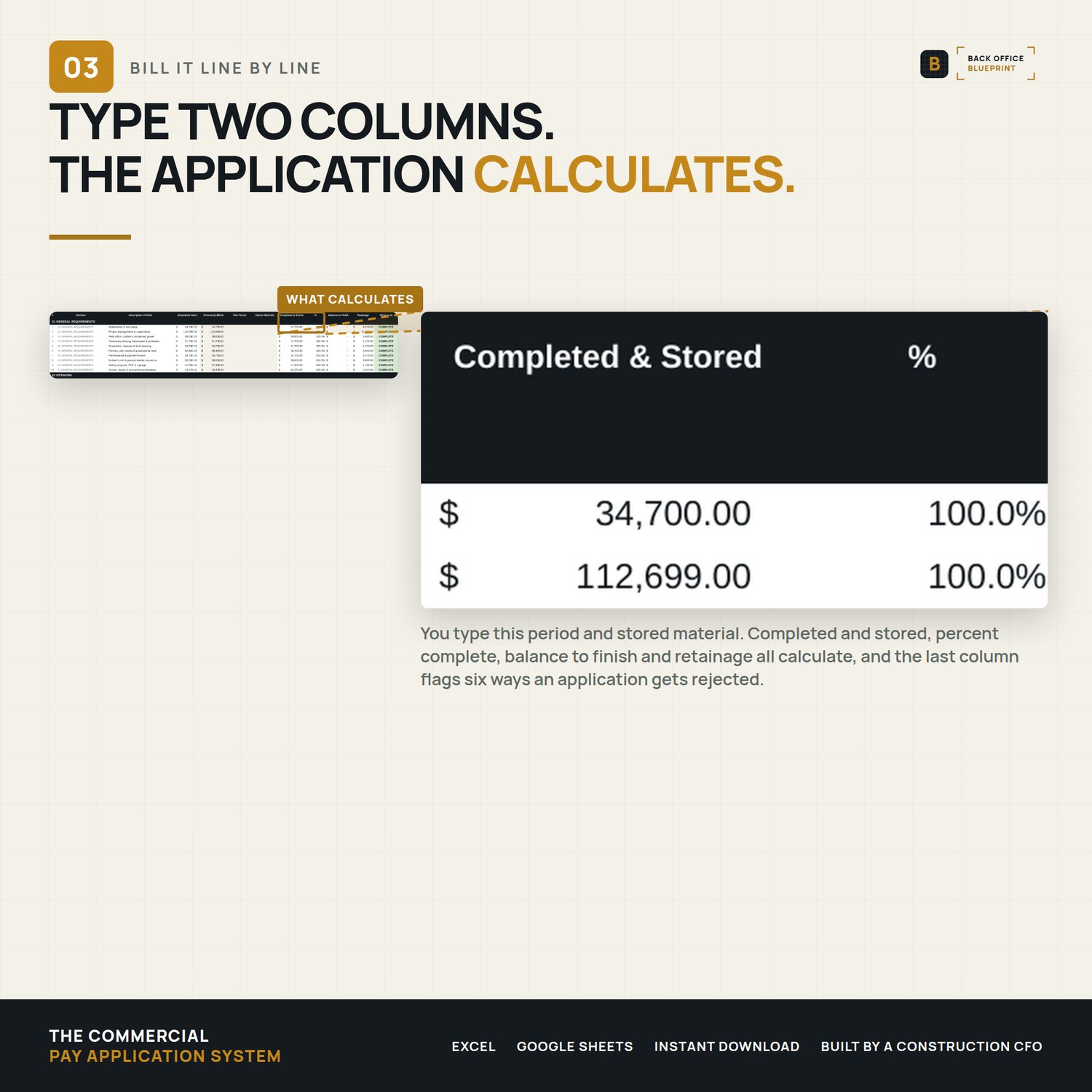
- Pay Application — the billing grid. Type this period and stored materials; previously billed, percent complete, balance to finish and retainage all calculate. Every line is checked for six ways a pay application gets rejected, including billing past the scheduled value and storing more material than the line is worth.
- Application Summary — the nine-line certificate the owner and the architect sign. Original contract sum through current payment due. Nothing to type on it.
- Retainage & Release — what has been held, what has come back, what is still out, and how many days it has been sitting there since substantial completion. The application history feeds the certificate, so what the architect actually certified is what the next application subtracts.
- Closeout Blockers — the 18 items that hold a retainage check, grouped the way a closeout meeting walks them. Punch list, as-builts, O&M manuals, certificate of occupancy, test and balance, final lien waivers, consent of surety. Anything not marked Accepted is counted, and the retainage tab names the number out loud.
- Stored Materials — the bill of sale and the insurance certificate, tracked per line, because those two missing pieces of paper are why a stored materials claim gets refused.
- Change Order Log — approved change orders move the contract sum. Submitted and draft ones are tracked and deliberately left out of it.
Plus Project Setup, a Start Here tab, and a Dashboard with the four checks to run before you send.
────────────────
What you get
- The blank workbook, ready for your first application
- A filled example — a 12,400 SF medical office at application 14 of 14, 98.8% complete, $599,899.10 of retainage held and 7 closeout items open
- A 16-page user guide with the license terms
Excel format. Opens in Excel and Google Sheets. Every formula is the plain kind — nothing that needs a current subscription to calculate.
- It uses the same CSI divisions as my commercial estimating system, so an estimate rolls into a schedule of values without retyping it.
- ────────────────
What happens after you buy
The files are yours immediately. Nothing to install, no account to make, no add-in.
If something doesn't work the way you expected, write to hello@getbackofficeblueprint.com. We answer personally.
────────────────
This is not a published industry form and it isn't legal advice. It produces the information a progress billing carries; if your contract names a specific form, work the numbers here and transfer them.
I built this after watching a builder finish a job in October and get the last check the following August. Every month of that delay was paperwork. None of it was the work.